


First Journeys North: MISU PhD Students Join Veteran Researcher on Arctic Expedition
In September, the Icebreaker Oden will once more set out on a journey to the Arctic region. On board, a mix of PhD students and researchers will engage in research and education, and a mission to map the seafloor. Meet MISU researcher Matthew Shupe and two MISU students who are presently preparing for the journey ahead. “This is a great opportunity to build new research capacity by bolstering the next generation of polar scientists,” Matthew explains.
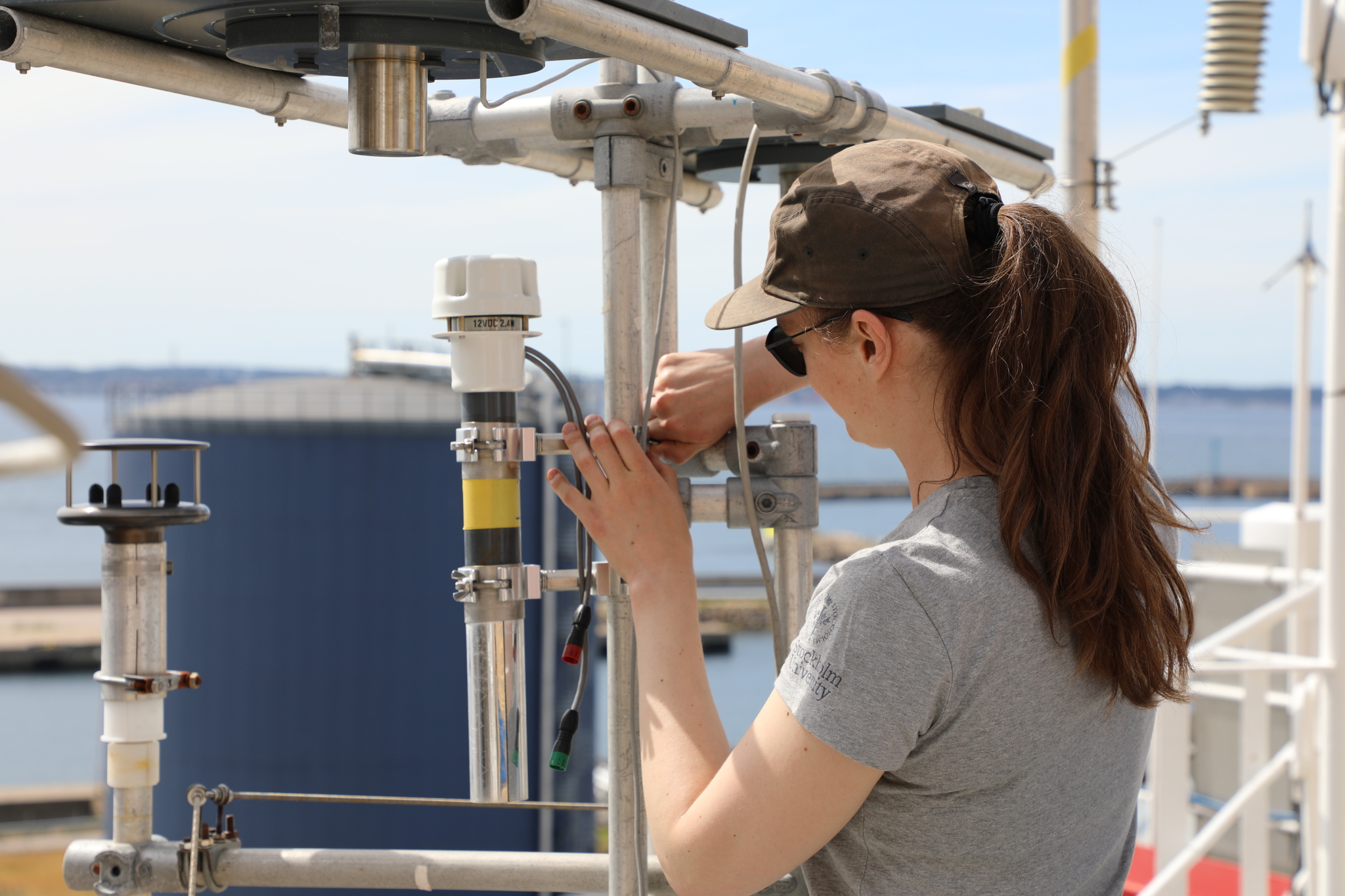
Image: Linnea installing a sensor to measure temperature and moisture on top of I/B Oden.
The icebreaker Oden is an ageing vessel, nearing its end-of-service. Despite its long service it will once more brave the Arctic Ocean equipped with new scientific instruments. The Arctic environment is a region that is changing faster than anywhere else on our planet due to global heating, with widespread implications. These changes are exacerbated by human green-house gas emissions.
The hopes for the expedition are high, and the researchers aim to collect some very rare observations that will help us better understand these changes.
Understanding these processes requires collaboration across many scientific disciplines. Expeditions like this not only provide the observations needed, but also bring together scientists from different backgrounds helping to train the next generation of polar researchers.
For PhD students, the research school brings together participants from several different disciplines, providing the opportunity to study the Arctic climate system as a whole – by examining interactions between the atmosphere, ocean, ice, and biosphere.
Veterans and first-time explorers
Among those on board is a researcher who knows these waters well. Matthew Shupe who’s presently working at MISU on H.M. The King's Professorship in Environmental Science has been on Oden multiple times, including in 2008 and 2014, along with numerous other research vessels and stations.
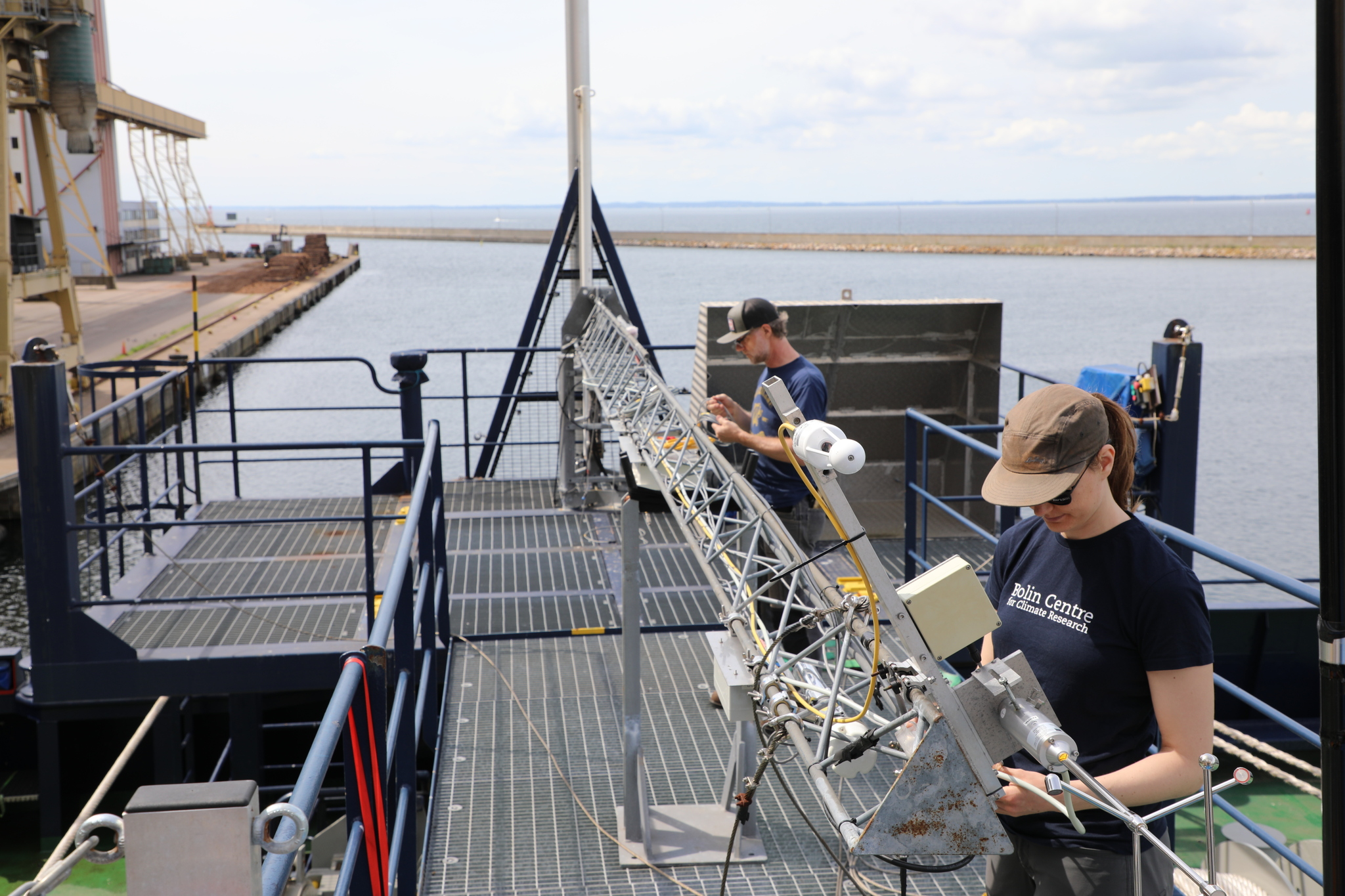
Image: Linnea and Matthew installing energy flux instruments on the foredeck of I/B Oden.
Recalling past expeditions, he highlights one moment in particular.
“The greatest was in 2014,” he recalls, “observing the first sunset of the season (i.e., first day that the sun went below the horizon in late summer) in flaming reds and oranges on one horizon while a full moon was rising against a deep purple sky on the opposite horizon. Spectacular,” he adds.
“It is always exciting to see what the Arctic will present. I have many perspectives of the Arctic from many locations, years, and conditions. I've built up a general understanding of how the system "works" and what to expect.“
But despite his experience, the Arctic always seems to reveal new details.
“New insight into cloud variability, or to how the sea ice responds to atmospheric radiation. New insight into the movement of ice, or the interaction of storms with the local atmospheric structure. It’s a complex place, and it always shows me something new.”
Matthew is very excited to support the participants of this field school in learning about Arctic fieldwork.
“I am personally so in love with the Arctic, and I hope to help turn others onto its beauty and brilliance.”
In late June, a team of Stockholm University scientists, including Matthew and MISU PhD student Linnea, participated in "mobilization" activities onboard Icebreaker Oden. Over three days they installed a large suite of instruments to measure atmospheric processes, including sensors that characterize cloud properties, count the number of aerosol particles, and quantify the transfer of energy from the atmosphere to the surface, among many others.
After three days of hard work carrying boxes, pulling cables, connecting systems, and troubleshooting problems, they can confirm that all instruments are ready for the upcoming expedition.
New Perspectives from Early-Career Scientists
For PhD students Hanna Winge and Linnea Huusko, this will be their first visit to the Arctic.
“I have previously worked on smaller research vessels, such as Electra in the Baltic Sea, but I have never been on an icebreaker before. I'm really looking forward to taking the step from conducting coastal observations in the Baltic Sea to doing research in the Arctic aboard Oden”, says Hanna Winge.
“I have several friends and colleagues who have been on expeditions with Oden so I’ve seen pictures and heard stories. I’m very excited to get to experience it myself!” says Linnea Huusko.
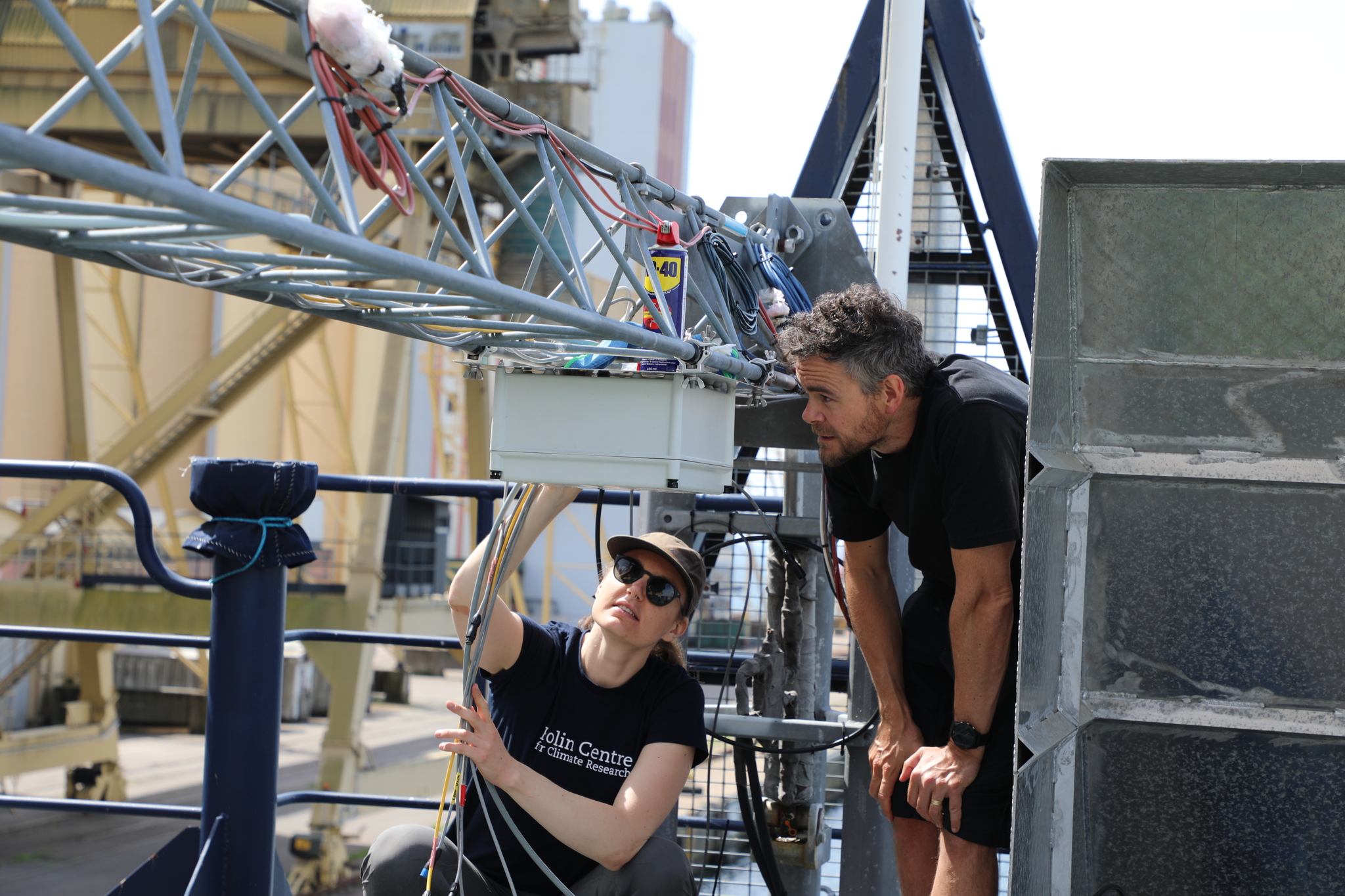
Image: Linnea and John Prytherch installing energy flux instruments on the foredeck of I/B Oden.
Linnea is a modeller and usually works with simulations of the atmosphere. During this expedition she is specifically looking forward to learning more about working with observational data – especially since she will be involved in the collection herself.
For Hanna, who is already well versed in collecting observational data, the Arctic environment will provide novel learning opportunities.
“My current research is based on observational data from the Baltic Sea, so I'm especially interested in seeing how observations are carried out in the Arctic.,” she says.
This expedition will provide a unique opportunity to work with advanced oceanographic instrumentation and gain first-hand experience of how high-quality observations are collected in one of the world’s most challenging environments.
“I hope this experience will broaden both my technical skills and my understanding of Arctic climate processes and help me contribute to Arctic research in the future”.
Hopes for the journey ahead
For Linnea, the thought of being disconnected from friends and family for 6 weeks is daunting.
“I think being away from all the distractions of modern society can open opportunities for new connections in a very special way. I look forward to sharing that experience with everyone else on board and hopefully making some new friends!”
Hanna is also looking forward to building friendships and collaborations that continue long after the expedition has ended.
“I believe this expedition will be a very meaningful experience for me, both in terms of my development as a researcher and for the friendships, memories, and collaborations that may come out of it.,” she muses.
The Arctic is changing rapidly, with wide-reaching implications for the planet. As polar ice sheets melt, global ocean currents and atmospheric jet streams are beginning to shift. Less sunlight is reflected back into space, and critical ecosystems are strained.
This is why research expeditions like this one carry great importance for our understanding of climate systems and the world around us.
“My biggest hope is that by the end of this expedition we will have 25 new people (the participants in the school!) with glowing impressions of the Arctic that will give them a lifetime of fond memories and help them serve as Arctic ambassadors to the rest of the world.,” Matthew concludes.
As a new generation of researchers prepares to step onto the ice, expeditions like this ensure that the future of Arctic science remains in capable and curious hands.
Last updated: 2026-07-06
Source: MISU