


Stockholm researchers map the Arctic seabed
This summer, the icebreaker Oden is once again on expeditions in the Arctic. The focus is on mapping the seabed for a fibre cable as well as research projects and a graduate school. Around ten researchers and doctoral students from Stockholm University are on board.
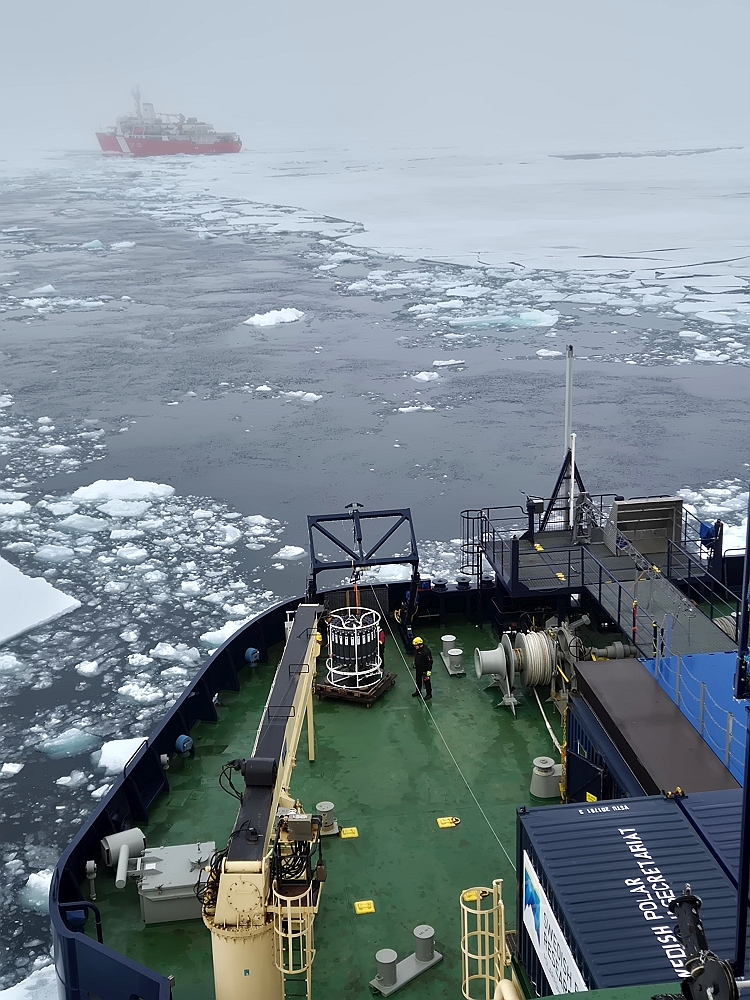
Working on board the Oden to prepare a so-called CTD with a rosette sampler. Among other things, temperature and salinity in the sea are measured, and water samples are taken. In the background, the Canadian icebreaker CCGS Louis S. St-Laurent can be seen. Photo: Richard Gyllencreutz
Until September, icebreaker Oden is in the Arcticon expeditions. During the first expedition, which ended on 9 August, the Swedish icebreaker mapped the seabed within the framework of the international project Polar Connect. It is a Northern European initiative for a fibre connection between Europe and Asia via the Arctic Ocean – the shortest route between the two continents. The cable will enable ultra-high transmission capacity while avoiding geopolitically sensitive areas. From the Swedish side, the Swedish Research Council and the Swedish Polar Research Secretariat coordinate the work, which is partly funded by the EU. In the summer of 2025, Oden and the Canadian icebreaker CCGS Louis S. St-Laurent began the work of mapping the seabed over parts of the cable route. In the summer of 2027, they are supposed to go on a third expedition.
On August 10, the Canada-Sweden Arctic Ocean 2026 expedition started from Longyearbyen on Svalbard. At that time, Oden and Louis S. St Laurent went further into the Arctic Ocean to continue work on mapping and sampling, among other things. There is also a graduate school on board.
Expert knowledge of mapping the seabed
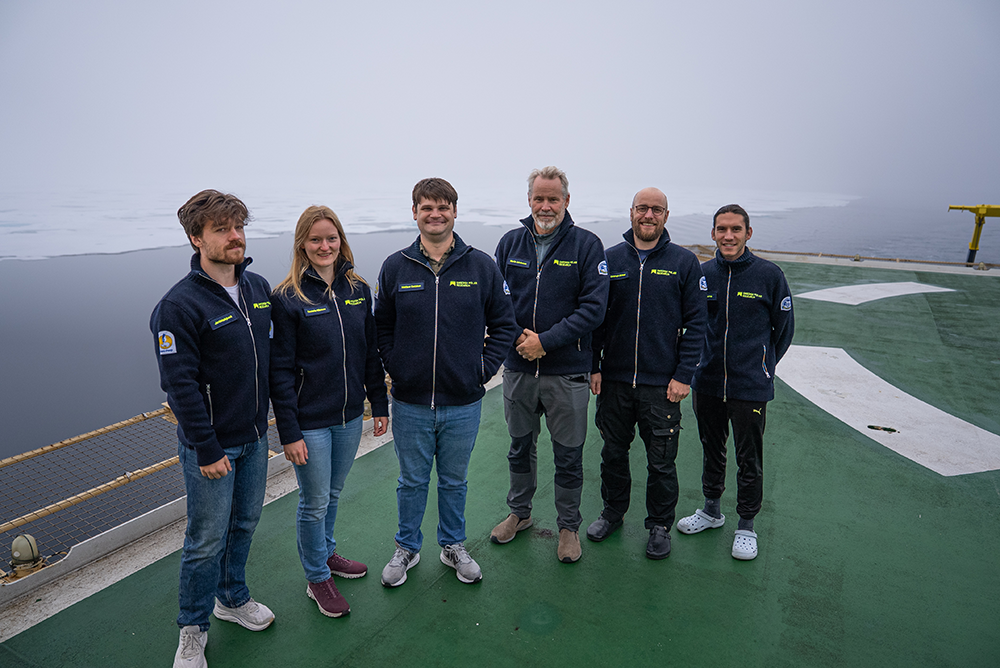
The research team, led by Martin Jakobsson (third from the right), who worked on mapping the seafloor during the first part expedition onboard Oden. Photo: Marcus Junghard
As with most expeditions on board Oden, researchers at Stockholm University have prominent roles this year as well. Martin Jakobsson is Professor of Marine Geology and Geophysics and Deputy President at Stockholm University. He has led nine major international marine research expeditions, mainly to the Arctic. He is also one of the leading names in the global initiative Nippon Foundation–GEBCO Seabed 2030, with the vision of mapping the entire world ocean by 2030.
Martin Jakobsson's area of expertise is geophysical mapping of seabeds using acoustic methods. This expertise comes in handy within the framework of Polar Connect. When Oden was out on last year's expedition together with the Canadian vessel, Martin Jakobsson led the work of measuring and upgrading sonar systems on board Oden. Matt O'Regan, Professor of Marine Geology at Stockholm University, who was responsible for taking sediment samples from the seabed, also participated in that expedition. In 2025, an international graduate school was also given at Oden, led by professor Michael Tjernström at Stockholm University.
Stockholm researchers on this summer's expeditions
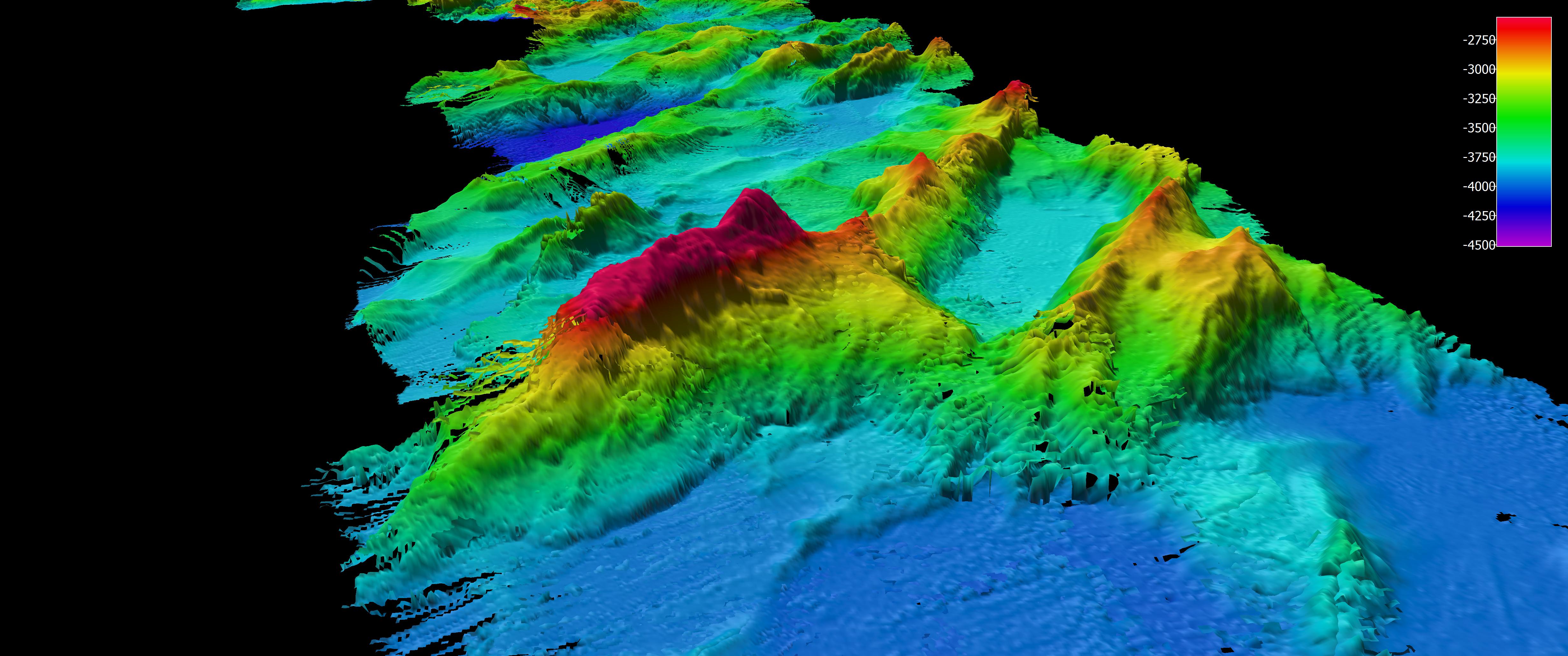
Depiction of a tall underwater mountain.
Thera are two expeditions on Oden this summer. The first began in Svalbard on 24 July with just over two weeks of measurements of the seabed off Svalbard and towards the deep part of the sea on the European side of the North Pole. The measurements were made along the planned cable route and in more detail in places where the seabed is complicated. These areas are especially important to gain knowledge about for Polar Connect. The other, which started on August 10, is a longer expedition of just over 40 days, where Sweden collaborates with Canada, and the icebreaker CCGS Louis St-Laurent. On board Oden, the Swedish Polar Research Secretariat is also organising a polar research school as in 2025.
During the expeditions, researchers at Stockholm University are in charge of the mapping. Martin Jakobsson led a research team of five people from Stockholm University, who kept the mapping work going around the clock during the first expedition. Of the six working packages conducted at Oden during the second expedition, three are led by researchers at Stockholm University. Matthew O'Regan at the Department of Geological Sciences is leading a research project responsible for sediment sampling. Richard Gyllencreutz at the Department of Geological Sciences leads the work on the geophysical mapping during the second period of the expedition. Matthew Shupe at the Department of Meteorology leads the meteorological research on board. In addition, doctoral students and a master's student from the university join Oden as participants in the international polar research school. On board Oden there are also researchers from universities in different countries.
During the expedition, measurements will be made continuously of the seabed, sea ice, ocean currents, weather and aerosols (small particles in the air). The researchers work both on board the ship and out on the ice with the help of helicopters, drones, buoys and advanced sensor systems. The goal is to increase understanding of the interaction between ocean, ice and atmosphere in an Arctic that is rapidly changing as a result of climate change. Research data from the expedition will be made openly available through Swedish and international databases.
Sediment cores will map the history of the Arctic Ocean
During the expedition, a research group in marine geology, led by professor Matthew O'Regan at Stockholm University, will investigate the development and environmental history of the Arctic Ocean by collecting sediment cores from the seabed. These sediments serve as a natural archive that preserves traces of past climates, ocean conditions, and sea ice stretching back millions of years. The samples will help scientists reconstruct the environmental history of the Arctic and improve interpretations of geophysical survey data collected over the ocean basin.
An important long-term goal of the programme is to determine when the Arctic sea ice first formed, how stable it has been through the ages and how the Arctic climate system reacted to previous periods of warming and cooling. The research team will focus on regions where sediments have accumulated very slowly, allowing for the creation of long, continuous records of Arctic environmental changes over millions of years.
“We will also target older sediment layers that are exposed along underwater mountain ridges. Targeting these old, protruding sediments is a key to age-calibrating geophysical survey data. We managed to do this on last year's expedition when we recovered sediments dating back to the time of the dinosaurs," says Matthew O'Regan.
Studies of how the atmosphere interacts with the sea surface
Meteorology professor Matthew Shupe is, together with a doctoral student, collecting measurement results on how the atmosphere interacts with the sea surface. They work with various instruments to study how much ice is released from the clouds and how the sun's rays penetrate the clouds. They also release weather balloons every six hours for various studies.
Read a longer text about meteorological research on board the expedition
New equipment for air samples
Earlier this summer, researchers from the Department of Environmental Science at Stockholm University installed a new air intake and a new aerosol lab on board Oden. This is now a permanent installation as part of the research infrastructure at Oden. The equipment makes it possible to take samples of air and especially aerosols (small particles in the air) every time Oden sets out on an expedition.
“This will significantly expand our access to data. In the future, we hope to be able to expand the permanent instrumentation," says Paul Zieger, Professor of Experimental Atmospheric Science at Stockholm University.
At this year's expedition, the researchers will measure the amounts of aerosols and black carbon. In addition, they will take regular air samples and collect samples from puddles of meltwater, which will later be analyzed in the lab at Stockholm University.
“We hope to be able to collect more data on the composition and properties of aerosol particles in the High Arctic," says Paul Zieger.
Graduate school at Oden
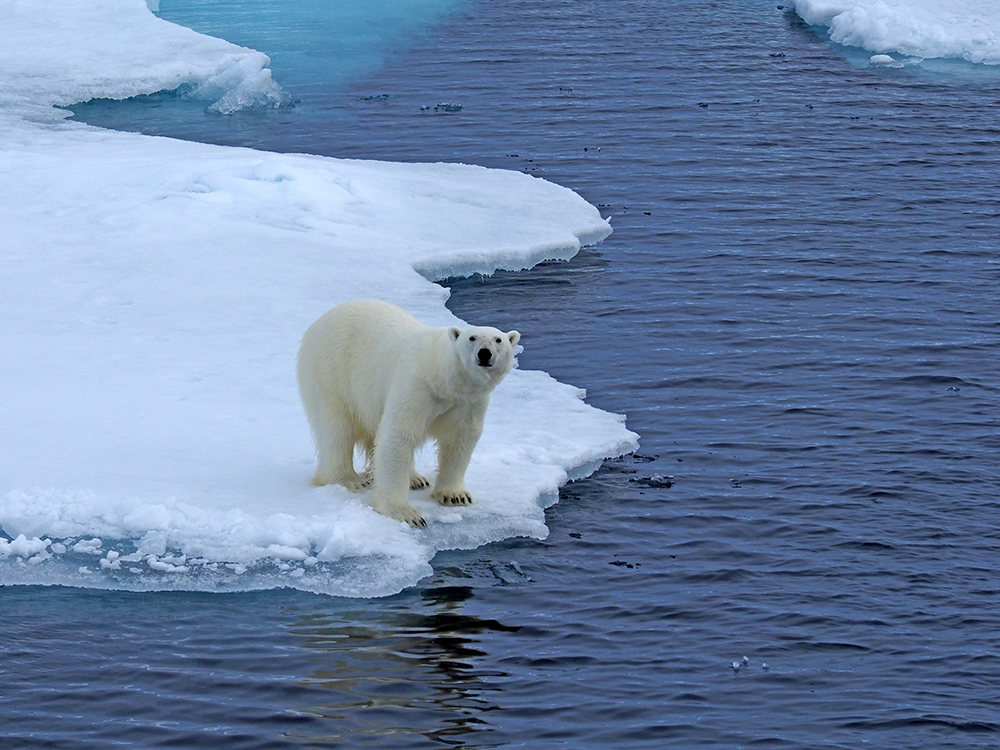
A polar bear on the ice close to icebreaker Oden. Photo: Martin Jakobsson
On board Oden, as last year, a graduate school is arranged for doctoral students and researchers at the beginning of their careers from Swedish and Canadian universities with a focus on the Arctic climate system. The programme combines lectures, seminars and practical fieldwork, where participants have the opportunity to work together with senior researchers. Participants contribute to observations and data collection while gaining hands-on experience with advanced research methods and instruments. In addition, an author and an upper secondary school teacher are on board within the framework of the Swedish Polar Research Secretariat's teacher and artist programmes, respectively.
Canada-Sweden Arctic Ocean 2026 – Swedish Polar Research Secretariat
Read article "Research school at icebreaker foster a new generation of Arctic researchers
Read more about Martin Jakobsson's research
Read about Martin Jakobsson's Wallenberg Scholar project "Using AI to predict the retreat of glaciers"
Last updated: 2026-08-20
Source: Communications Office