


Expedition Arctic Ocean 2026, blog post 7: What do scientists act like?
I was asked if I went on vacation prior to this expedition. Several people I have spoken with spent time on holiday before the expedition. I have spent the summer working almost every day, preparing major projects for my PhD before I departed for Oden, knowing that I will not be able to attend to them while I am away.
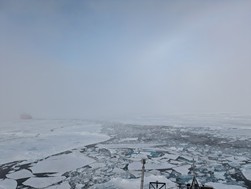
In the time that I did not spend on my thesis projects I made packing lists, downloaded papers and textbooks to reference in case I am caught without answers, and stored software code and documentation so that I can be self-sufficient with limited network access during the trip. The large AI models I am training were still being tuned before the flight to Svalbard. By the time I arrived in Svalbard from Vancouver, Canada, I was utterly exhausted. It is in this state that I embarked on a 42 day journey in which I would not only be surrounded by people constantly, but by brilliant people.
Many people I have spoken with since my return to academia - especially women - struggle to consider themselves scientists. It was only when I left my 8 year career in IT and software that I began to feel comfortable calling myself a software engineer. While I knew students were selected for this expedition for a reason, I was completely unsure as to the reason I was selected. Would the program leaders be disappointed by my knowledge of meteorology when they actually met me? What was I expected to know as a member of the Meteorology and Aerosols Work Package? I know I have had considerably less of an education in my field as someone who had previously been interested in pure math, tried on a career in IT, then decided to enter a completely new field. And sometimes it shows.
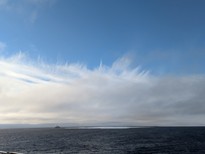
In the first week, there was excitement, 24-hour sun, anxiety, and most of all embarrassment about the infancy of my developing career as an atmospheric scientist. My mental wits were nearing an end already in the first week of the trip. I felt guilty that these emotions overwhelmed the fact that I was currently living out an experience that had previously been a lofty dream. On top of that, I was about to go to the North Pole and meet Santa. What kind of privileged ingrate can still feel bad when they're about to meet Santa?
It was only once we left the North Pole that things began to change. I heard more and more about the diverse backgrounds of everyone on the ship. We are not experts in the entire field of Atmospheric Science on our team. We are largely experts in our own specialties. We do not all come from rigorous and uninterrupted years of study. We do not constantly carry the serious, calculated, I-have-figured-it-all-out tone that is required in our research papers. It is extremely important for me to witness the scientific leaders on this ship engage in humor and human vulnerability. I am reminded that I am not actually required to act with a sense of serious stoicism at all times. This is good, because I do not really want to act that way.
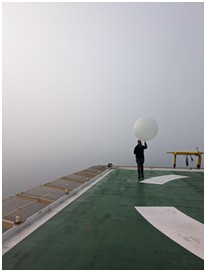
I know that I have worked hard for this opportunity, and that I have been picked because someone believed that I showed potential as a scientist. However, when I feel that I have dropped the ball in showing this potential - either by butchering basic meteorology while fielding questions from helpers during 6:00 am balloon launches or by referring to the Primary Production team's samples as "itty bitty bugs" - I know that I still have a lot to offer outside of science.
I have been able to show the little I inherited from my mother's "engineering gene" as I trace wires, open boxes, explore file systems and pore through manuals. I have been able to channel my father's energy in jumping into a conversation with humor and curiosity, and trying to cut through the seriousness of most situations. My sister is a tenacious 5'3” firefighter and mother of three. I pretended to be her when I wrestled the frozen helium tank this morning. When I forget whatever I am supposed to be or accomplish on this ship, I remember that we are all bringing so much more to the table when we present ourselves with everything - our history, our families, and our sometimes not-so-scientific personalities.
/Melissa Westland, 20 August 2026
Last updated: 2026-08-28
Source: MISU