We are delighted to invite you to submit your abstract for the Swedish Climate Symposium: a symposium dedicated to advancing scientific understanding of climate change and its environmental and societal consequences. Deadline 30.01.26!
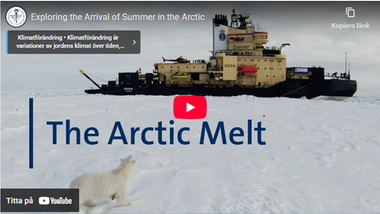
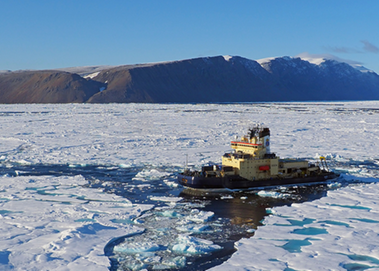
The film “Chasing the Arctic Melt” from Stockholm University won the “Best Science Film” category at the Explorers Festival in Iceland in November. The film, which also shows life as a researcher on an expedition, takes place aboard the icebreaker Oden, where a group of researchers are studying Arctic ice melt.
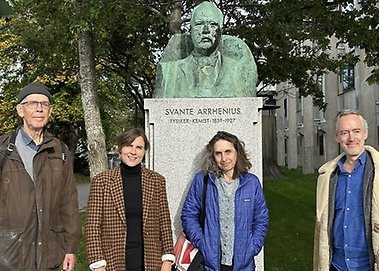
The Bolin Centre for Climate Research recently welcomed The New Yorker staff writer Elizabeth Kolbert, a Pulitzer Prize–winning journalist and author of the acclaimed book The Sixth Extinction, to Stockholm University. Kolbert is currently a fellow at the American Academy in Berlin, where she is working on her new project, Under the Glacier: How Ice Shaped Our World and Will Determine Its Future. In this project, Kolbert explores how Earth’s ice ages reveal the powerful feedbacks that shape our planet’s climate, both in the deep past and in our warming future. Her interest in Svante Arrhenius, the Swedish chemist and Stockholm University professor, stems from his pioneering efforts to understand the causes of the ice ages. In doing so, Arrhenius became one of the first scientists to quantify the warming effect of carbon dioxide in the atmosphere — a discovery that laid the foundation for modern climate science. I became interested in Svante Arrhenius because he set out to explain the ice ages, but ended up ‘discovering’ global warming, Kolbert says. “So he’s a key figure in thinking both about the climate of the past and about the climate of the future.” During her visit, Kolbert met with Professor Emeritus Henning Rodhe to revisit Arrhenius’s original 1896 climate calculations and compare them with today’s models. She also spoke with Gustaf Arrhenius, Svante Arrhenius’s great-grandson, who shared personal reflections and historical context on his great-grandfather’s scientific legacy. Together, these conversations illuminated how ideas first formed in late 19th-century Stockholm continue to resonate in the global effort to understand and respond to climate change. Kolbert’s research will ultimately culminate in a new book, but along the way, she hopes to share parts of the story in The New Yorker. Her visit highlights how the roots of climate science continue to inspire curiosity, collaboration, and storytelling — from Stockholm to New York and beyond.
The Stockholm University film ”Chasing the Arctic Melt” was awarded ”Best Science Film” at the Explorers Festival in Iceland in November. The film takes place aboard the icebreaker Oden, where a group of scientists study the rhythm of the Arctic melt, revealing the human side of research. See the film produced by Stockholm University