Are you a researcher, expert, or decision-maker working on climate change and its impacts? Registration now to one of Sweden’s most important meeting places for climate research in 2026.
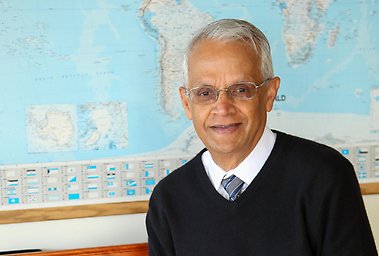
Former Bert Bolin Lecturer and advisor Professor Ramanathan has been awarded the prestigious 2026 Crafoord Prize in Geosciences by the Royal Swedish Academy of Sciences
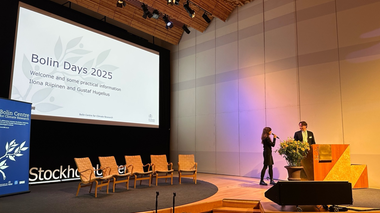
The Bolin Centre for Climate Research successfully hosted the 17th edition of its annual internal conference, Bolin Days 2025, on 26–27 November at Stockholm University.
We are delighted to invite you to submit your abstract for the Swedish Climate Symposium: a symposium dedicated to advancing scientific understanding of climate change and its environmental and societal consequences. Deadline 30.01.26!
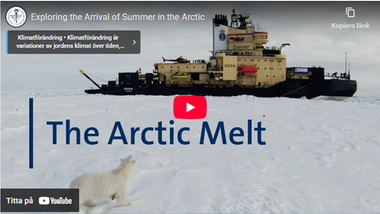
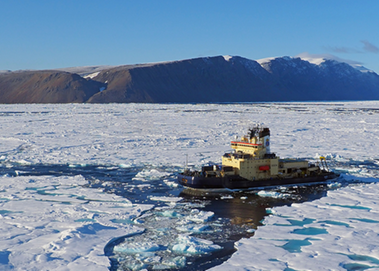
The film “Chasing the Arctic Melt” from Stockholm University won the “Best Science Film” category at the Explorers Festival in Iceland in November. The film, which also shows life as a researcher on an expedition, takes place aboard the icebreaker Oden, where a group of researchers are studying Arctic ice melt.
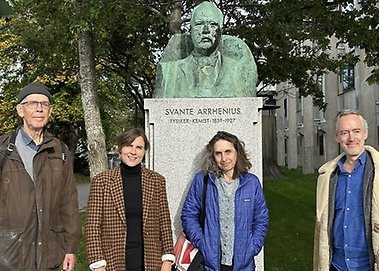
The Bolin Centre for Climate Research recently welcomed The New Yorker staff writer Elizabeth Kolbert, a Pulitzer Prize–winning journalist and author of the acclaimed book The Sixth Extinction, to Stockholm University. Kolbert is currently a fellow at the American Academy in Berlin, where she is working on her new project, Under the Glacier: How Ice Shaped Our World and Will Determine Its Future. In this project, Kolbert explores how Earth’s ice ages reveal the powerful feedbacks that shape our planet’s climate, both in the deep past and in our warming future. Her interest in Svante Arrhenius, the Swedish chemist and Stockholm University professor, stems from his pioneering efforts to understand the causes of the ice ages. In doing so, Arrhenius became one of the first scientists to quantify the warming effect of carbon dioxide in the atmosphere — a discovery that laid the foundation for modern climate science. I became interested in Svante Arrhenius because he set out to explain the ice ages, but ended up ‘discovering’ global warming, Kolbert says. “So he’s a key figure in thinking both about the climate of the past and about the climate of the future.” During her visit, Kolbert met with Professor Emeritus Henning Rodhe to revisit Arrhenius’s original 1896 climate calculations and compare them with today’s models. She also spoke with Gustaf Arrhenius, Svante Arrhenius’s great-grandson, who shared personal reflections and historical context on his great-grandfather’s scientific legacy. Together, these conversations illuminated how ideas first formed in late 19th-century Stockholm continue to resonate in the global effort to understand and respond to climate change. Kolbert’s research will ultimately culminate in a new book, but along the way, she hopes to share parts of the story in The New Yorker. Her visit highlights how the roots of climate science continue to inspire curiosity, collaboration, and storytelling — from Stockholm to New York and beyond.
The Stockholm University film ”Chasing the Arctic Melt” was awarded ”Best Science Film” at the Explorers Festival in Iceland in November. The film takes place aboard the icebreaker Oden, where a group of scientists study the rhythm of the Arctic melt, revealing the human side of research. See the film produced by Stockholm University
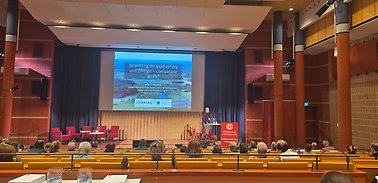
The first Swedish Biodiversity Symposium was held at the Conference Centre Wallenberg in Gothenburg 21–23 October. The Bolin Centre and RT4 were co-organizers of the symposium, which was fully booked with over 400 participants. The Symposium was focused on Transformative change- from knowledge to action and was oriented to a science-policy interface to improve communication and discussion of knowledge on biodiversity. Besides Bolin Centre members, other participants were from many different biodiversity stakeholders, such as other universities, authorities such as the Swedish Board of Agriculture and the Swedish Environmental Protection Agency, municipalities including the City of Stockholm, companies such as those involved in agriculture and steel, NGOs like WWF, and other research- and museum entities. It was the largest gathering of biodiversity scientists and other biodiversity stakeholders in Sweden. Each day had a theme and started with a thought-provoking discussion panel around topics like “Is Swedish biodiversity governance transformative?”, “Societal transformation – how do we make it happen?” and “Future Directions? Unlocking a sustainable future”. For many attendees, these discussions were a highlight of the meeting. Each topic brought together people with different approaches and viewpoints about how Sweden can apply scientific knowledge about biodiversity concerns to actionable change.
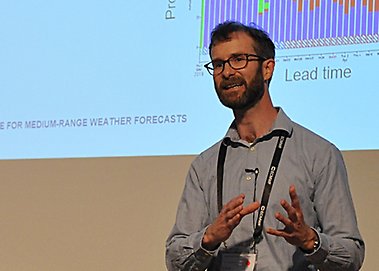
Linus Magnusson from ECMWF, the European Centre for Medium-Range Weather Forecasts, is appointed Adjunct Professor at MISU on 10 percent, from 1 September. He will e.g. supervise Master degree projects, do Arctic research related to forecast evaluation and model/observation improvements, support planning and forecasting during Arctic campaigns, and some preparation of course material.