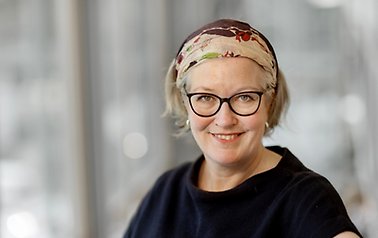
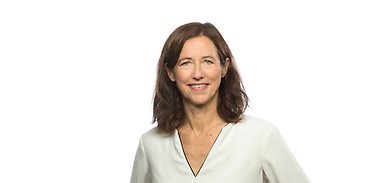
The recruitment group has decided to put forward Professor Jane Reichel, Dean at the Faculty of Law, to be presented to the Consultative Assembly as proposed candidate for the position of new Vice President at Stockholm University.
Future academic cooperation with exchange of researchers, students and administrators, especially in the field of education. This was the aim of a visit to Stockholm University by six African partner universities from the European University Alliance Civis. The link between all the elements will be “TRACEE”, a joint master's programme focusing on climate research. “Europe and Africa are continents that belong together and will belong together. We have much to gain from working together. Europe is an ageing continent, Africa has a young population,” says Stefan Helgesson, Vice President of Stockholm University and one of the initiators. “What sometimes stands in the way of cooperation is the difficult colonial history that Europe has not fully come to terms with. But there is also a long history of contacts. I think it is in the common interest of both Africa and Europe that we forge closer ties. Not least in view of the ongoing turbulent geopolitical changes in the world,” Stefan Helgesson continues. Exchange of teachers and students The visit is an Erasmus+ initiative under Civis, organised by the International Office at Stockholm University. Representatives from six African partner universities in South Africa, Senegal, Uganda, Tunisia, Morocco and Mozambique visited Stockholm University to discuss forms of future cooperation, both for Stockholm University directly and for other European universities within Civis. As a first step, the African universities will nominate teachers to participate in the transdisciplinary master's programme TRACEE with a focus on climate, environment and energy, a project led by Stockholm University. “The idea is that Stockholm University and other European partners will host researchers from African universities for faculty exchanges, but also that researchers from European universities will be able to work with African partner universities. We also hope that student mobility will increase in both directions. For example by enabling students from Stockholm University to spend a semester at the African partner universities,” says Stefan Helgesson. How did the week turn out? “It has been fantastic. We have already achieved a lot of what we set out to do. Firstly, to get to know the six partner universities and the people who work there, in order to establish a basis for cooperation,” says Åsa Petri, Head of the International Office at Stockholm University. The group, which included academic leaders and researchers as well as administrators from the six universities, visited departments and research centres and made practical plans for future exchanges and collaborations. “The visits to institutions and centres were very much appreciated, but we also worked practically on funding and visa issues, which are crucial when working on exchange plans. We hope that we, through Civis, can find a way to lay the foundations for that,” says Åsa Petri. Did the visit contribute to the Civis objectives? “It was a great success. We managed to achieve much more than I expected,“ says Christian Möllman, coordinator of the partnership with African universities within Civis. “Stockholm University is the first Civis university to invite all African partners to its campus to establish a bilateral link. This will open up a broader scope of academic cooperation in parallel to the educational exchange. It was also good that all the other European member countries were invited to a part where we could work on the outlines of the larger cooperation within Civis. This part was also a success,” he continues. What are the synergies between African och European universities? “It is clear that there is a lot to cooperate on in terms of climate adaptation and climate change, but also social and economic challenges that ultimately drive migration. These are issues where African universities have a lot to contribute. The cooperation is primarily focused on education, but the research component will also be developed in the future, although it depends more on individual initiatives by researchers,” says Stefan Helgesson. What are the strengths of the African partner universities? “You have to realise that these are all very large, excellent universities that cover the whole spectrum, including medicine and technology. There is a huge amount of expertise in African universities that has not been made fully visible in the global academic community, so there is much to discover. In addition to climate change, I know there is a lot going on in the humanities and social sciences that we can learn from. For those who want to develop digital technologies in a more inclusive way, there are also great opportunities to do so in collaboration with African universities,” says Stefan Helgesson. About Civis Civis - European Civic University Alliance, is an alliance of several European universities that aims to facilitate cross-border cooperation and increase the mobility of students, teachers and staff. Read more about Civis Read more about Civis african partners Read more about TRACEE What did the partners think of the visit? Makerere University, Kampala, Uganda
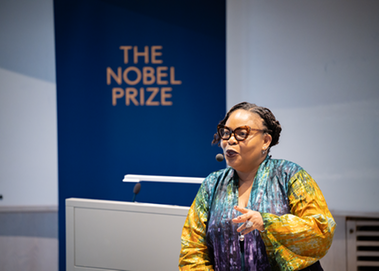
Education is very important to make the world a better place. But you need to complement your academic knowledge with compassion for others to make a difference. This was the message of Nobel Peace Prize Laureate Leymah Gbowee when she met students at Stockholm University.
Researchers at Stockholm University have been awarded funding in Formas' 2024 Communication Call for projects aimed at disseminating research on sustainable development. The following researchers have been granted funding: Linda Laikre , professor at the Department of Zoology, receives 1,793,419 SEK for the project "Conservation of Genetic Diversity: From Knowledge to Action in Livestock Breeding for Increased Resilience." Laikre's research focuses on micro-evolutionary processes affecting the loss of genetic diversity, particularly how human activities influence these processes and what can be done to ensure the long-term survival of populations by preserving genetic biodiversity.
Three of the sixteen grants awarded to prominent mathematicians within the Knut and Alice Wallenberg Foundation's mathematics program go to Stockholm University this year. The mathematics program is a long-term investment by the Knut and Alice Wallenberg Foundation. During the years 2014–2029, SEK 650 million will be allocated to Swedish mathematical research. Every year, both younger and more senior mathematicians are recruited to Sweden. At the same time, young Swedish mathematicians will have the opportunity to travel the world on a postdoctoral position. This year, eight young Swedish mathematicians will have the opportunity to travel abroad to start a postdoctoral position, while five researchers and three visiting professors from abroad will be recruited to Swedish universities. As in the past, the Royal Swedish Academy of Sciences evaluates the candidates nominated by Swedish universities. “This program is not only of huge significance for Swedish mathematical research, but also for the many other sciences that need mathematical knowledge, so we are extremely happy to be able to help by evaluating the candidates who could be the ones to receive funding,” says Hans Ellegren, Secretary General of the Royal Swedish Academy of Sciences. Three grants to Stockholm University Eight researchers receive international postdoctoral positions and funding for two years after they return to Sweden. Two of these researchers work at Stockholm University: PhD-student Axel Ljungström (University of Nottingham, UK) and Dr Simon Cooper, Stockholm University (Kings College London, UK). Five researchers receive grants to recruit a foreign researcher for a postdoctoral position in Sweden, including Associate Professor Daniel Ahlberg at Stockholm University. Read below about the grants to Stockholm University. Randomness that drives growth fronts Associate Professor Daniel Ahlberg will receive funding from the Knut and Alice Wallenberg Foundation to recruit an international researcher for a postdoctoral position at the Department of Mathematics, Stockholm University.
This summer, chemists from across Sweden will gather as the Swedish Chemical Society hosts its third national meeting. This time, the event will take place in Västerås, bringing together participants from both academia and industry. The planning is led by Berit Olofsson, Professor of Organic Chemistry at Stockholm University, and Mark Rutland, Professor of Surface and Corrosion Science at the KTH Royal Institute of Technology.
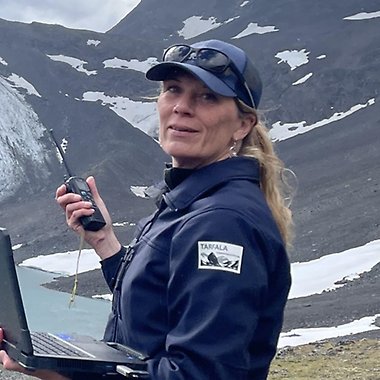
The year 2025 has been designated by the United Nations as the Year of Glaciers' Preservation. Researchers at the Tarfala Research Station of Stockholm University conduct research on glaciers as part of both national and international projects. The Earth's glaciers are an important part of the climate system and have existed for many long periods in the Earth's history. They form when more snow remains in place than melt away. Shrinking glaciers are an indicator of global warming. That's why it's important to research glaciers and monitor their condition, says Nina Kirchner, professor of glaciology at Stockholm University and director of the Tarfala Research Station. “Everyone knows that ice melts at zero degrees Celsius. And if it gets too warm, the glaciers will melt!” Nina Kirchner emphasizes. When Nina Kirchner started studying glaciers, she was a mathematics student in Switzerland. She wanted to use math to study the surrounding glaciers. Eventually, she came to the field expertise. “I love my job, I love snow and ice!” The seasons are not what they used to be Swedish glaciers are about 6 000 - 8 000 years old and have sometimes grown and sometimes shrunk during that time. The trend now is that they are shrinking.
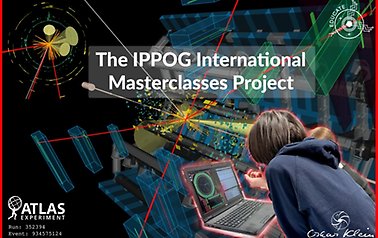
On Monday, the Oskar Klein Centre (OKC) hosted an International Particle Physics Masterclass at Vetenskapens Hus, welcoming 13 enthusiastic high school students from Stockholm and Västerås.
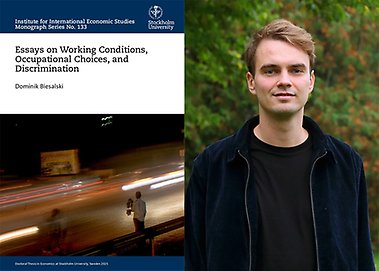
Dominik's thesis "Essays on Working Conditions, Occupational Choices, and Discrimination" sheds light on workplace safety in Uganda, the career decisions of young adults, and the colonial roots of homophobia in Sub-Saharan Africa.
The QS World University Rankings by Subject 2025 places Stockholm University in the global top 50 in three subjects, and number one in Sweden in seven subjects. The highest ranked subject is Social Policy and Administration where Stockholm University is ranked 30 in the world.
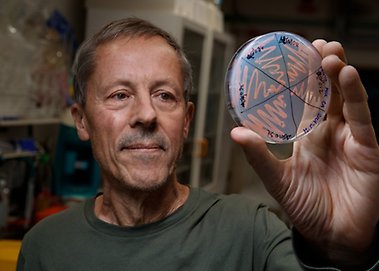
Proteins are the building blocks of life. They build our cells, send signals and transport substances. But they will only work correctly if they attain their exact 3-dimensional form. Gunnar von Heijne is demonstrating at a previously inconceivable level of detail how protein folding is achieved.
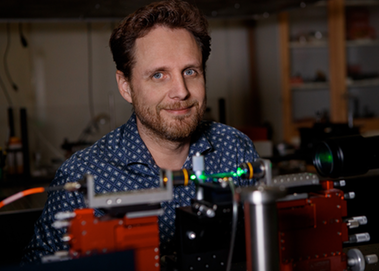
Using knowledge from one field in another can lead to unexpected breakthroughs. Wallenberg Scholar Emil Bergholtz has established a system to constantly explore new fields. The next step is to substantiate his theories within topological systems by building an extremely sensitive sensor.