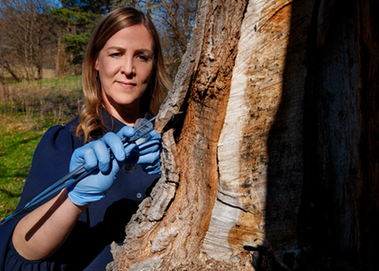
Wild yeasts live in the forests all around us. Yet, little is known about the role they play in ecosystems. They can be used to develop new beer and bread flavors, but wild yeast can also serve as a unique model for studying climate change.
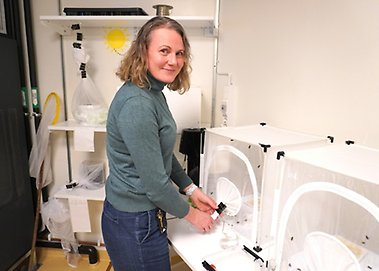
How is the ability of bumblebees to pollinate affected by the temperature rise due to climate change? This is what researcher Emily Baird is investigating in collaboration with Swedish farmers.
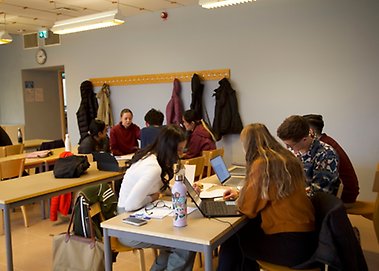
Can students use AI tools responsibly in academic assignments? In the Environmental Field Studies course, master’s students recently got to decide for themselves. As part of a short classroom experiment, students were asked to create rules for how AI could be used when preparing their group field reports. These written assignments are graded pass/fail and are meant to help students process information gathered in the field, practice academic writing, and present data clearly. There was a lively discussion in the group, with a range of views—including one student who proposed banning AI entirely. In the end, the class voted on a set of shared rules and reached a consensus that allows limited, task-specific use of AI tools.
Congratulations to Frida Bender, appointed Professor of Climate modeling, and Thorsten Mauritsen, appointed Professor of Climate science, at the Department of Meteorology (MISU) at Stockholm University, and to Magnus Hieronymus at SMHI, appointed Associate Professor of Atmospheric Sciences and Oceanography. Frida Bender, Professor of Climate modeling
What happens to young people who come into contact with social services due to criminal activity? Researchers at Stockholm University aim to find out in a new project that places the crime prevention work of social services at its core.
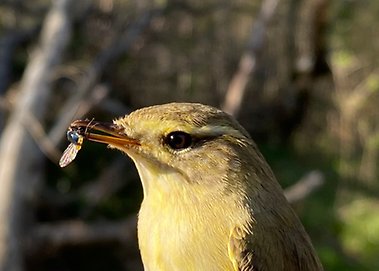
When migratory birds return to Sweden after a long winter it signals the arrival of spring for many people. However, climate change is affecting how and when birds migrate. Research shows that many migratory species are now arriving earlier than they did just a few decades ago, which can have consequences for both the birds themselves and the ecosystems they depend on.
Six researchers at Stockholm University have been awarded grants from the King Carl XVI Gustaf 50th Anniversary Fund for Science, Technology and the Environment. The King Carl XVI Gustaf 50th Anniversary Fund for Science, Technology and Environment was founded in 1996 to celebrate the Swedish King's 50th birthday. The recipients will receive SEK 100,000 to support their ongoing research efforts. Of the 16 recipients, six are from Stockholm University: Josefin Engelhardt, PhD, Department of Environmental Science Health effects of chemical mixtures Mafalda Ferreira, PhD, Department of Zoology Genetics for preserving the resilience of ptarmigan to declining snow cover Malin Hasselgren, Department of Zoology Conservation through reintroduction – genetic consequences for Scandinavian Arctic foxes Bo Sha, Department of Environmental Science Emissions and transport of perfluorinated acids in coastal areas via sea spray Kyra Spaan, Department of Environmental Science Towards a cleaner future: Mapping environmental emissions from lithium-ion batteries Sayad Doobary-Vobora, Department of Chemistry Mechanochemistry paves the way for bio-based materials in the catalysis of organic reactions The award ceremony will take place on June 12, 2025, at the Royal Palace in central Stockholm. About the fund The four original founders were the Royal Swedish Academy of Sciences (KVA), the Royal Swedish Academy of Engineering Sciences (IVA), the Royal Swedish Academy of Agricultural Sciences (KSLA) and the Confederation of Swedish Enterprise (Svenskt Näringsliv, then Sveriges Industriförbund). The purpose was to promote research, technological development and enterprise that would contribute to the sustainable use of natural resources and the maintenance of biodiversity.
When evolutionary biologist Rike Stelkens from Stockholm University began studying yeast, she never imagined it would lead to a collaboration with a Swedish brewery or the launch of her own company. But a startling discovery in the forests of Patagonia may reshape how we think about beer, biodiversity and innovation.
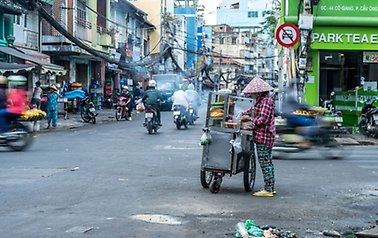
The Vietnam War or the Second Indochina War (1954–1975) as it is called in the English literature ended 50 years ago but its legacies and debates continue to cast a long shadow over Vietnam, Southeast Asia, the US and the international stage. Thiem Hai Bui, researcher at Stockholm Centre for Global Asia, Department of Political Science, Stockholm university explains the consequences of the war and its implications today.
Högskoleföreningen (The Liberal Arts College Association) has awarded the 2024 prize for outstanding scientific work to Friederike Allgöwer for her thesis "Mechanistic Insight into Photosystem II". Her research has deepened our understanding of photosynthesis, an essential, yet at the molecular level still not fully understood, biological process. The prize will be formally presented by the Liberal Arts College Association this autumn.
The fashion industry thrives on constant reinvention. Fast fashion companies pump out millions of garments daily, often at low prices, but at a high cost to both the environment and workers' rights. Yet fashion is deeply personal. It’s a powerful form of self-expression and identity. So, is it possible to stay stylish without compromising our planet? According to Malin Wennberg, a researcher on sustainable fashion, the answer is yes - but with nuance.