


Forestry waste could replace agricultural chemicals
By-products from the forestry and agricultural sectors could help deliver more sustainable food production in times of climate change, environmental degradation and geopolitical instability. That is the idea of Mika Sipponen at Stockholm University, who is preparing a multidisciplinary collaboration involving industry partners and researchers from other Swedish universities.
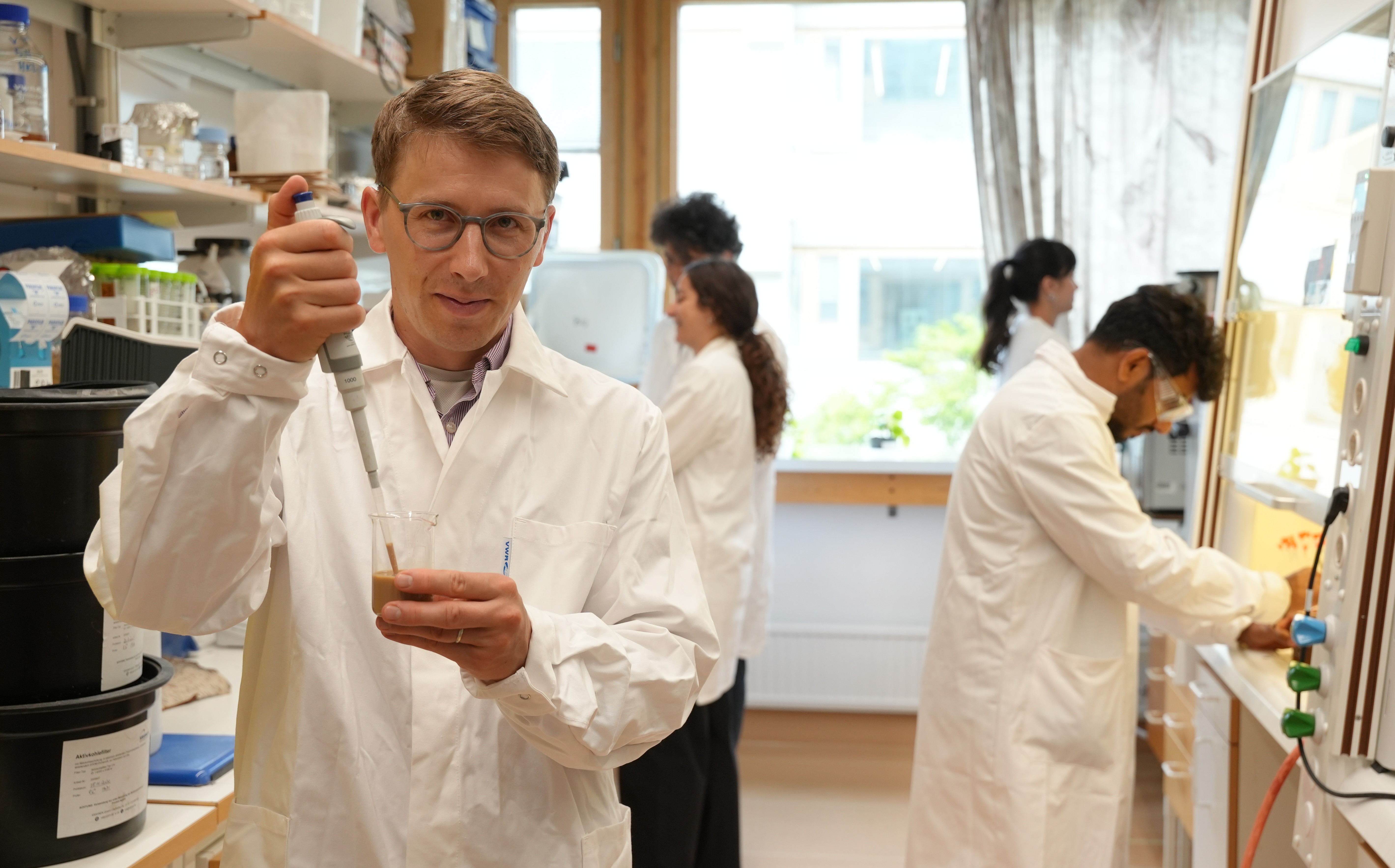
Mika Sipponen and associates in the lab. Photo: Karin Tjulin/Stockholm University
“Bark, sawdust, oat husks and other residues from agriculture and forestry consist largely of lignocellulose, which is currently underutilised. By extracting polyphenols from these materials, we could replace fossil-based pesticides and fertilisers,” says Mika Sipponen, Associate Professor in Materials Chemistry at Stockholm University and leader of several projects focused on developing lignin-based functional materials.
“Industry is keen to learn more about what we are doing, and we already have an important dialogue with companies and other stakeholders.”
Converting by-products to high-performance materials
Every year, the global forestry and agricultural industries generate hundreds of millions of tonnes of wood-based biomass. Mika Sipponen and his research group have developed methods for converting polyphenols, including lignin – a diverse group of complex molecules found in the cell walls of trees and plants, giving them structural strength – into high-performance materials such as paints and adhesives. The group already holds several patents and has launched a start-up company, with more patents under way, all thanks to Sweden’s well-established innovation ecosystem and strong support from the university, Mika Sipponen says.
The researchers are now working with microscopic polyphenol particles known as lignin colloids to address some of the major challenges facing sustainable agriculture and food production. One potential application is fertilisers that, thanks to their colloidal form, can attach to plant roots and release nutrients gradually and in the right amounts over an extended period of time. Another is plant protection products, which can otherwise contaminate soil and waterways if washed away by rain or degraded by sunlight before they have had time to take effect. The researchers hope their work will help reduce both the use of and the environmental spread of fertilisers and pesticides, and by that limiting their accumulation in the soil as well as in plants and animals.
Interdisciplinary collaboration necessary
Mika Sipponen. Photo: Karin Tjulin/Stockholm University
Mika Sipponen emphasises the importance of interdisciplinary collaboration:
“As materials chemists, we have some knowledge of soil chemistry and microbiology, but we work closely with experts from other departments at Stockholm University, including DEEP (the Department of Ecology, Environment and Plant Sciences) and ACES (the Department of Environmental Science). We also collaborate with leading researchers at other universities. We do not want to promote the use of polyphenols without understanding how their breakdown affects soil microorganisms and microbial ecosystems,” he says.
“Working with experts from different disciplines, backgrounds and experiences is essential. I believe that the real breakthroughs happen and the best ideas emerge when people think differently and have to explain their ideas to each other.”
Using AI to streamline the research process
Although Mika Sipponen sees significant potential for lignin-based materials, he stresses that lignin is not a raw material that can be used as it is in an easy way. First it must be processed to suit its intended application.
“There is definitely no ‘one-size-fits-all’ solution when it comes to lignin materials,” he says.
The hydrocarbon chains that make up lignin can vary in many different ways, which adds to the complexity of the research. Mika Sipponen explains that AI is proving valuable in streamlining the process of summarising information, sorting options and selecting the most promising candidates for experimental testing. Here too, his team works with colleagues at Stockholm University and other institutions to access expertise in data science and computational methods.
Combining basic and applied research
Mika Sipponen says he has always combined fundamental research aimed at understanding how the world works with the development of innovations that can be applied in practice and contribute to a better future.
“I do not believe in a strict division between basic and applied research. Even companies developing products often need to deal with very deep research challenges,” he says.
“The key is to identify the most challenging and interesting questions and then pursue them. The whole research group is highly motivated, and we have many early-career researchers who want to explore new directions rather than follow established paths. At one point we were running ten projects in parallel, but several are now completed, so things are a little calmer. We are ready for something new and more ambitious.”
Green and sustainable chemistry
Meeting and teaching young students is another aspect of the job that Mika Sipponen values. He teaches green and sustainable chemistry, focusing on chemical processes in which neither the starting materials, end products nor by-products are harmful. According to Sipponen, students are curious and eager to develop new methods, new chemistry and new knowledge. He also welcomes secondary school pupils who wish to complete their diploma project or gain laboratory experience.
“Not that long ago I was a student myself, and I remember what it felt like to be new and unsure about how things worked in a laboratory. I also remember how important it is to cultivate interests outside your field. Sometimes they can be useful in your work, and they can often inspire entirely new ideas.”
More information about Mika Sipponen’s research
Last updated: 2026-07-07
Source: Communications Office