


Master’s student in the forefront of research
Sólveig Guðjónsdóttir did her Master’s project at the Centre for Palaeogenetics, Stockholm University, analysing a 14,400-year-old tissue sample from a woolly rhinoceros found in the stomach of an ancient wolf. As one of the main authors of a scientific paper based on her research she’s now been interviewed by Scientific American, National Geographic and New York Times.
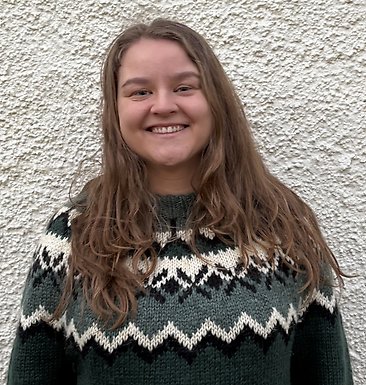
Sólveig Guðjónsdóttir. Photo: by Jorid Tase.
“Evolution has always interested me. It’s the story of life itself, how living things change over time and interact with their environment, and how the environment can shape them,” Sólveig Guðjónsdóttir explains.
She did her Master’s project at the Centre of Palaeogentics, a collaboration between Stockholm University and the Swedish Museum of Natural History, in 2022–2023.
“It’s interesting to look back in time and be able to see what the genes can tell us about the history of a species. You can learn a lot about a population’s history. And to hold a piece of tissue that is 14,000 years old in your hand is very exciting,” she says.
Sólveig Guðjónsdóttir comes from Iceland and did her bachelor’s degree there before she started on the Nordic Master’s Programme in Biodiversity and Systematics, a collaboration between five Nordic universities. While studying in Gothenburg she heard about the Centre for Palaeogenetics and contacted Love Dalén, one of the researchers at the centre, who mentioned this project – a chance to analyse tissue from one of the last woolly rhinoceros before they became extinct, tissue that had been preserved in the stomach of a wolf pup.
“If we could get high quality DNA it would be possible to get information about a critical time in the history of woolly rhinos. It was a big if – but thankfully we were able to get this data and could to do the study.”
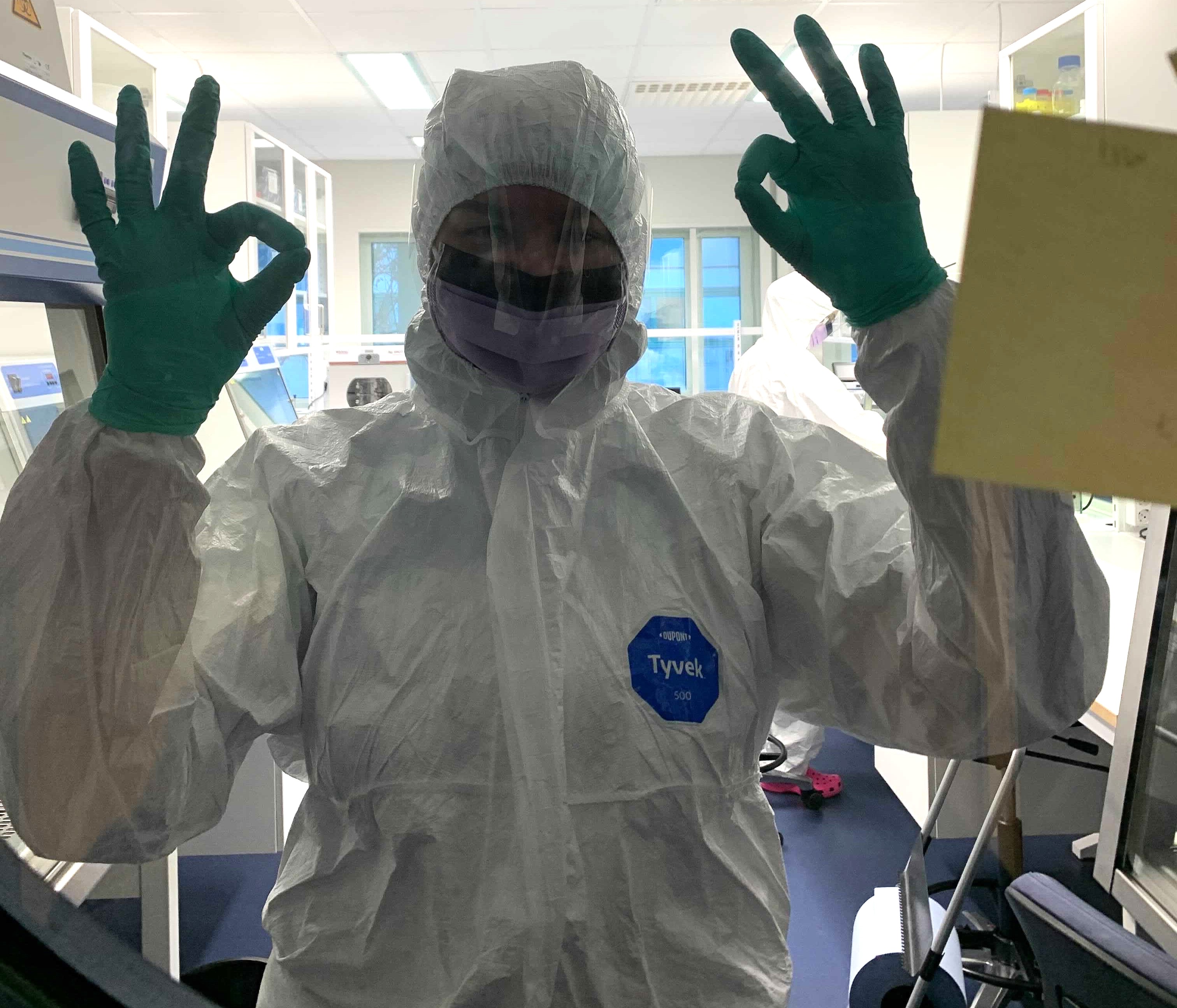
Sólveig Guðjónsdóttir in Centre for Palaeogenetics’ lab. Photo: Alexandre Gilardet/Centre for Palaeogenetics, Stockholm University.
Sólveig Guðjónsdóttir worked in the lab for half a year, followed by analysis and writing her thesis.“I was just a student, so I needed a lot of help, which I got. I learnt incredibly much,” she says.
Her master’s project is now the core of a scientific paper written in collaboration with researchers at the Centre for Palaeogenetics, published in the scientific journal Genome Biology and Evolution, a paper that has received a lot of attention:
“It feels very surreal; I’ve never done anything like this before. And now I would really like to go back to research and to a PhD.”
After her Master’s degree in 2023 Sólveig Guðjónsdóttir has been on parental leave and worked as a scientist at a biotech company producing medicine. Her present work does not relate to her master exactly, but she says that what you learn as a Master’s student – planning your work and executing it, data analysis and writing – are skills that are useful in any kind of work.
Read more about the woolly rhine genome recovered from the stomach of an ice age wolf
Last updated: 2026-01-16
Source: Communications Office