


Nordic Master's Programme in Biodiversity and Systematics
Be part of the new generation of taxonomists with the expertise and skills to take action against biodiversity loss. You will explore the incredible diversity of life, learn to identify and classify organisms, and gain both theoretical and practical research skills that open the way to careers in biodiversity conservation, systematics, and beyond.
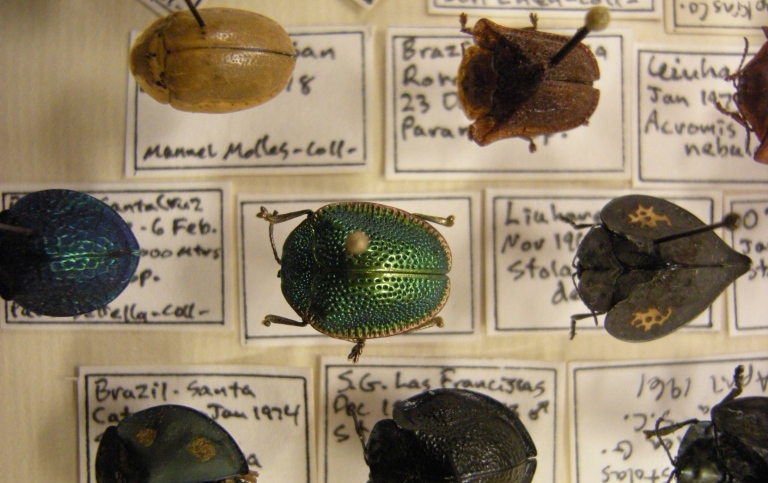
Unidentified Tortoise Beetles. Part of Don Ehlen's "Insect Safari" collection. Photo: Jon Mable/Wikimedia commons
The Nordic Master's Programme in Biodiversity and Systematics combines a strong theoretical foundation with extensive hands-on training. Courses are continuously updated to reflect the latest research, and the flexible structure allows you to tailor your studies to your own interests and career goals.
Reasons to choose the Nordic Master’s Programme in Biodiversity and Systematics:
- A unique Nordic collaboration between five leading universities
- Flexible distance learning combined with intensive field and lab sessions across the Nordic countries
- Broad training that combines biodiversity identification, systematics, theory, and research tools
- Excellent opportunities to gain practical skills in real research environments
- An international learning environment with students and teachers from across the Nordic region
The programme is a collaboration between five Nordic universities: Stockholm University, University of Gothenburg, Lund University, Uppsala University and the Norwegian University of Science and Technology (NTNU). Read more about the collaboration at the Nordic Academy of Biodiversity and Systematic Studies, NABiS.
Courses are taught as a combination of distance studies and intensive field or lab sessions (up to one week long) at field stations and universities across the Nordic region. This format offers flexibility in how and where you study, while also providing valuable practical experience in biodiversity and systematics research.
The programme includes courses in four main categories:
- Biodiversity identification
- Biodiversity classification
- Systematics theory
- Tools and skills
You are required to take at least one course in each category, giving you both breadth and depth in your training. In addition, you can choose from a wide selection of elective courses to shape your individual study path.
Year 1
Compulsory courses
Alpha taxonomical principles (Gothenburg)
Fundamental and Molecular Systematics (Uppsala)
Elective courses
Find the elective courses at the Nordic Academy of Biodiversity and Systematic Studies, NABiS
Year 2
Compulsory course
Degree project in Biodiversity and Systematics
(instructions apply for all degree projects at the department)
Independent project
Master’s degree projects are carried out within ongoing research projects at your host university.
Recent degree projects
- Phylogenomics of Marine Nematodes
- Phylogeny and species delimitation of an endemic radiation of diving beetles of Madagascar using genomic data
- Species diversity and phylogeny of Dakuidae (Acoela)
- Exploring a territory teeming with terrestrial tardigrades: Integrative taxonomy supports two new species of Macrobiotidae from Kristianstad vattenrike biosphere reserve
- The early worm para(d)(H)ox: exploring the xenacoelomorph Hox complement
The Master’s Programme in Biodiversity and Systematics is open for applications only in the first admission round, with a deadline in mid-January.
Specific eligibility
This programme requires previous university-level studies in specific subject areas. Read more about the entry requirements and see examples of academic backgrounds that typically meet them.
Selection process
Applicants that meet the eligibility requirements are ranked based on their merit rating. Only students with the highest merit ratings are selected for our programmes. The merit rating is based on the following four selection criteria, with equal weight:
- relevance of previous studies in relation to the programme
- grades of academic courses
- motivation letter
- research ideas
Required supporting documentation
To submit your motivation letter and research ideas you must use our cover letter form (updated yearly, only latest version accepted).
Note! The form is only available during the application period, up to the supporting documentation deadline.
After submitting the form, download the generated PDF. Do not make any changes to the resulting PDF!
To be considered your cover letter must be uploaded to you application at University Admissions before the supporting documentation deadline.
Recommendation letters and CVs are not considered.
A Master’s degree in Biodiversity and Systematics opens a wide range of career paths. Many graduates continue to academic research, contributing to our understanding of biodiversity and evolution, or work as museum curators managing biological collections.
The programme also prepares you for non-academic careers in areas such as nature conservation, environmental management, government agencies, and non-governmental organisations. With the combination of practical skills, theoretical knowledge, and research experience, you will be well equipped to make a meaningful impact on biodiversity and the sustainable management of natural resources.


