


Enclosed bays are most sensitive to disturbance from motorboats
Researchers working on the ‘Thriving Bays’ project have investigated which environments in shallow coastal areas of the Baltic Sea are most sensitive to disturbance from motorboats. The results show that the risk for boat-related impact is highest in the most enclosed bays, where extensive sediment resuspension from boat propellers can cause adverse effects on the aquatic environment and vegetation. In these bays, measures to mitigate disturbance from motor boats could be one way of protecting sensitive bottom vegetation.
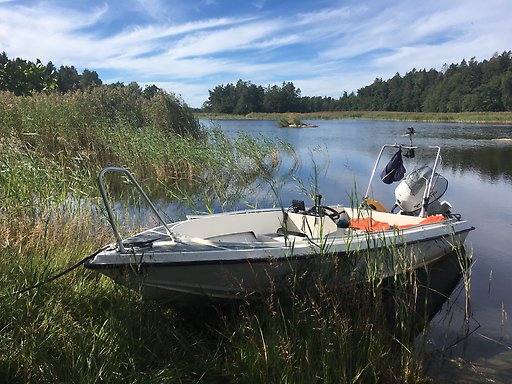
One of the boats used in the study. Photo: Thriving bays
”We know from previous studies that shallow bays containing marinas have sparse vegetation, consisting mainly of disturbance-tolerant plant species” explains Sofia Wikström one of the project leaders and lead author of the new study.
“That could indicate that boats have a negative impact on aquatic vegetation, but we wanted to find out more about this impact to understand if regulating boat traffic can contribute to ecological restoration of shallow coastal bays in the Baltic Sea.”
Potential negative effects
”In shallow, wave-sheltered bays, a lot of loose, easily disturbed sediment accumulates”, explains Sofia Wikström .
”When stirred up by wake and turbulence from motorboats, the sediment makes the water turbid, shading plants growing at the seabed. The plants can also suffer from smothering by resuspended sediment that settle on the leaves. Together, this can be detrimental to sensitive plants and algae.”
Sediment disturbance can also release nutrients from the sediment into the water. That promotes the growth of phytoplankton, which further reduces the amount of light available to the bottom vegetation.
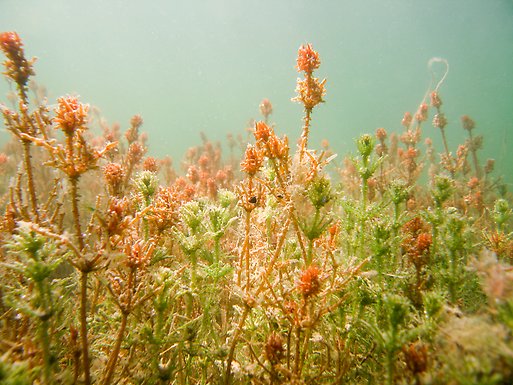
Stoneworts are sensitive to disturbance from boat traffic. Photo: Joakim Hansen
Extensive testing yielded interesting results
As the vegetation is of great importance to other species, protecting or restoring it may be an important step in ecological restoration of shallow coastal bays. There is therefore good reason to investigate the effects of boat traffic more closely.
”We carried out experiments in which we operated a small motorboat in several bays with different types of bottom sediments and vegetation,” explains Sofia Wikström. ”We measured turbidity and the amount of nutrients in the water both before and after the boat disturbance. The tests were carried out both in spring, when there is not much bottom vegetation, and in late summer, when there is a lot of vegetation in some of the bays.”
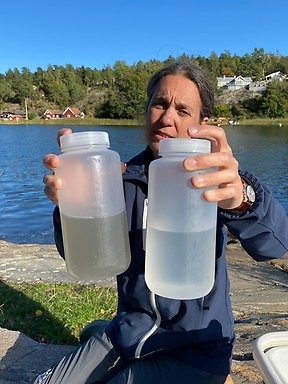
Sofia Wikström shows the difference in water turbidity before and after a boat has passed. Photo: Thriving bays
Encouragingly, the results showed that the boat disturbance only led to a marginal release of nutrients from the sediments. Abundant vegetation had a slightly mitigating effect on the turbidity, but did not eliminate it entirely. The areas that proved to be most sensitive to boat disturbance were, as expected, very enclosed bays sheltered by a shallow threshold and reeds growing at the mouth. In these bays, there is so little natural water movement from waves and currents that fine sediment particles and organic material accumulates at a high rate, resulting in a very loose sediment with a high water content.
“These are the coastal areas where restrictions to boat traffic can be most relevant to implement for environmental protection”, says Sofia Wikström.
Environmental information is available on nautical charts
The research group is now working on the issue of how to reduce the impact of boats in these sensitive areas, with the aim of developing proposals for appropriate measures. However, useful environmental information is already available on nautical charts for the Stockholm archipelago.
“In collaboration with stakeholders from the boating community, we have managed to display information about bays with sensitive underwater vegetation in the Stockholm archipelago in an app showing nautical charts. This can help boat owners who wish to help improving conditions for these underwater environments.”
“By navigating cautiously – for instance keeping a low speed – and by anchoring carefully, you can make a difference for the aquatic environment,” concludes Sofia Wikström.
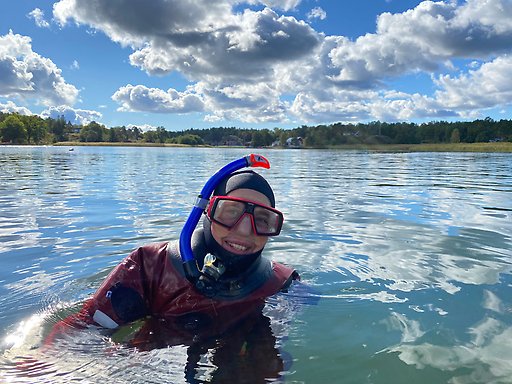
Sofia Wikström investigates the effects of boat traffic. Photo: Thriving bays
Read more
The scientific paper:
Sediment properties and aquatic vegetation affect resuspension from boats in shallow coastal bays, Journal of Environmental Management, 2026
Our news-article about sensitive underwater vegetation showing in nautical charts (in Swedish only)
Last updated: 2026-08-26
Source: Stockholm University Baltic Sea Centre