Within a new graduate school in marine, climate and environmental issues, 12 doctoral students at several of Stockholm University's departments will be hired. The graduate school is directed towards students who are interested in understanding their own research in a broad and interdisciplinary context. A particular focus is on deepening the understanding and provide new knowledge of the specific conditions and challenges of the Baltic Sea in a changing climate.
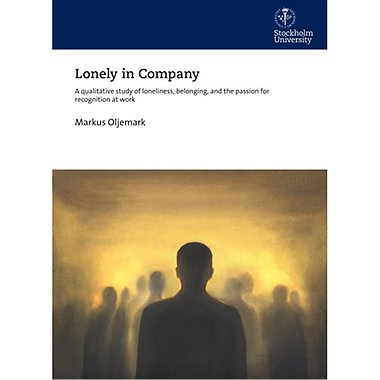
One out of every two office workers experiences loneliness in their jobs. Yet, loneliness has not been extensively explored within management and organizational research. How people experience and cope with loneliness at work remains relatively uncharted territory. In his thesis, "Lonely in Company," Markus Oljemark contributes new knowledge about how loneliness is experienced in workplaces.
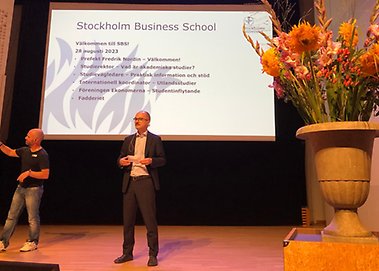
On the first day of the autumn semester, August 28th, Stockholm Business School greeted over 1000 new students in Aula Magna. All newly admitted students were invited to SBS Welcome information that began with an opening speech by Head Fredrik Nordin.
The Jan Wallander and Tom Hedelius Foundation, along with the Tore Browaldh Foundation, have decided to award the following research grants to Stockholm Business School. Leading by algorithm: Reconfiguring the nature of leadership in digitalized work environments, 1 500 tkr, Nick Butler, Management section The project examines the development and application of digital leadership tools in high-performance organizations. Our aim is to gain insights into how data-driven analytics are transforming the nature and scope of leadership in digitalized work environments. The project addresses two main questions: 1) How is the task of leadership transformed by algorithms? 2) How do data-driven analytics affect the leader-follower relationship? The project explores the opportunities and challenges faced by organizations in which soft leadership skills are blended with automated inputs. The data collection process is based on a qualitative methodology, drawing on semi-structured interviews with product developers and senior managers as well as observations of key strategic meetings in participating organizations. Corporate information, trading, and equity market liquidity, 1 500 tkr, Lars Nordén, Finance section According to the efficient markets’ hypothesis, equity market prices reflect all relevant information. Firms disclose corporate information through, e.g., quarterly announcements and other news releases. When the news becomes public, it is incorporated into stock prices either by market makers updating their outstanding quotes, or by investors trading on the information. Private information must be traded on to be incorporated into prices. Uninformed investors, like retail traders, rely on efficient markets to get fair prices when they trade. When market makers face the risk of trading with informed investors, they provide less liquidity. We investigate how firms’ information and informed investors’ trading affect equity market liquidity, and how to properly measure these effects. Exploring the new finance: Meme stocks, melt-ups, and going green, 1 800 tkr, Håkan Jankensgård, Finance section In this project, we will investigate how retail investors behave and perform in response to several new and puzzling phenomena that have appeared in the financial markets in recent years. Following the financial crisis in the late 2000s, the world experienced a prolonged period of relative stability that turned out to profoundly alter the way the markets viewed risk and return. During the Covid-19 pandemic, retail investing experienced a renaissance as people with too much time and money on their hands took to stock market investing, and social media became a force to be reckoned with. Partly as a consequence of this, the financial vocabulary has had to be extended to include, for example, so-called “meme-stocks” and “melt-ups”, which is to say a highly local and social media-driven boom. Around the same time, an increasing demand for “green assets” started to affect how capital is allocated and, by extension, how assets are priced. Our research will probe into how retail investors help generate these phenomena and how they ultimately perform in them. More knowledge about these matters is desirable because this investor category is often made out to be less sophisticated and in need of the regulators’ protecting hand, although, intriguingly, anecdotal evidence suggest that their usage of social media has occasionally given them the upper hand. In pursuing this knowledge, we will benefit from access to unique high-frequency ownership lists that allow us to learn about financial markets from a new angle compared to the traditionally used order books. The Jan Wallander and Tom Hedelius Foundation, as well as the Tore Browaldh Foundation, aim to support social science research primarily in the fields of business administration, economics, and economic history. Read more about the foundations.
On Friday, June 2nd, Stockholm Business School celebrated all the students who graduated during the academic year 2022/2023. Restaurant Proviant in House 2 on Campus Albano was filled with happy and dressed-up students. Teachers and other staff members also joined in celebrating the students' graduation.
Founded in Stockholm in 2016, EMIC is a small multidisciplinary idea conference that demands no paper nor conference fee but yet to be published ideas. May 25-26, 2023 Conference Chair Tony Fang Conference hosts Jeremy Clegg, University of Leeds, UK Tony Fang, Stockholm University, Sweden Fredrik Tell, Uppsala University, Sweden Program Sweden, Scandinavia, central Europe (CET) For program times in other time zones see pdf 8th EMIC Timetable (771 Kb) May 25 13:00-13:05 Fredrik Nordin Head of Stockholm Business School, Stockholm University Welcome speech Fredrik Nordin (63 Kb) 13:05-13:30 Thomas Hylland Eriksen, University of Oslo “Away out of the polycrisis” 13:30-14:00 Mats Alvesson, Lund University “Re-imagining the research process. New ideas for how to understand and do research” 14:20-14:40 Marina Latukha Léonard de Vinci Pôle Universitaire “Human capital outflow and geopolitical turbulence: Unpacking new research perspectives” 14:40-15:00 Mike Peng, University of Texas at Dallas “Managing in Communist Capitalism” 15:00-15:30 Rickard Grassman, Stockholm Business School, Stockholm University “Bank crises and ethics” 15:30-16:00 Yih-Teen Lee, IESE Business School, University of Navarra “Temporal and cultural transcendence: Insights from the construction of Sagrada Familia across 140 years” 16:00-16:20 Hinrich Voss, University of Bristol "International production and climate change" 16:20-16:40 Ari Van Assche HEC Montreal “Global supply chain practices and inequality of opportunity” 16:40-17:00 Break 17:00-17:30 Tony Fang, Stockholm Business School, Stockholm University “The global success of Swedish music” 17:30-18:00 Andrei Panibratov, Léonard de Vinci Pôle Universitaire ”Bulls and bears: Inscribing SOEs’ roles into the global climate agenda” 18:00-18:30 Olga Golubeva, Tony Fang, Stockholm Business School, Stockholm University “The impact of sanctions on Russia on Swedish MNEs: How accounting can contribute to our understanding” 18:30-19:00 Gary Gereffi, Duke University “Rethinking Supply Chain Resiliency in a Post-Pandemic World” 19:30-20:00 Break 20:00-20:20 Sigbjørn Landazuri Tveteraas, University of Stavanger “Do economic complexity and change agency determine how destinations emerge from crises?” 20:20-20:40 Etel Solingen University of California, Irvine “Snarled in the Gray Zone: The Geopolitics of GVCs” 20:40-21:00 Rosalie L. Tung Simon Fraser University Ivo Zander, Uppsala University Tony Fang, Stockholm Business School, Stockholm University “Tech Cold War and implications for IB research” 21:00-21:30 Fredrik Tell, Uppsala University “Reglobalization in a disruptive world – Strategic challenges for multinationals” May 26 09:30-10:00 Changqi Wu, Shandong University “Why does BRI work?” 10:00-10:30 Rudolf R. Sinkovics, University of Glasgow “Towards societally engaged international business” 10:30-11:00 Bryan Jean, National Taiwan University “Does business model innovation enhance international performance for emerging market firms?” 11:00-11:20 Lena Zander, Uppsala University ”More Task-oriented Leadership in Times of Trouble: tonic or toxic?” 11:20-11:40 Jeremy Clegg University of Leeds "How should research capture today's less effective reality?" 11:40-12:00 Chris Medlin, University of Adelaide, Tony Fang, Stockholm Business School, Stockholm University “Yin-Yang thinking and Western Cartesian modes of theorizing” 12:00-13:00 Break 13:00-13:20 Anlan Zhang, Cardiff University “Corporate legitimation competition in the media: A case study of Trump’s TikTok ban” 13:20-13:40 Patrik Ström, Stockholm School of Economics “Services and the green transition in emerging economies” 13:40-14:00 Elizabeth Yi Wang, University of Leeds “Revisiting International Business’s Contribution to Poverty Alleviation” 14:00-14:20 Fang Zheng, Agder University “A systematic review of international business policy” 14:20-14:40 Li Ma, Peking University “Issues on Bell and Road Initiative (BRI)” 14:40-15:00 Niina Nummela, University of Turku “Problematising research on global mobility – focus on individuals with cosmopolitan identity” 15:00-16:00 Break 16:00-16:20 Peter P. Li, Copenhagen Business School “On decoupling" 16:20-16:40 Pervez Ghauri, University of Birmingham “MNEs and sustainable development” 16:40-17:00 Karin Berglund, Anna Wettermark, Jessica Lindberg, Stockholm Business School, Stockholm University “Transforming enterprise education” 17:00-17:30 8th EMIC Lifetime Achievement Award The award goes to Gary Knight, Professor of Global Management, Willamette University, USA Read more about Gary Knight See Gary Knight's speech “The Past and Going Forward: Some Thoughts on International Business and Sustainability” Presentation Gary Knight (1073 Kb) END
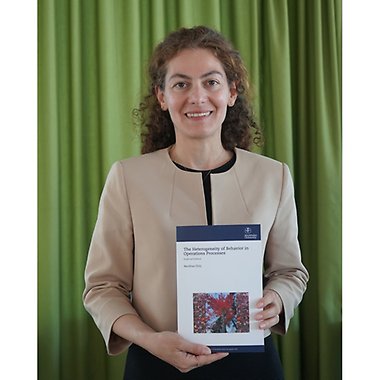
Behavioral science research has established that observed human behavior may deviate considerably from model suggestions. In addition to the realization that there is no such thing as standardized human behavior, there are also substantial differences in how people deviate from the model. A good example of this variation is huge variability in the forecasts of different professionals with similar information. So, different individuals make dissimilar decisions in the same situation when using the same information. Recently, behavioral operations management has seen an increased focus on understanding the role of humans in the decisions and processes these models aim to capture. However, still little is known about the factors that determine the observed behavioral heterogeneity. With this realization, Neslihan Özlü aspires to create knowledge about the drivers of this “behavioral heterogeneity” with the four studies in her dissertation The Heterogeneity of Behavior in Operations Processes. Neslihan Özlü defended her dissertation at Stockholm Business School on May 12th.
Gaining the right to host a World Cup is doable, but winning it? Well, that’s something else. The book The Footballization of China is written by Professor Emeritus Sten Söderman and it´s about the development of football in China. Many observers of the Chinese football industry wonder how a country can achieve world dominance in a sport in which it has no previous success. This lack of history means there are no reliable data upon which to make meaningful predictions. - Therefore, using network strategy at club level and applying it to national level – common practice in analysis of industrial sectors – and creating some variables of my own, I examine how the Chinese have developed a competitive football system through a combination of government directives, market liberalization and privatization. By definition, my methodology has introduced an element of subjectivity into my analysis and conclusions says Sten Söderman. - Nevertheless, I assess the current state of football in China and suggest ways of improving the national men’s team’s international competitiveness and increasing its chances of winning the 2050 World Cup he continues.
Evert Gummesson, a beloved emeritus professor at Stockholm Business School, passed away on April 2nd, 2023 at the age of 87. He was a distinguished figure in the field of service marketing and management, and his contributions to the academic community will be deeply missed. After graduating from the Stockholm School of Economics, Gummesson earned his Ph.D. from Stockholm University. He received numerous honors in academia, including becoming a fellow and Honorary Doctor of Hanken School of Economics, Helsinki, as well as a fellow of the University of Tampere in Finland, among other notable distinctions. He was widely regarded as an international pioneer in the fields of marketing, service, relationships, and qualitative methodology, owing to his extensive experience and expertise.
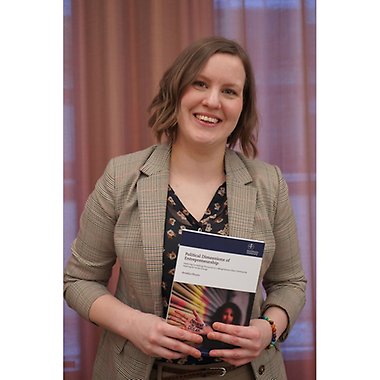
A new thesis shows the political dimension of social entrepreneurship. Amelia Olsson defended her thesis Political Dimensions of Entrepreneurship - Exploring Competing Discourses in a Marginalized Urban Community Aspiring for Social Change on March 7 at the Management section, Stockholm Business School. The study explores the political dimension of entrepreneurship emerging within the context of a subaltern counterpublic (a form of community cultivating contestation of current social structures) primarily consisting of second-generation Swedes with connections to marginalized suburbs in Stockholm. It examines discursive struggles within a network of entrepreneurs that are part of the community, who organize in various ways against social exclusion and marginalization to improve conditions for marginalized people and construct a more inclusive and democratic society. - I have been interested in politics, activism and big societal debates for a long time, and before I started my PhD I noticed that some entrepreneurs combined their activism with entrepreneurship. I found this phenomenon interesting and saw examples of it in the anti-racist movement in Sweden. This became the starting point of my study, says Amelia.
Ran Xing, assistant professor at the Finance section, Stockholm Business School, has been awarded with the Hans Dalborg Award for his research about explicit and implicit value of high-turnover investment strategies.
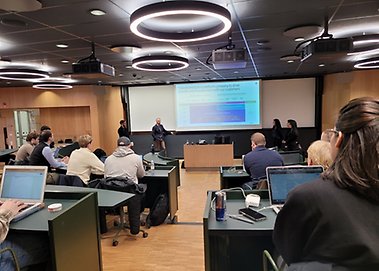
On March 7th, Peter Nyquist, Head of Investor Relations at Ericsson, met and interacted with the students of the Corporate Finance course at Stockholm Business School. Mr. Nyquist participated in the course by answering questions and explaining the complex business of the Swedish telecom giant Ericsson. The questions were asked by the students in the preparation for their final task on the course - a DCF, Discounted cash flow, valuation of Ericsson. This semester, the company Ericsson is the case company for the Corporate Finance course. The case company in the course is the company to which the theory of corporate finance is applied, with various financial calculations and discussions, such as the annual general meeting, corporate governance, board of directors, ownership, optimal capital structure, dividends, and risk assessment. And the final exercise in the course is to perform a DCF valuation of the case company, i.e. Ericsson. To have an efficient Q&A session four students – Sara Wattar, Bianca Cordero Zalihic, Diba Zibari, and Mohammed Dirawi – led the session by creating structure and asking introductory questions to Mr. Nyquist.