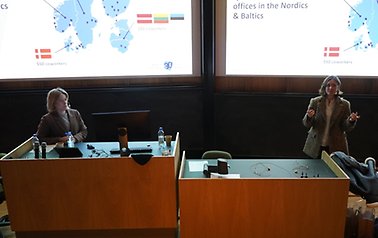
The course "Research Frontiers in Financial Economics" explores various domains within finance, including Sustainable Finance and Sustainability aspects of Real Estate Valuation. On December 9, 2024, students received a visit from Filippa Drakander and Filippa Dracke von Euler, both of whom are engaged in Sustainability issues, at Newsec , a property consulting firm that was founded in 1994 by Urban Edenström, operating in the Nordic and Baltic countries.
In the article Bright Light, Dark Room: Where do Corporate Insiders Trade? Alexander Hübbert and Lars Nordén investigate the trading venue choices of corporate insiders, whether they opt to trade on public exchanges or in dark, less transparent markets. They examine how these choices depend on whether insiders are informed or possibly violating trading restrictions. Their findings show that informed insiders tend to trade on public exchanges to quickly benefit from their information, while those engaged in illegal trading are more likely to use dark markets to conceal their actions. Additionally, they observed that trading on dark markets correlates with lower abnormal returns, suggesting that insiders face a trade-off between transparency and execution risks. Alexander Hübbert started the PhD program at Stockhlm Business School in August 2021 and is now working on his second paper. His research is about insider trading. Researching insider trading is important because it provides critical insights into how the trading behavior of insiders, especially in opaque or "dark" venues, impacts overall market transparency and fairness.
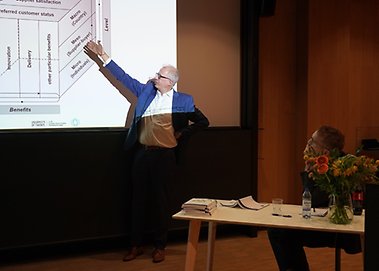
David Fridner’s new dissertation, "Customer Attractiveness in the Public Sector", explores how public organizations can become more attractive as customers, thereby fostering long-term, value-creating relationships with their suppliers. Through three articles, Fridner demonstrates ways public organizations can enhance their supplier relationships, overcome bureaucratic obstacles, and establish partnerships that promote innovation, delivery reliability, and cost efficiency. David Fridner defended his dissertation at the Marketing Section, Stockholm Business School, on November 1. The dissertation challenges traditional market logic by focusing on suppliers’ perceptions of public customers - termed customer attractiveness in the public sector. The articles examine this concept from various angles: what it comprises, why public organizations might want to actively address it, and how they can approach it. The first article, " The Perks of Being an Attractive Public Customer ", explores the importance of being an attractive public customer. The findings reveal that it can be key to mobilizing suppliers toward quality improvements and innovation, while also protecting against risks like delivery failures and added costs. The second article, " Becoming an Attractive Public Customer to Strategic Suppliers ", investigates what creates customer attractiveness for strategic suppliers. Findings show how different forms of trust play a crucial role in generating supplier value and long-term customer attractiveness, which ultimately serves as a foundation for mutually productive relationships with key suppliers. The third article, " From Bureaucracy to Collaboration: Emerging Tactics to Enhance Customer Attractiveness in the Public Sector ", examines practical methods public organizations can use to foster customer attractiveness. The results highlight four tactics public customers can employ during procurement and contracting phases to overcome barriers to customer attractiveness associated with public procurement.
Ai Jun Hou, Sara Jonsson, and Qinglin Ouyang, all from the Finance section, recently had their article, “From Employee to Entrepreneur: The Role of Unemployment Risk,” accepted for publication in the Journal of Financial Economics, one of the top three journals in finance. In this article, Ai Jun Hou, Sara Jonsson, Qinglin Ouyang, and their co-author Xiaoyang Li (Deakin University) use Swedish administrative data to study how increased unemployment risk affects employees’ decisions to enter entrepreneurship. They use the 2001 relaxation of the Last-In-First-Out dismissal rule, which shifted unemployment risk from the most junior employees to the more senior ones, as a shock to unemployment risk. The results show that employees facing increased unemployment risk are more likely to enter entrepreneurship. Additionally, they track the income dynamics of the new entrepreneurs and the performance of their ventures, finding that entrepreneurs who faced higher unemployment risk do not underperform compared to other entrepreneurs. The study indicates that rigid employment protection policies can be an impediment to entrepreneurship, and the findings have important implications for designing policies to spur entrepreneurship.
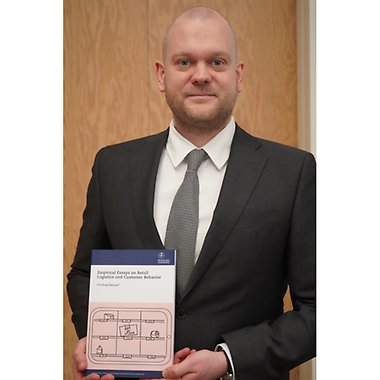
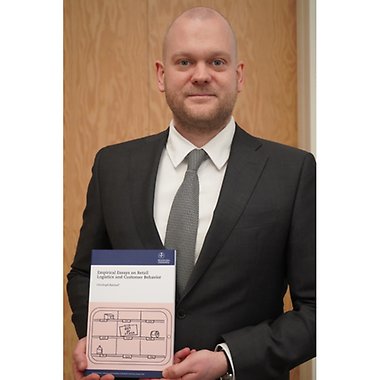
Online and omnichannel retail led to changes in customer behavior that speak to the relevance of logistics. Therefore, logistics has moved from being a back-office operation to sitting at the forefront of retailers´ service offerings. Christoph Baldauf defended his thesis "Empirical Essays on Retail Logistics and Customer Behavior" on January 27. His thesis explores this transformation in four research articles, with a view to contributing to a better understanding of the relevance in retail today, and its impact on customer behavior. The thesis demonstrates how logistics does not solely impact a retailer’s cost side of the business but also demand from customers. As such, the thesis highlights the integrative approach needed between marketing and operations, since logistics performance is increasingly relevant for marketing performance. The thesis also accentuates the role of people in operations management research by emphasizing how customers are impacted by retail logistics, which adds to a better understanding of how people affect real-life operational processes.
The 2024 annual meeting of the European Working Group on Retail Operations was held at the WU Vienna University of Economics and Business. During the conference The Doctoral Dissertation Award was awarded to Christoph Baldauf (now: Center for Retailing, Stockholm School of Economics) for his thesis on the relevance of logistics in online and omnichannel retail. The thesis was successfully defended at Stockholm Business School in February 2023.
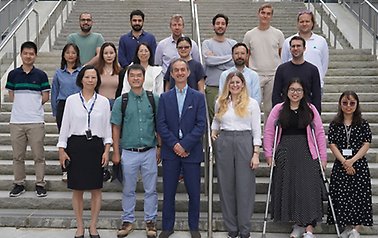
During the summer, the SACCess group had two articles published in well-renowned journals. SACCess is an acronym where S stands for speed and acc for acceleration. The project, which includes researchers from Brazil, Italy, China, Lithuania, Poland, and Sweden, was initiated by Martin Johanson, currently affiliated with SBS, in 2016 and primarily aims to understand and explain the speed of companies' internationalization. However, the data offers more insights than that, and so far, the analyses have aimed to deepen the understanding of companies' internationalization strategies, what influences them, and what they lead to. Six articles have been published so far, and now the project is entering the next phase where the group begins to explore concepts drawn from theories on the Learning Advantage of Newness and Time Compression Diseconomies to further understand the speed of internationalization, speed to internationalization, and acceleration of speed. Articles from the SACCEss-project published in peer-reviewed journals so far: Oliveira, Luis, Johanson, Martin & Fleury, Afonso, 2024, A Bird in the Hand is Worth Two in the Bush: How SMEs Leverage Different Types of Knowledge and Networks during Effectual Internationalization, Journal Business Research . Bai, Wensong, Francioni, Barbara, Johanson, Martin, Oliveira, Luis & Ratajczak-Mrozek, Milena, 2024, Entrepreneurial Alertness, Effectuation and International Performance in SME Internationalization, Journal of Small Business Management . Oliveira, Luis & Johanson, Martin. 2024, The Performance of Decision-making Strategies in SME Internationalization: The Role of Host Market’s Institutional Development, Management International Review . Bai, Wensong, Hilmersson, Mikael, Johanson, Martin & Oliveira, Luis, 2024, SMEs’ Regional Diversification: Dynamic Patterns and Home Market Institutional Determinants, International Marketing Review . Bai, Wensong, Francioni, Barbara, Johanson, Martin, Oliveira, Luis & Ratajczak-Mrozek, Milena, 2022, Where Business Networks and Institutions Meet: Uncertainty and SME Internationalization Decision-making, Journal of International Management. Bai, Wensong, Johanson, Martin, Oliveira, Luis & Ratajczak-Mrozek, Milena, 2021, The Role of Business and Social Networks in the Effectual Internationalization: Insights from Emerging Market SMEs, Journal of Business Research.
The summit glacier on Kebnekaise's southern peak continues to shrink. The annual altitude measurement at the end of the summer shows that Sydtoppen (the South Peak) – Sweden's former highest point – is now 3.3 meters lower than last year and also 6.9 meters lower than Kebnekaise's north peak.
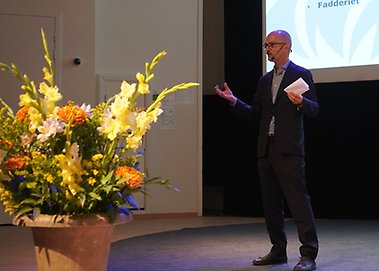
The autumn semester has now begun, and Stockholm Business School welcomed over 1,000 newly admitted students with an Orientation Session in Aula Magna on September 2nd. Head of Department Fredrik Nordin welcomed all students to Stockholm Business School and Stockholm University.
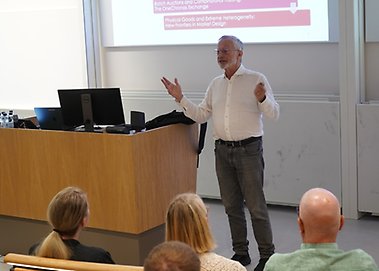
Paul Milgrom, professor at Stanford, gave a keynote speech at the Summer School in Market Microstructure that was hosted by Stockholm Business School in July 2024. The course attracted more than 60 PhD students and practitioners from all over the world. What is going on under the hood when you buy shares at the stock exchange? That is a question that most investors have never thought about, but one that is central in the field of market microstructure. Stockholm Business School is home to several researchers in that field, and we recently hosted the Summer School in Market Microstructure. This doctoral course, which attracted more than 60 participants from all over the world, is taught by Prof. Thierry Foucault (HEC Paris) and Prof. Albert J. Menkveld (VU Amsterdam).
We are excited to share the highlights from our PhD-level summer course on International Finance, held from August 5-9, 2024. Professor Lucio Sarno from the Judge Business School at the University of Cambridge delivered a series of insightful lectures that significantly enhanced our understanding of international finance.
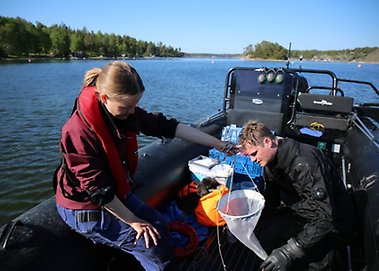
Large predatory fish have become harder to find in the coastal bays of the Baltic Sea, which are now dominated by sticklebacks. Many of these bays have also become more turbid and show signs of severe eutrophication. Scientists have seen this shift spread from the open sea to coastal environments and are now looking for explanations as to why this has happened and whether it could contribute to unforeseen climate impacts. In one of the largest field sampling programmes of the year, the FORCE project map changes and how best to restore coastal predatory fish stocks and biodiversity. From Västervik to Östhammar, the composition of fish species, plants and algae living in 32 different bays will be analysed. In addition, samples of nutrient levels and plankton will reveal the water quality in these areas. The sampling station at Krysshamnsviken in the Stockholm archipelago is a hive of activity, with several fishing nets being thoroughly sorted and rinsed on the adjacent boat jetty and beach, while samples are collected by divers and assistants in a rib boat out in the bay. Krysshamnsviken is one of 32 sites that FORCE researchers surveyed in 2014 to investigate the relationship between fish species, vegetation and water quality. Now, 10 years later, they are back to see how these have developed. " These bays are very different. They have different amounts of predatory fish and sticklebacks, as well as different levels of protection from fishing. The number of seals and cormorants in these areas also vary. In total, this gives us a better picture of the causes and possible measures, such as fishing closures, to improve the environmental status," says Johan Eklöf, Professor in Marine Ecology at the Department of Ecology, Environment and Plant Sciences at Stockholm University and project leader for FORCE. Link between sticklebacks and climate change The decline in predatory fish such as pike and perch and the increase in sticklebacks is affecting many natural values. The situation has contributed to turbid bays with more filamentous algae and severe symptoms of eutrophication. More predatory fish help to keep water areas clean and clear, and could counteract these symptoms. The researchers are now trying to find out whether stronger populations also could be linked to climate effects. " We will investigate whether areas with a lot of predatory fish are better at storing carbon than areas dominated by sticklebacks, where carbon turnover is higher," says Johan Eklöf.