News

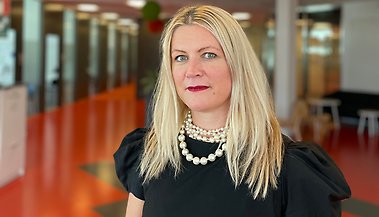
  • Portrait photo of Lisa Kaati, Associate Professor at the Department of Computer and Systems Sciences (DSV), Stockholm University.

    Data-driven method may help police combat human trafficking

    Buying sex has been illegal in Sweden since 1999. Despite this, sexual services are openly marketed on numerous websites — and buyers freely share their reviews. This is revealed in a new study.

    Department of Computer and Systems Sciences
  • Reused code may be the source of cyber attacks

    The code in your modern software is not new. To a large extent, it’s been reused from older software. The problem with this? You might be the victim of a software supply chain attack.

    Department of Computer and Systems Sciences
  • AI is not always fair – we need to solve the ethical dilemmas

    Machines lack human intelligence, and relying on them for important decisions can therefore be dangerous. AI may discriminate, lie and make mistakes – without feeling guilty about it. Clàudia Figueras’s research on ethics and AI shows how we can approach the problem.

  • AI for Science symposium bridges academia and industry

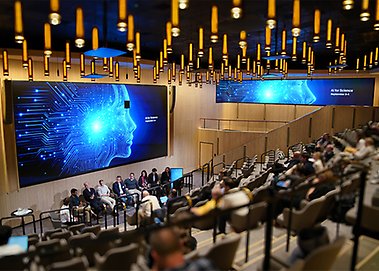
    In September, the Royal Swedish Academy of Sciences hosted AI for Science in Beijer Hall, co-organized with the new EDUCATE Centre of Excellence. The two-day meeting brought together researchers and technology leaders to compare strategies for using AI across disciplines—from cosmology and particle physics to fusion, materials discovery and weather forecasting.

    Oskar Klein Centre
  • Household power – from consumer to producer of energy

    Stockholm University joins ENERPOL, a project where leading European institutions explore policy strategies that empower households in the energy transition. Households are redefined: They are not only consumers, but also producers and flexibility providers critical to a fair, climate-neutral energy system.

  • Leveraging AI to create a digital twin of the Universe

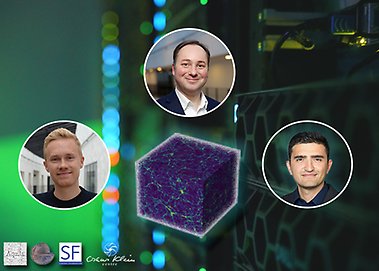
    In a novel study published in Monthly Notices of the Royal Astronomical Society in August 2025, scientists at the Oskar Klein Centre have developed an AI-powered method to build a digital twin of the Universe—reconstructing its early state and simulating its entire evolution up to the galaxies we see today.

    Oskar Klein Centre
  • It takes more than just a new app to go digital

    In his fresh PhD thesis, Rahmat Mulyana explores successful digital transformation. He stresses the importance of IT governance to balance between control and flexibility. We asked him what organizations can do to up their digital game.

  • Award-winning app takes on everyday life with psoriasis

    What if an app could help people with psoriasis monitor their skin remotely and predict flare-ups—cutting down on costly and time-consuming visits to the doctor? That is the vision behind PsoriScan, a start-up idea developed by master’s student Hossam Shahin during the Startup Garage Spring 2025 Business Development Bootcamp – an idea that went on to win 10,000 SEK.

    Department of Computer and Systems Sciences
  • Congratulations, team DSVx!

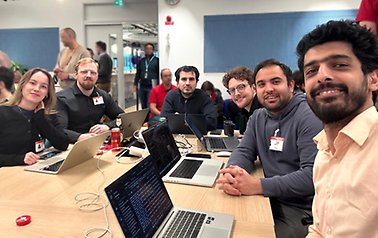
    Four PhD students, a graduated master’s student and a data scientist from Ericsson teamed up for a hackathon. The result? Success. The team – DSVx – reached second place!

    Department of Computer and Systems Sciences