


How can universities teach for a sustainable future? Insights from Teachers’ Conference 2026
How can sustainability be integrated into teaching? And what role does trust play in learning? These were some of the topics discussed at the 2026 Teachers’ Conference, held under the theme “Teaching for Democracy and Sustainability.”
A comprehensive programme featuring around 40 roundtable discussions, oral presentations, workshops, and panel discussions brought together approximately 230 participants at the Stockholm University Teachers’ Conference 2026.
President Hans Adolfsson welcomed participants and noted that the role of universities is becoming increasingly important in a time marked by rapid technological paradigm shifts, continued negative climate developments, and widening social inequalities.
“The growing polarisation in Europe and especially in the United States, where perceptions of facts and knowledge have changed dramatically and distrust in the fundamental values of universities is increasing, is a troubling development. Therefore, it is important that we hold firmly to our core values and receive the protection needed to continue carrying out our socially vital missions,” he said.
The Teachers’ Conference is held every two years and organised by Centre for the Advancement of University Teaching (CeUL). It is aimed at all staff involved in teaching or educational development. The conference is also open to staff from other institutions within the Stockholm trio university alliance, and both Karolinska Institutet and KTH Royal Institute of Technology were represented.
Sustainability and trust in teaching
The keynote speakers were Rachel Forsyth and Mirjam Glessmer, educational developers at Lund University. Their keynote lecture, Teaching for Tomorrow: Trust, Agency and Sustainability in Higher Education, explored how sustainability can be integrated into all teaching and the role trust plays in learning.
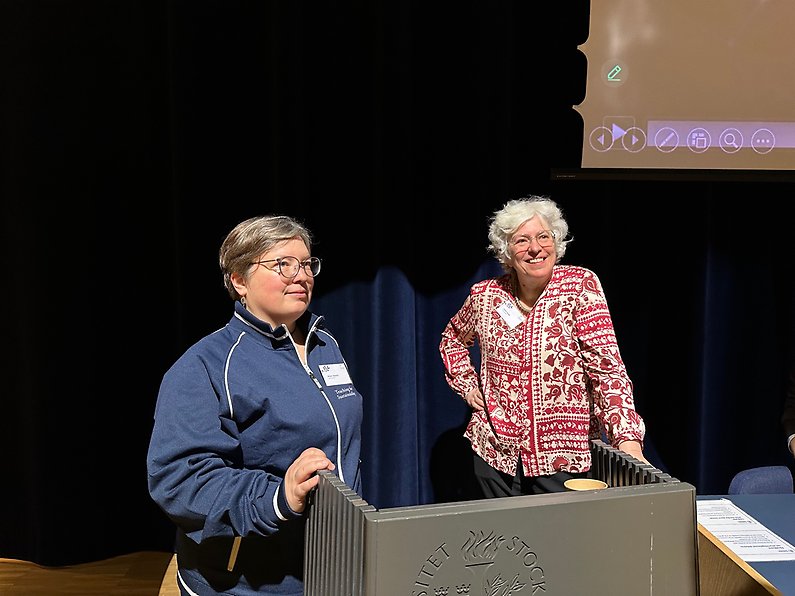
Mirjam Glessmer and Rachel Forsyth, Lund University. Photo: CeUL
Mirjam Glessmer presented five perspectives on how sustainability can be woven into teaching: A chat on “how to teach for sustainability”. Her key message was that all courses can contribute, but this requires teachers to make their responsibility visible and create opportunities for meaningful dialogue with students.
Rachel Forsyth focused on trust in the age of generative AI: How teachers build trust with students in the presense of GenAI. She emphasised the importance of not avoiding the issue, but instead actively discussing AI with students. Experiences from focus groups show that students are asking for clear guidance on how these tools can be used in their studies and future professional work within their disciplines. Against this backdrop, trust becomes crucial, she argued, as does making the democratic principles of education visible.
Panel discussion on education for sustainability and democracy
The conference concluded with a panel discussion featuring Iann Lundegård, Associate Professor of Education at the Department of teaching and learning, Johan Wickström, Associate Professor of Education at Uppsala University; and Maria Wolrath Söderberg, Associate Professor of Rhetoric at Södertörn University. Together, they discussed education for sustainability and democracy.
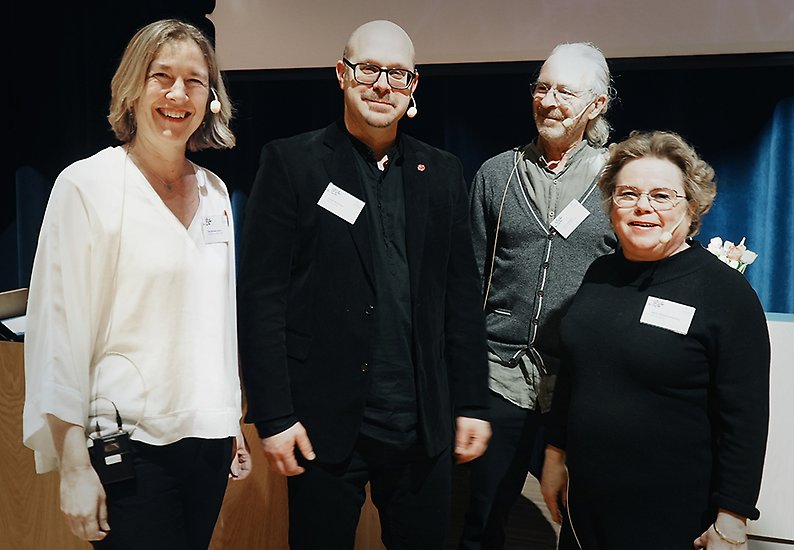
Klara Bolander Laksov, Stockholm University; Johan Wickström, Uppsala University; Iann Lundegård, Stockholm University; and Maria Wolrath Söderberg, Södertörn University. Photo: CeUL
“We are facing a threat to democracy around the world and need to highlight universities as arenas of resistance and discuss what we do on a broader level, but also bring these issues into our daily practices: which aspects of education already function as a democratic dimension? Is there anything in teaching that would not be possible in an authoritarian society? In the United States, universities have adapted very quickly,” Johan Wickström pointed out.
Iann Lundegård emphasised that democracy should be understood as a process within education in which students actively participate in knowledge creation, develop critical thinking, and encounter diverse scientific perspectives through dialogue characterised by openness and trust.
Maria Wolrath Söderberg warned against fear of addressing sustainability issues in teaching.
“I have met many colleagues who have become cautious and comply in advance. We need to become bolder and more active in the public conversation and in our interactions with students. I send students out on critical participatory assignments where they receive responses they did not expect — they learn a great deal from that,” she said.
Moderator Klara Bolander Laksov, Professor of Higher Education and Director of CeUL, concluded by encouraging teachers to exercise pedagogical leadership by raising important issues in conversations with colleagues and students. In this way, a shared direction can emerge, where people learn from and together with one another. She also reminded participants that CeUL offers courses for those who wish to develop their pedagogical leadership.
Read more about professional development at CeUL.
Support material: Sustainable Teaching in Practice – A Guide for University Teachers
Text: Gunilla Nordin, Communications Office
Last updated: 2026-05-21
Source: Department of Education