


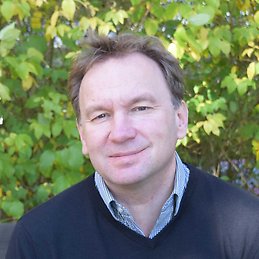
Attila Szabo Affilierad forskare
Kontakt
Namn och titel: Attila SzaboAffilierad forskare
Arbetsplats: Specialpedagogiska institutionen Länk till annan webbplats.
Besöksadress Albanovägen 28
Postadress Specialpedagogiska institutionen106 91 Stockholm
Om mig
Jag är fil.dr. och lektor vid Utbildningsförvaltningen i Stockholms stad samt affilierad forskare vid Specialpedagogiska institutionen, Stockholms universitet.
Min forskning fokuserar främst på särskild begåvning, i synnerhet matematisk begåvning, matematisk problemlösning och olika aspekter av lärarstudenters utbildning. Jag är även författare till en läromedelsserie i matematik för gymnasiet.
Jag är ledamot i Skolforskningsnämnden vid Skolforskningsinstitutet och i det vetenskapliga rådet vid Global Center for Gifted and Talented Children. Därutöver är jag ledamot i Svenska kommittén för matematikutbildning (SKM) och i den internationella kommittén för International Group for Mathematical Creativity and Giftedness (igMCG).
För närvarande är jag biträdande handledare för Diana von Börtzell-Szuch och Hannah Holmqvist Mohammed, doktorander inom forskarskolan GiftED.
Westling Allodi, M., & Szabo, A. (2026). Current developments in gifted education: Sweden. In V. Margrain & K. Tirri (Eds.), Nordic perspectives on gifted education (pp. 91–110). Stockholm University Press. https://doi.org/10.16993/bdo.f
Brandl, M., Benölken, R., & Szabo, A. (2026). Technology-driven innovations to improve marginalized students’ access, engagement, and learning outcomes in mathematics: Digital interactive mathematical maps, digital revolving doors and Intize. In E. Ampadu, Z. Jojo, E. Hartell, G. Sunzuma, & F. S. Mensah (Eds.), Mathematics for all: Bridging the gap for underprivileged and gifted learners (pp. 281–299). Springer. https://doi.org/10.1007/978-3-032-22072-1_13
Brandl, M., & Szabo, A. (2026). Challenging deconstruction of signs by iconoclasm as a motivational aspect for the mathematically gifted and creative personality: A theoretical consideration and hypothesis [Conference presentation]. Gesellschaft für Didaktik der Mathematik (GDM), Wuppertal, Germany.
Westling Allodi, M., von Rosen, T., & Szabo, A. (2025, June). How is the Swedish educational system doing for the academically successful students? How many of these students are resilient? Analyses based on data from PISA 2022 [Poster presentation]. European Council for High Ability (ECHA), Karlstad, Sweden.
Brandl, M., & Szabo, A. (2024). Digital learning environments to support autonomous learning processes of mathematically creative and gifted students. In M. E. Auer, U. R. Cukierman, E. Vendrell Vidal, & E. Tovar Caro (Eds.), Towards a hybrid, flexible and socially engaged higher education: Proceedings of the 26th International Conference on Interactive Collaborative Learning (ICL 2023) (pp. 198–205). Springer.
Szabo, A., Tillnert, A.-S., & Mattsson, J. (2024). Displaying gifted students’ mathematical reasoning during problem solving: Challenges and possibilities. The Mathematics Enthusiast, 21(1–2), 179–202. https://doi.org/10.54870/1551-3440.1623
von Börtzell-Szuch, D., Westling Allodi, M., & Szabo, A. (2024). Students with advanced literacy skills and related literacy instruction. Gifted and Talented International, 39(2), 137–161. https://doi.org/10.1080/15332276.2024.2425847
Sjöstrand, T., Niklasson, J., Kyprianou, C., Szabo, A., & Andrews, P. (2023). Do linear equations act as a gatekeeper to later mathematical learning? Evidence from a study of Swedish upper secondary students. In P. Drijvers, C. Csapodi, H. Palmér, K. Gosztonyi, & E. Kónya (Eds.), Proceedings of the Thirteenth Congress of the European Society for Research in Mathematics Education (CERME13) (pp. 660–667). Alfréd Rényi Institute of Mathematics and ERME. https://hal.science/hal-04418299/document
Fahlgren, M., Szabo, A., & Vinerean, M. (2022). Prospective teachers designing tasks for dynamic geometry environments. In Proceedings of the Twelfth Congress of the European Society for Research in Mathematics Education (CERME12). Bozen-Bolzano, Italy. https://hal.archives-ouvertes.fr/CERME12/hal-03747493v1
Kai-Larsen, E., Rimeslåtten, M., Szabo, A., & Andrews, P. (2022). Swedish students’ exploration of trigonometrical relationships: GeoGebra and protractors yield qualitatively different insights. In Proceedings of the Twelfth Congress of the European Society for Research in Mathematics Education (CERME12). Bozen-Bolzano, Italy. https://hal.archives-ouvertes.fr/CERME12/hal-03748397v1
Mellroth, E., & Szabo, A. (2022). Talented upper secondary students’ perception of online mathematical challenges. In S. A. Chamberlin (Ed.), On the road to mathematical expertise and innovation: Proceedings of the 12th International Conference on Mathematical Creativity and Giftedness (MCG 12) (pp. 311–313). University of Nevada, Las Vegas. https://d-nb.info/1268386723/34
Szabo, A., Vinerean, M., Fahlgren, M., & Sriraman, B. (2022). Prospective teachers constructing dynamic geometry activities in order to challenge gifted pupils. In S. A. Chamberlin (Ed.), On the road to mathematical expertise and innovation: Proceedings of the 12th International Conference on Mathematical Creativity and Giftedness (MCG 12) (pp. 265–271). University of Nevada, Las Vegas. https://d-nb.info/1268386723/34
Vinerean, M., Szabo, A., Fahlgren, M., & Sriraman, B. (2022). Prospective teachers constructing dynamic geometry activities for gifted pupils: Connections between the frameworks of Krutetskii and van Hiele. Gifted Education International, 38(2), 273–294. https://doi.org/10.1177/02614294211046544
Szabo, A., Vinerean, M., & Fahlgren, M. (2020). Surveying prospective teachers’ conceptions of GeoGebra when constructing mathematical activities for pupils. In A. Donevska-Todorova, E. Faggiano, J. Trgalova, Z. Lavicza, R. Weinhandl, et al. (Eds.), Proceedings of the Tenth ERME Topic Conference (ETC 10) on Mathematics Education in the Digital Age (MEDA) (pp. 131–132). https://hal.archives-ouvertes.fr/hal-02932218
Brandl, M., & Szabo, A. (2019). Overexcitability, iconoclasm and mathematical creativity and giftedness. In M. Nolte (Ed.), Proceedings of the 11th International Conference on Mathematical Creativity and Giftedness (pp. 53–58). Hamburg University.
Misfeldt, M., Szabo, A., & Helenius, O. (2019). Surveying teachers’ conception of programming as a mathematics topic following the implementation of a new mathematics curriculum. In U. T. Jankvist, M. van den Heuvel-Panhuizen, & M. Veldhuis (Eds.), Proceedings of the Eleventh Congress of the European Society for Research in Mathematics Education (pp. 2713–2720). Utrecht University. https://hal.science/hal-02417074v1/document
Szabo, A. (2018). Creativity and giftedness: Interdisciplinary perspectives from mathematics and beyond, edited by R. Leikin and B. Sriraman [Book review]. Roeper Review, 40(4), 273–275. https://doi.org/10.1080/02783193.2018.1501646
Szabo, A. (2017). Mathematical memory revisited: Mathematical problem solving by high-achieving students. In T. Dooley & G. Gueudet (Eds.), Proceedings of the Tenth Congress of the European Society for Research in Mathematics Education (pp. 1202–1209). Dublin City University. https://hal.science/hal-01935805/document
Szabo, A. (2017). Matematikundervisning för begåvade elever: En forskningsöversikt [Mathematics education for gifted pupils: A systematic overview]. Nordic Studies in Mathematics Education, 22(1), 21–44. https://doi.org/10.7146/nomad.v22i1.148755
Szabo, A., & Andrews, P. (2017). Examining the interaction of mathematical abilities and mathematical memory: A study of the problem-solving activity of high-achieving Swedish upper secondary students. The Mathematics Enthusiast, 14(1), 141–160.
Szabo, A., & Andrews, P. (2017). Uncovering the relationship between mathematical ability and problem-solving performance of Swedish upper secondary school students. Scandinavian Journal of Educational Research. https://doi.org/10.1080/00313831.2016.1258671
Szabo, A. (2015). Mathematical problem-solving by high-achieving students: Interaction of mathematical abilities and the role of mathematical memory. In K. Krainer & N. Vondrová (Eds.), Proceedings of the Ninth Congress of the European Society for Research in Mathematics Education (pp. 1087–1093). Charles University. https://hal.science/hal-01287316/document