


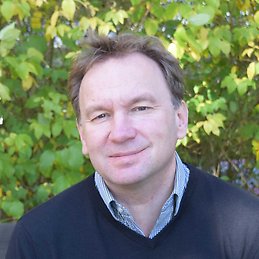
Attila Szabo Affiliated researcher
Contact
Name and title: Attila SzaboAffiliated researcher
Workplace: Department of Special Education Länk till annan webbplats.
Visiting address Albanovägen 28
Postal address Specialpedagogiska institutionen106 91 Stockholm
About me
I hold a PhD and serve as a Senior Lecturer at the Stockholm Education Administration and as an affiliated researcher at the Department of Special Education, Stockholm University.
My research focuses on gifted education, particularly on mathematical giftedness, mathematical problem solving and aspects of pre-service teacher education. I am also author of a mathematics textbook series for Swedish secondary school.
I am a member of the Swedish Institute for Educational Research’s governing board and the Scientific Advisory Board of the Global Center for Gifted and Talented Children. I am also a member of the Swedish Committee for Mathematics Education (SKM) and the International Committee of the International Group for Mathematical Creativity and Giftedness (igMCG).
I currently serve as assistant supervisor to Diana von Börtzell-Szuch and Hannah Holmqvist Mohammed, doctoral students in the GiftED Research School.
Westling Allodi, M., & Szabo, A. (2026). Current developments in gifted education: Sweden. In V. Margrain & K. Tirri (Eds.), Nordic perspectives on gifted education (pp. 91–110). Stockholm University Press. https://doi.org/10.16993/bdo.f
Brandl, M., Benölken, R., & Szabo, A. (2026). Technology-driven innovations to improve marginalized students’ access, engagement, and learning outcomes in mathematics: Digital interactive mathematical maps, digital revolving doors and Intize. In E. Ampadu, Z. Jojo, E. Hartell, G. Sunzuma, & F. S. Mensah (Eds.), Mathematics for all: Bridging the gap for underprivileged and gifted learners (pp. 281–299). Springer. https://doi.org/10.1007/978-3-032-22072-1_13
Brandl, M., & Szabo, A. (2026). Challenging deconstruction of signs by iconoclasm as a motivational aspect for the mathematically gifted and creative personality: A theoretical consideration and hypothesis [Conference presentation]. Gesellschaft für Didaktik der Mathematik (GDM), Wuppertal, Germany.
Westling Allodi, M., von Rosen, T., & Szabo, A. (2025, June). How is the Swedish educational system doing for the academically successful students? How many of these students are resilient? Analyses based on data from PISA 2022 [Poster presentation]. European Council for High Ability (ECHA), Karlstad, Sweden.
Brandl, M., & Szabo, A. (2024). Digital learning environments to support autonomous learning processes of mathematically creative and gifted students. In M. E. Auer, U. R. Cukierman, E. Vendrell Vidal, & E. Tovar Caro (Eds.), Towards a hybrid, flexible and socially engaged higher education: Proceedings of the 26th International Conference on Interactive Collaborative Learning (ICL 2023) (pp. 198–205). Springer.
Szabo, A., Tillnert, A.-S., & Mattsson, J. (2024). Displaying gifted students’ mathematical reasoning during problem solving: Challenges and possibilities. The Mathematics Enthusiast, 21(1–2), 179–202. https://doi.org/10.54870/1551-3440.1623
von Börtzell-Szuch, D., Westling Allodi, M., & Szabo, A. (2024). Students with advanced literacy skills and related literacy instruction. Gifted and Talented International, 39(2), 137–161. https://doi.org/10.1080/15332276.2024.2425847
Sjöstrand, T., Niklasson, J., Kyprianou, C., Szabo, A., & Andrews, P. (2023). Do linear equations act as a gatekeeper to later mathematical learning? Evidence from a study of Swedish upper secondary students. In P. Drijvers, C. Csapodi, H. Palmér, K. Gosztonyi, & E. Kónya (Eds.), Proceedings of the Thirteenth Congress of the European Society for Research in Mathematics Education (CERME13) (pp. 660–667). Alfréd Rényi Institute of Mathematics and ERME. https://hal.science/hal-04418299/document
Fahlgren, M., Szabo, A., & Vinerean, M. (2022). Prospective teachers designing tasks for dynamic geometry environments. In Proceedings of the Twelfth Congress of the European Society for Research in Mathematics Education (CERME12). Bozen-Bolzano, Italy. https://hal.archives-ouvertes.fr/CERME12/hal-03747493v1
Kai-Larsen, E., Rimeslåtten, M., Szabo, A., & Andrews, P. (2022). Swedish students’ exploration of trigonometrical relationships: GeoGebra and protractors yield qualitatively different insights. In Proceedings of the Twelfth Congress of the European Society for Research in Mathematics Education (CERME12). Bozen-Bolzano, Italy. https://hal.archives-ouvertes.fr/CERME12/hal-03748397v1
Mellroth, E., & Szabo, A. (2022). Talented upper secondary students’ perception of online mathematical challenges. In S. A. Chamberlin (Ed.), On the road to mathematical expertise and innovation: Proceedings of the 12th International Conference on Mathematical Creativity and Giftedness (MCG 12) (pp. 311–313). University of Nevada, Las Vegas. https://d-nb.info/1268386723/34
Szabo, A., Vinerean, M., Fahlgren, M., & Sriraman, B. (2022). Prospective teachers constructing dynamic geometry activities in order to challenge gifted pupils. In S. A. Chamberlin (Ed.), On the road to mathematical expertise and innovation: Proceedings of the 12th International Conference on Mathematical Creativity and Giftedness (MCG 12) (pp. 265–271). University of Nevada, Las Vegas. https://d-nb.info/1268386723/34
Vinerean, M., Szabo, A., Fahlgren, M., & Sriraman, B. (2022). Prospective teachers constructing dynamic geometry activities for gifted pupils: Connections between the frameworks of Krutetskii and van Hiele. Gifted Education International, 38(2), 273–294. https://doi.org/10.1177/02614294211046544
Szabo, A., Vinerean, M., & Fahlgren, M. (2020). Surveying prospective teachers’ conceptions of GeoGebra when constructing mathematical activities for pupils. In A. Donevska-Todorova, E. Faggiano, J. Trgalova, Z. Lavicza, R. Weinhandl, et al. (Eds.), Proceedings of the Tenth ERME Topic Conference (ETC 10) on Mathematics Education in the Digital Age (MEDA) (pp. 131–132). https://hal.archives-ouvertes.fr/hal-02932218
Brandl, M., & Szabo, A. (2019). Overexcitability, iconoclasm and mathematical creativity and giftedness. In M. Nolte (Ed.), Proceedings of the 11th International Conference on Mathematical Creativity and Giftedness (pp. 53–58). Hamburg University.
Misfeldt, M., Szabo, A., & Helenius, O. (2019). Surveying teachers’ conception of programming as a mathematics topic following the implementation of a new mathematics curriculum. In U. T. Jankvist, M. van den Heuvel-Panhuizen, & M. Veldhuis (Eds.), Proceedings of the Eleventh Congress of the European Society for Research in Mathematics Education (pp. 2713–2720). Utrecht University. https://hal.science/hal-02417074v1/document
Szabo, A. (2018). Creativity and giftedness: Interdisciplinary perspectives from mathematics and beyond, edited by R. Leikin and B. Sriraman [Book review]. Roeper Review, 40(4), 273–275. https://doi.org/10.1080/02783193.2018.1501646
Szabo, A. (2017). Mathematical memory revisited: Mathematical problem solving by high-achieving students. In T. Dooley & G. Gueudet (Eds.), Proceedings of the Tenth Congress of the European Society for Research in Mathematics Education (pp. 1202–1209). Dublin City University. https://hal.science/hal-01935805/document
Szabo, A. (2017). Matematikundervisning för begåvade elever: En forskningsöversikt [Mathematics education for gifted pupils: A systematic overview]. Nordic Studies in Mathematics Education, 22(1), 21–44. https://doi.org/10.7146/nomad.v22i1.148755
Szabo, A., & Andrews, P. (2017). Examining the interaction of mathematical abilities and mathematical memory: A study of the problem-solving activity of high-achieving Swedish upper secondary students. The Mathematics Enthusiast, 14(1), 141–160.
Szabo, A., & Andrews, P. (2017). Uncovering the relationship between mathematical ability and problem-solving performance of Swedish upper secondary school students. Scandinavian Journal of Educational Research. https://doi.org/10.1080/00313831.2016.1258671
Szabo, A. (2015). Mathematical problem-solving by high-achieving students: Interaction of mathematical abilities and the role of mathematical memory. In K. Krainer & N. Vondrová (Eds.), Proceedings of the Ninth Congress of the European Society for Research in Mathematics Education (pp. 1087–1093). Charles University. https://hal.science/hal-01287316/document