Research catalogue

Discover the research at Stockholm University through our pages for research subjects, projects and research groups!

They also lead you to our researchers profile pages, our departments and courses and programmes.

Refine
Research type

Research type

Status

Research areas

Research areas

Departments

Departments

Showing 201-220 of 2793 results

  • Baltic Sea Catchment

    Research subject

    Human activities contribute to a higher pollution load in the sea. Researchers at the Baltic Sea Science Centre study the transportation of different types of pollution, such as nutrients or hazardous substances, from land to sea.

  • Baltic Sea Fellows

    Research group

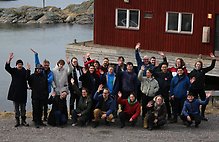
    The Baltic Sea Fellows are an interdisciplinary network of researchers at Stockholm University, investigating marine environmental challenges from multiple perspectives. Spanning multiple departments, they combine scientific expertise with policy insight to support sustainable ecosystem management.

  • Baltic Sea Observatory for coastal ecosystems and climate change

    Research project

    This research project is conducted within the CoastClim research group and brings together cutting-edge expertise in marine ecology, biogeochemistry and atmospheric physics to quantify the full spectrum of habitat-specific greenhouse gas fluxes and aerosol production in the Baltic coastal zone.

  • Baltic Sea Oceanography

    Research group

    The Baltic Sea is one of the best-surveyed and studied seas on Earth. Yet the Baltic Sea circulation and its role in the complex climate system is neither fully quantified nor understood, in spite of important implications for coastal societies of the Baltic Sea region.

  • Baltic Sociolinguistics

    Research subject

    Latvian and Lithuanian are official EU-languages in Latvia and Lithuania, respectively. These languages are spoken both as first and second languages among the populations of each country.

  • Basic olfactory terms: towards a universal semantic space of odors

    Research project

    In order to determine whether there is a “universal” olfactory-semantic space, this project investigates semantic differences and similarities between vocabularies used to describe odors in culturally diverse languages.

  • BatMapper: using citizen science in bat research

    Research project

    BatMapper is a citizen science project to capture information on bats and their roosting locations in Sweden.

  • Bats and Landscape Ecology

    Research group

    Our research focuses on the climatic and landscape processes that govern bat populations.

  • Bayesian Inference

    Research subject

    Bayesian statistics is the formal process of updating beliefs about uncertain quantities in light of new data. The uncertainty is quantified by subjective probabilities, leading to a natural and practical way to make predictions and optimal decisions under uncertainty.

  • Bayesian methods for general time-varying parameter models with global-local shrinkage process priors

    Research project

    Time series data are among the most common data types in all sciences. This research project develops new models and computationally efficient methods for time series models where the data generating process changes over time.

  • Becoming a Student : A Genealogy of the Normalizing Conditions at School Entry

    Research project

    Starting school is a major change where the child becomes a student and part of school life. This brings not only a new daily reality but also new expectations about how the student is and should be. This dissertation examines how Swedish compulsory school shapes ideas about the student and how this affects the individual’s opportunities.

  • Beginnings and endings in psychoanalytic psychotherapy

    Research project

    Beginnings and endings in psychoanalysis and psychoanalytic psychotherapy: A multi-center case-control study within the anaclitic-introjective personality continuum – Swedish arm.

  • Behavior Analysis and Autism in Higher Education, 2nd International Summit and Conference

    Research project

    The prevalence of autism has increased at a much higher rate than any other disability and is estimated to be approximately 1 in 54

  • Behavioural Economics

    Research subject

    Behavioral economics introduces ideas from the field of psychology into conventional economic analysis.

  • Belen Martin-Matute group

    Research group

    Our research focuses on the development of efficient and selective homogeneous and heterogeneous catalytic reactions for the construction of carbon-carbon and carbon-heteroatom bonds, with application to the late-stage functionalization of complex organic molecules.

  • Belowground beneficial and antagonistic microbes on perennial herbs

    Research project

    Plants are host to a wealth of microbes, both beneficial and antagonistic, and these may be found both on aboveground plant structures and in the roots.

  • Benefits, tensions and inconsistencies in the health and welfare system

    Research project

    The case of New Public Management in Swedish substance abuse treatment

  • Bengt Mannervik's research group

    Research group

    Enzymology is a cornerstone in the molecular life sciences. Rates of chemical reactions in cells and cellular signaling are governed by enzymes. It is becoming increasingly evident that enzymes are integral components of more wide-ranging molecular interactions such that the study of enzyme functions should be extended to their cellular context.

  • Berit Olofsson group

    Research group

    Our research is focused at development of sustainable organic synthesis through the use of hypervalent iodine chemistry.

  • Better, worse or no difference: police, private security guards and the policing of migrant youth

    Research project

    The aim with this project is to investigate the interaction in stigmatized areas between the police, private security guards and migrant youth. The focus is on questions related to crime and victimization, as well as the intersection between private and public control