


Research project A non-canonical role of POU/Oct proteins in regulation of mitosis, proliferation and cancer.
POU/Oct transcription factors are frequently implicated in cancer, yet the mechanisms by which they promote tumor cell proliferation remain incompletely understood.
Our recent work reveals an unexpected, non‑transcriptional role of class II POU/Oct factors (POU2F) in mitosis (Gohel et al, 2026). In Drosophila, loss of the POU2F homolog Nubbin (Nub) during the transcriptionally silent syncytial embryonic stages, causes severe mitotic defects, including mitotic spindle abnormalities, chromosome mis‑segregation, and reduced embryonic viability. These functions are independent of DNA binding and nuclear localization, demonstrating a direct role in mitotic regulation. Similarly, reduction of POU2F1/Oct1 in live human cells caused disorganized mitotic spindles, spindle collapse and the formation of multinucleated cells. The non-transcriptional mitotic roles of Nub and POU2F1/Oct1 reveal a previously unrecognized mechanism of POU/Oct proteins and provides new insight into their potential oncogenic properties.
Ongoing work is dedicated to understanding the molecular mechanisms underlying these mitotic functions, including the Nub paralog Pdm2, at both the transcriptional and non-transcriptional levels. By combining classical and molecular genetics with biochemistry, structure-function analyses, microscopy and live imaging we aim for a comprehensive view of the functional roles during mitosis. In addition, we will elucidate if these mitotic functions are evolutionarily ancient characters of POU2F/Oct factors, or rather analogous functions that have evolved independently in insects and mammals.
Keywords: Mitosis, Mitotic spindle, Chromosome segregation, POU/Oct factors, Cancer
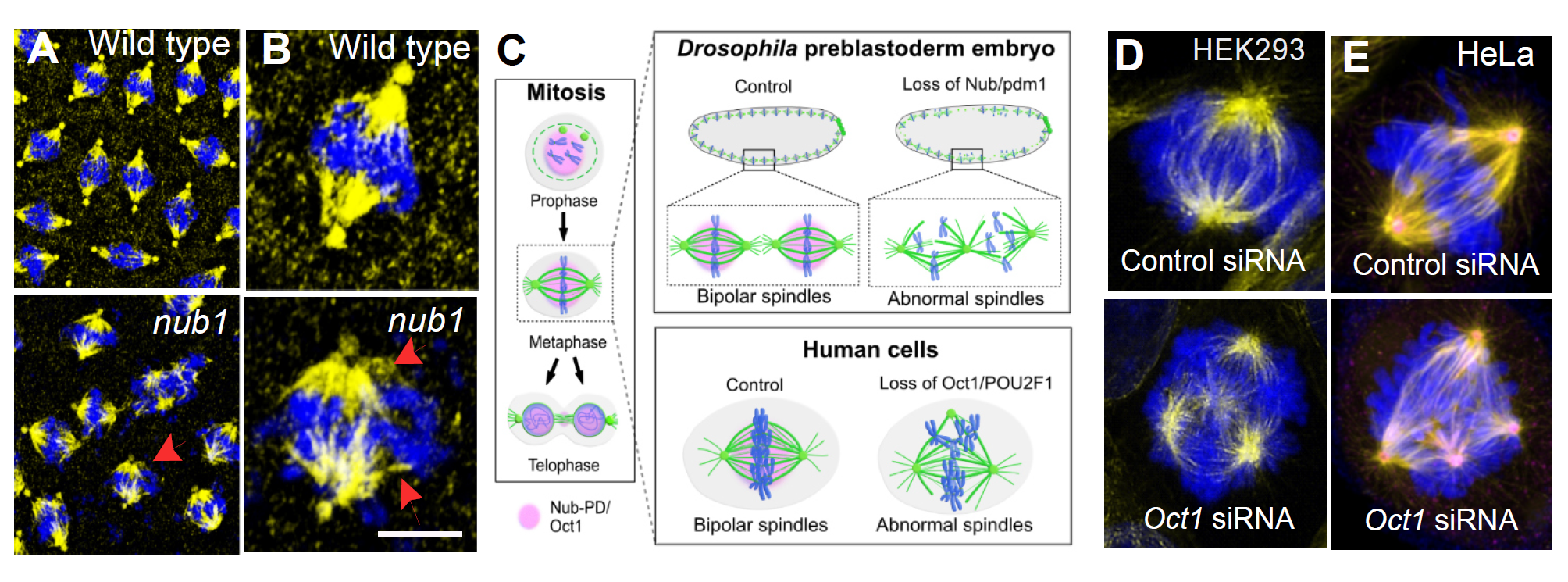
POU2F proteins play important roles during mitosis. A-B Mitosis in Drosophila mutant nub1 embryos shows detached microtubular bundles (red arrows) and multipolar spindles. C Schematic representation of abnormal mitoses due to lack of POU2F proteins. Nub and OCT1 localization in wt (magenta). D-E Loss of OCT1 in HEK293 (D) and in HeLa (E) cells leads to multipolar spindles and multinucleated cells.