


Research group AI-Enabled Digital Twins Research Group
We develop digital twins of buildings, patients and healthcare processes, and study how AI can improve their capabilities. We focus on twins that are explainable and support safe decisions, from reducing energy use to improving clinical care.
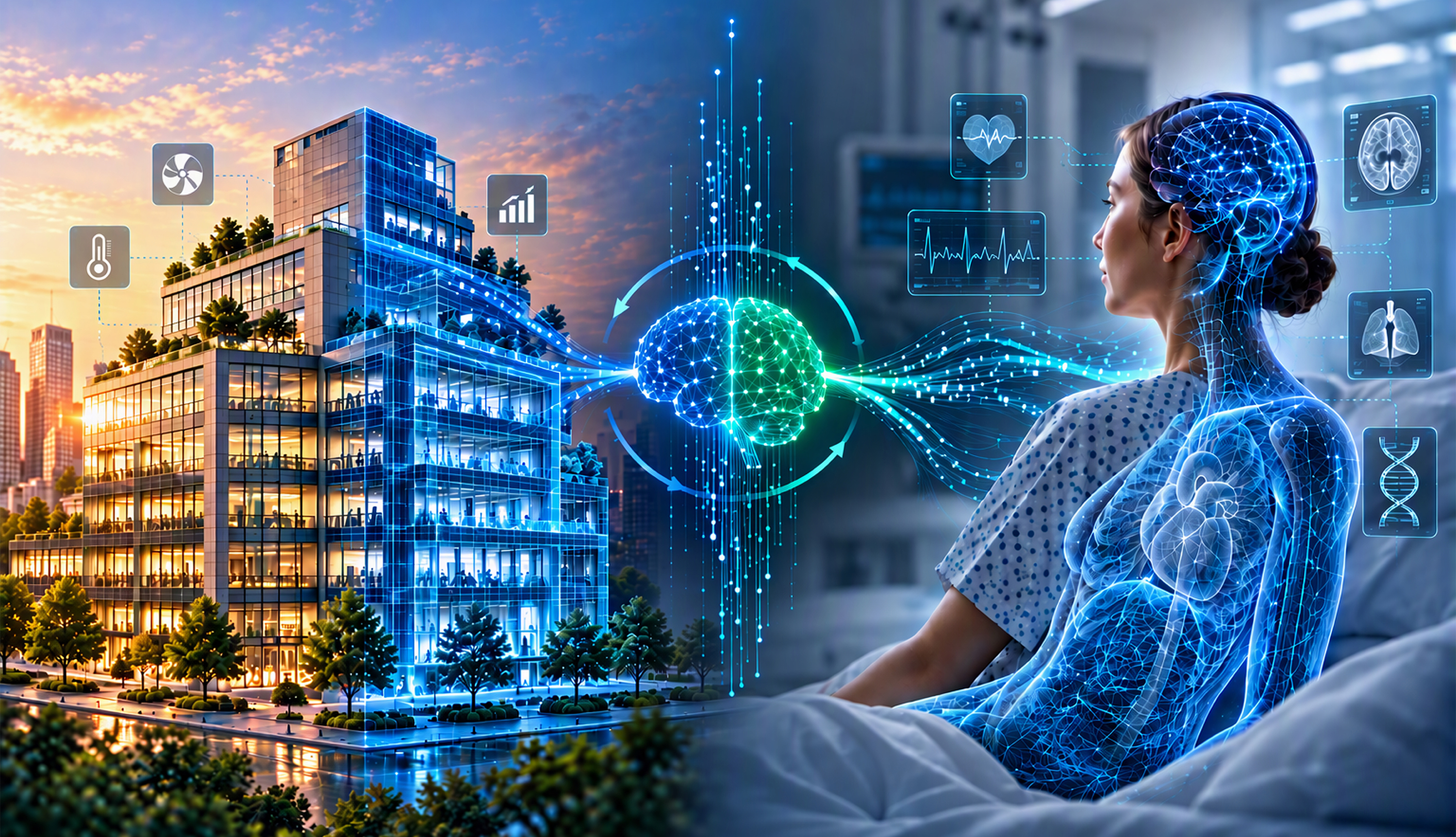
The AI-Enabled Digital Twins Research Group works at the intersection of digital twins and artificial intelligence, two of the key driving technologies of the fourth industrial revolution and of modern healthcare. We develop and study digital twins that represent, for example, smart buildings, patients, or healthcare processes, and how AI can strengthen them.
We approach digital twin engineering from a systems perspective: how digital twins are conceptualised, designed and developed. Drawing on the Department of Computer and Systems Sciences’ long tradition of systems engineering and development methods, our work includes modelling approaches, methods for deriving digital twin requirements and architectures from organisational and domain needs, and ways of aligning digital twins with the business processes and capabilities they support.
We also develop data science methods, especially for time-series and other sequential data, that strengthen the analytical capabilities of digital twins. These include forecasting the states and behaviour of a system, explainability of model outputs, counterfactual analysis, and detecting and managing outliers.
Our work is driven by real-world applications, such as reducing the energy consumption of a smart building, supporting safe clinical decision-making, reducing bottlenecks in a healthcare process, and improving industrial and organisational processes.
There are no research project connections.
Kreuzer, T., Papapetrou, P. and Zdravkovic, J. (2024).
Artificial intelligence in digital twins—A systematic literature review
Data & Knowledge Engineering, 151, 102304.
Kreuzer, T., Papapetrou, P. and Zdravkovic, J. (2024, September).
AI explainability methods in digital twins: a model and a use case
In International Conference on Enterprise Design, Operations, and Computing (pp. 3-20). Cham: Springer Nature Switzerland.
Kreuzer, T., Papapetrou, P. och Zdravkovic, J. (2025, June).
A Meta-model for Integrating Explainable Forecasting with Digital Twins
In International Conference on Advanced Information Systems Engineering (pp. 171-182). Cham: Springer Nature Switzerland.
Rugolon, F., Randl, K., Jovanovic, B., Miliou, I. and Papapetrou, P. (2026).
Multimodal Machine Learning for Early Prediction of Metastasis in a Swedish Multicancer Cohort
JCO Clinical Cancer Informatics, 10, e2500141.
Miri, N., Zdravkovic, J. and Jalali, A. (2026)
Towards Collaborative Process Twin Ecosystems
Accepted at 24th International Conference on Business Process Management (BPM 2026), Workshop on Futures of Business Process Management, to appear.
Tsikonofilos, K., Bruyns-Haylett, M., May, H. G., Donat, C. K. and Kozlov, A. S. (2025).
Alterations in topology, cost, and dynamics of gamma-band EEG functional networks in a preclinical model of traumatic brain injury
Network Neuroscience, 9(3), 1013-1038.