Gulnara Tagirdzhanova Assistant Professor
Contact
Name and title: Gulnara TagirdzhanovaAssistant Professor
Workplace: Department of Ecology, Environment and Plant Sciences Länk till annan webbplats.
Visiting address Svante Arrhenius väg 20 A
Postal address Institutionen för ekologi miljö och botanik106 91 Stockholm
About me
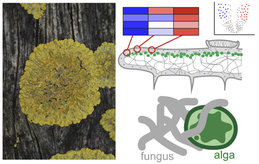
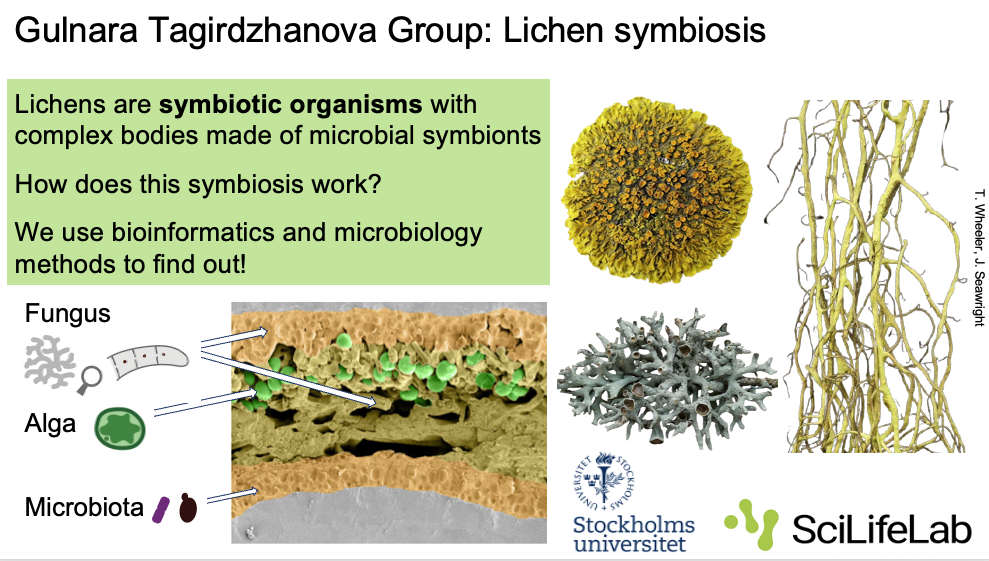
I am an Assistant Professor in the Department of Ecology, Environment and Plant Sciences, where I study fungal-algal symbioses, known as lichens. How is it possible that multiple microbes - fungi, algae, bacteria - self-assemble into a lichen, which is big, complex, and three-dimensional? How can symbiotic interactions lead to a stable body plan? How do lichen architectures develop and grow? To address these questions, I use meta-omics, microscopy, and cell biology tools. My ultimate goal is to study lichen symbiosis as a case of complexity arising in evolution. Previously, I was a postdoc at Johannesson group in DEEP and Nick Talbot’s group in The Sainsbury Lab (Norwich, UK). My PhD is from the Symbiosis & Evolution Lab at the University of Alberta (Canada).
INTERESTED IN A MASTERS PROJECT? I'm looking for a MSc student for a project in lichen biology. I have several potential projects to choose from, see more under the 'Teaching' tab
MSc projects in lichen biology:
Two of several possible MSc projects are:
1. Diversity of viruses associated with lichens explored using metagenomics.
Lichens are home to a giant diversity of organisms, most of the under-exlored. In this project, you will screen massive amounts of metagenomic data in order to study the most neglected component of this biodiversity: viruses. Apply if you want to learn more about data-driven research works in biology. The project relies on bioinformatics. Prior skills with a programming language (preferably R) and Unix command line are a plus.
2. Symbiont recognition explored using co-culturing of lichen symbionts.
For many lichens, the symbiosis is re-established every generation. A spore of the fungal symbiont and the anicellular alga need to find each other and establish contact. How does it work? In this project, you will work with cultures of the fungus and the algae and apply microscopy to learn more about this process.
The group is based in DEEP and in SciLifeLab campus Solna. To learn more about the lab visit https://metalichenlab.github.io/.
Contact me: gulnara.tagirdzhanova@su.se
The group is based in DEEP and in SciLifeLab campus Solna. To learn more, visit our home page metalichenlab.github.io/) or our SciLifeLab page].
Selected publicatons
Tagirdzhanova G., Scharnagl K., … & Talbot N. J. 2025. Complexity of the lichen symbiosis revealed by metagenome and transcriptome analysis of Xanthoria parietina. Current Biology 35(4): 799–817.
Tagirdzhanova G., Brown N. E., … & Talbot N. J. 2026. Tangerine: a new family of Starships from lichen-forming fungi. PNAS 123(33): e2534402123.
Tagirdzhanova G., Raistrick J., Talbot N. J. 2026. Chromosome-level genome assembly of the photobiont microalga Trebouxia sp. ‘A48’ from the lichen Xanthoria parietina. New Phytologist 249(2): 1036-1052.
Tagirdzhanova G., Saary P., … & Spribille T. 2024. Microbial occurrence and symbiont detection in a global sample of lichen metagenomes. PLOS Biology 22(11): e3002862.
For the full list visit lab home page and the Google Scholar profile