


Research project Complexity emerging from microbial interactions: understanding lichen symbiosis through spatial multi-omics
How do lichens create complex, highly organised structures from communities of microscopic organisms? This project investigates how fungi, algae, bacteria, and other symbiotic partners coordinate their growth to form stable lichen bodies with specialised structures and functions.
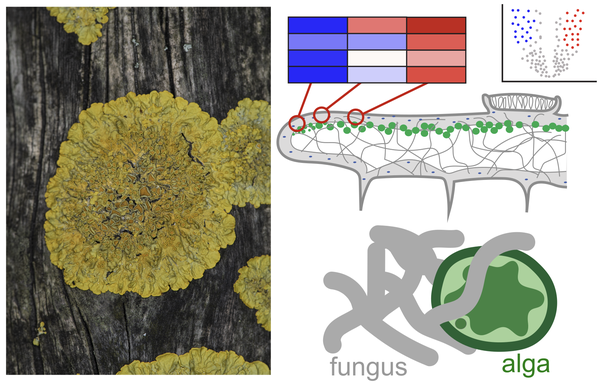
Left: Xanthoria parietina lichen. Right: schema of cross-section through a lichen showing the cells of the two main symbionts. Illustration: Gulnara Tagirdzhanova
Lichens are remarkable biological systems in which multiple microorganisms live and function together as a single, organised entity. Despite their ecological importance and structural complexity, the mechanisms that enable these symbiotic partners to coordinate their growth and development remain poorly understood.
Using advanced spatial genomics and transcriptomics, this project will map the genetic and functional characteristics of cells across different parts of lichen bodies. The research will examine how specialised “tissues” form, how reproduction and genetic diversity are organised within lichens, and how patterns of gene expression change during growth and development. By uncovering the mechanisms that enable lichens to achieve complex multicellularity and division of labour, the project will provide new insights into how biological complexity emerges through cooperation between different organisms.
Symbiotic organisms known as lichens can be viewed as an alternative path to multicellularity. Lichens present a unique case of complex and stable architectures emerging from interactions between multiple symbionts: a hyphal fungus, unicellular algae, and, in many cases, yeasts and bacteria. In isolation, all of these might be considered microorganisms. Within a lichen, however, the symbionts coordinate their growth, leading to a consistent body plan with multiple ‘tissue’ types and conserved structures. The mechanisms of these microbe-microbe interactions remain largely unknown. Here, I propose to study lichen architectures using spatially-resolved genomics and transcriptomics.
In order to understand how complex multicellularity with apparent division of labor is achieved by the lichen symbionts, the project will map how the genetic and functional profiles of cells vary between different ‘tissues’ and different parts of a lichen body.
The project uses genomic data to test whether a single lichen body can consist of multiple individuals of the fungal symbiont and study sexual reproduction by mapping genotypes from different parents. Transcriptomic data eill br used to identify functional gene groups involved in creating ‘tissues’ in lichen bodies.
The project will examine the dynamics of lichen growth by tracking changes in gene expression from the older more central to the younger more marginal parts. This will contribute to the understanding how complexity emerges in biology more broadly.