


COP31: Why it’s important to see the glass half full in the climate gloom
Expectations for COP31 are low, and frustration is high that emissions aren’t falling fast enough. But the international climate negotiations have delivered more than many realize, say two researchers at Stockholm University. The big problem, they argue, isn’t lobbyists but states whose economies run on oil.
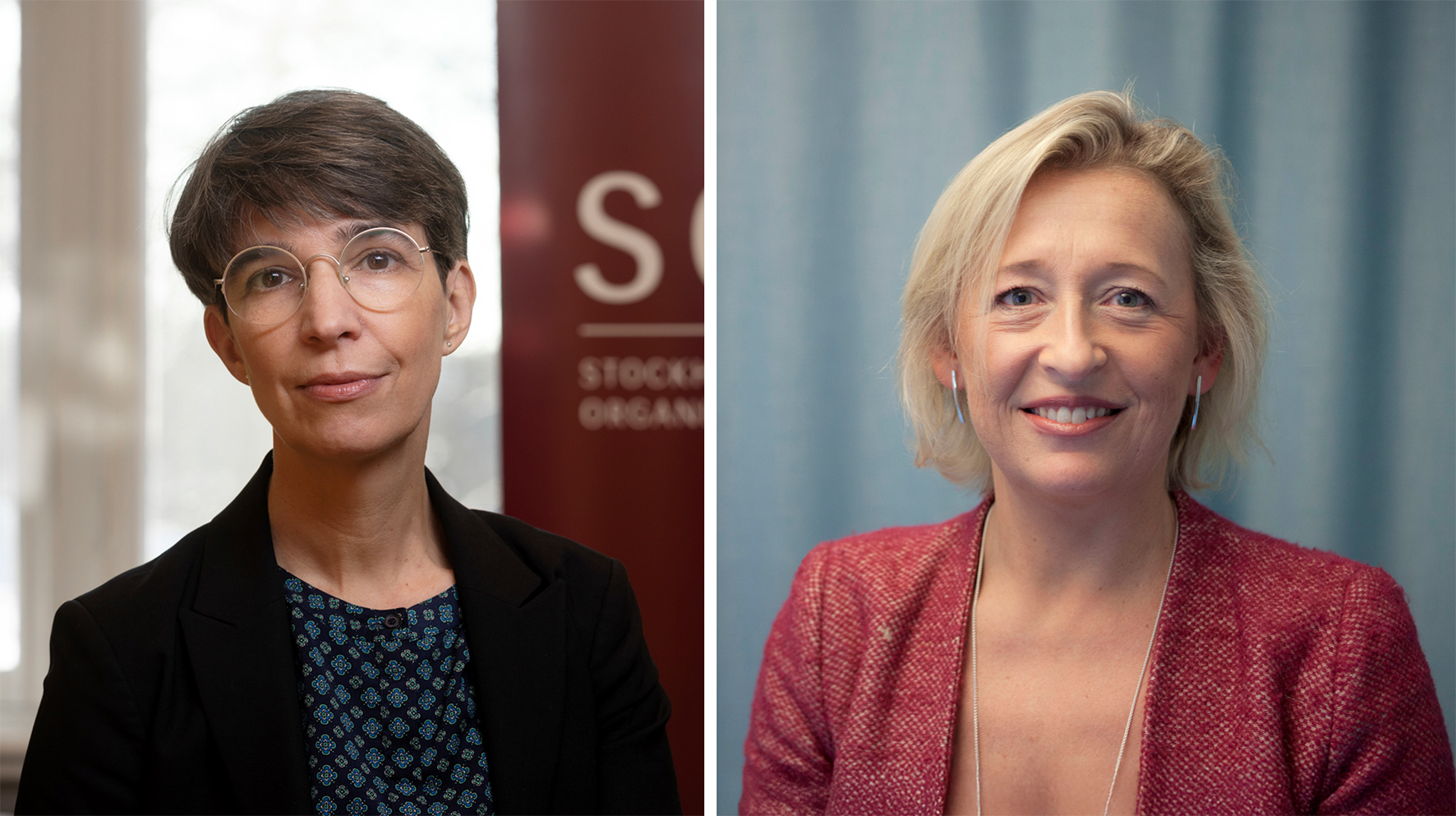
Adrienne Sörbom and Karin Bäckstrand research international climate policy. COP31 runs from 9 to 20 November in Antalya, Turkey. Photo: Rickard Kilström and Sara Moritz.
In one sense, the COP process has failed. Despite all the meetings and effort, emissions are not falling at the pace climate science says is needed to meet the two-degree target.
But it is also possible, and important, to see the glass as half full, say Karin Bäckstrand and Adrienne Sörbom, two of Sweden’s leading experts on international climate policy.
“For 30 years we’ve been negotiating and refining an international rulebook. States do have voluntary commitments under it, but as a result we’ve seen an explosion of national climate legislation. If we hadn’t had this framework and built up this infrastructure, and brought more and more countries on board, now just over 190 states, we’d be in a much worse place,” says Karin Bäckstrand, professor of environmental social science, who has studied international climate efforts since the late 1990s.
Adrienne Sörbom, a professor who researches global politics with a focus on climate, and who has attended many COP meetings herself, agrees.
“In a way, it’s remarkable how far we’ve come. The Paris Agreement, concluded at the 2015 COP, was a huge achievement. It isn’t just a formal agreement. It has also helped bring down emissions and future risks. And it works, in the sense that countries are now doing what the agreement says they should do: collecting data and evaluating progress. Of course, we need to do much more. Implementation of the Paris commitments is still lagging behind.”
The danger of giving up
Adrienne Sörbom says there is a risk in focusing only on the difficulties of recent years, when climate action has met resistance in several countries. That can breed resignation and a loss of faith that a transition is possible, which could play into the hands of fossil fuel interests.
“Things aren’t really moving as slowly as they’re made out to be. There’s something in the logic of the media that makes it focus heavily on the problems. At bottom, these are enormously big issues, where countries have to change their entire economies and infrastructures. Of course it’s hard.”
Karin Bäckstrand stresses that the goals and ambitions are in place. That is crucial, even if the road ahead is full of obstacles.
“The biggest challenge in climate action is no longer agreeing that climate change has to be tackled, but rapidly delivering the sweeping societal changes that are required. Today, 80 percent of the world’s countries effectively have net-zero emissions plans. Yes, these are plans that haven’t yet been fulfilled, but the first step in managing a transition, and political science research shows this, is to set an ambition and a goal. Turning goals into action then comes down to political will, to funding, and to addressing the fair distribution of costs and responsibility.”
Who is holding back the transition?
COP meetings are sometimes portrayed as a place full of oil-funded lobbyists who want to undermine science and sink agreements. Sörbom, who has researched the role of advocacy organizations at COP, doesn’t share that picture.
“There are a great many advocacy organizations at COP, and my view is that the majority of them have a strong drive to solve the problems. It’s hard to be at COP if you don’t talk about green transition, even if you’re an oil company. Inside COP, everyone has to accept climate science. Otherwise it simply doesn’t work. The difficulties lie more in the fact that perspectives and needs are so different.
“Advocacy organizations have taken on an important role at COP in building bridges between actors and interests, and in working to ensure there is an agreement at all, even if that is sometimes motivated by what benefits their own business.”
So who is mainly holding back the negotiations and the phase-out of fossil fuels? Sörbom’s answer is unequivocal.
“It’s the states that rely on oil as their main source of income. Countries like the US, Brazil, Russia, several OPEC members, and also Norway, are not primarily interested in phasing out fossil fuels. And these actors essentially don’t need to lobby, because they’re sitting at the negotiating table themselves. We have to be able to acknowledge that this is the big problem in the climate negotiations.”
Bäckstrand shares that view.
“Oil, coal and natural gas remain economically vital resources for many countries, and that stands in the way of phasing out fossil fuels. What’s more, much of the world’s fossil resources are located in authoritarian states.”
Challenges ahead of COP31
When COP31 opens on 9 November, the meeting will be shaped by several challenges, says Karin Bäckstrand. But there are ways forward too.
“A fundamental problem is that the world still depends on fossil fuels for 80 percent of its energy. Many developing countries, South Africa for example, want to make the transition but still need to use fossil energy because they haven’t yet developed alternatives. We can’t simply demand that these countries stop using fossil fuels immediately.”
The solution, according to Bäckstrand, is to give developing countries better access to green technology. That could happen through more climate finance, more green investment, and technology agreements and partnerships, all of which would speed up the rollout of renewable energy worldwide.
“Climate aid is an area where Sweden has been a leader, and it’s very important that we keep that up going forward.”
Industrialized countries, too, need to move fast. For them, it’s about going from pledges and targets to actual delivery.
“Sweden is to be fossil-free [net-zero emissions] by 2045 and the EU by 2050. To achieve that, we need clear roadmaps. We need stronger national legislation, stronger policy instruments, more investment in green industry, fair solutions, and clearer follow-up, if we are to break free of our dependence on fossil fuels.
“In recent years we’ve seen a backlash on climate, and opposition to ambitious climate policy has grown. Going forward, it will be very important to build broad public support by showing that climate policy can be both smart and fair.”
At the same time, there are dark clouds that can’t be ignored, Bäckstrand notes.
“The growing geopolitical tensions we see today, with wars, trade conflicts, protectionism and also competition over green technology, make the vital cooperation on climate more difficult.”
She is also worried about developments in the US under Trump.
“The two years since Trump was re-elected have been a real low point for international climate action. The US has left the Paris Agreement and has also announced its withdrawal from the UN Framework Convention on Climate Change, the UNFCCC. That means a total retreat by the second-largest emitter, which is also a country with enormous technological innovation for the green transition. It’s of course very negative that such a major player is pulling out of global cooperation.”
Bright spots give hope
At the same time, Bäckstrand sees signs that give her hope for international climate action.
“We’re now seeing a complete explosion in the growth rate of renewables. Many countries realize there’s an enormous competitive advantage in being at the front of the global green race. China, for example, has for several years been investing heavily in exporting fossil-free electrification and electric vehicles.”
She also points out that the costs of climate change and fossil dependence are becoming ever clearer, which will hopefully strengthen the incentives for a faster transition.
“Many countries are now feeling the effects of climate change in the form of wildfires, loss of life, damaged infrastructure and lost GDP. Russia’s full-scale invasion of Ukraine and the wars in the Middle East have also shown the risk and vulnerability that fossil dependence entails.”
Climate work within the UN
The UNFCCC is the UN Framework Convention on Climate Change. Adopted in 1992, it now has almost every country in the world as a party. The convention is the foundation of international climate cooperation, and both the Kyoto Protocol and the Paris Agreement build on it.
COP stands for Conference of the Parties. It is the annual summit where the countries that have joined the UNFCCC negotiate climate policy. The first was held in Berlin in 1995, and the Paris Agreement was reached at COP21 in 2015.
The IPCC is the UN’s climate science panel, the Intergovernmental Panel on Climate Change. Established in 1988, it compiles research on climate change, its impacts and possible responses. The IPCC doesn’t conduct its own research but reviews thousands of scientific studies. Its reports serve as a basis for the climate negotiations.
Last updated: 2026-11-04
Source: Communications Office