


Lignin-based materials that purify water and capture carbon dioxide
Each year, the world’s pulp and paper industry burns around 70 million tons of a by-product – lignin. Wallenberg Academy Fellow Mika Sipponen wants to put lignin to better use: as a base for new living materials. Microorganisms in them can help to purify water and capture carbon dioxide.
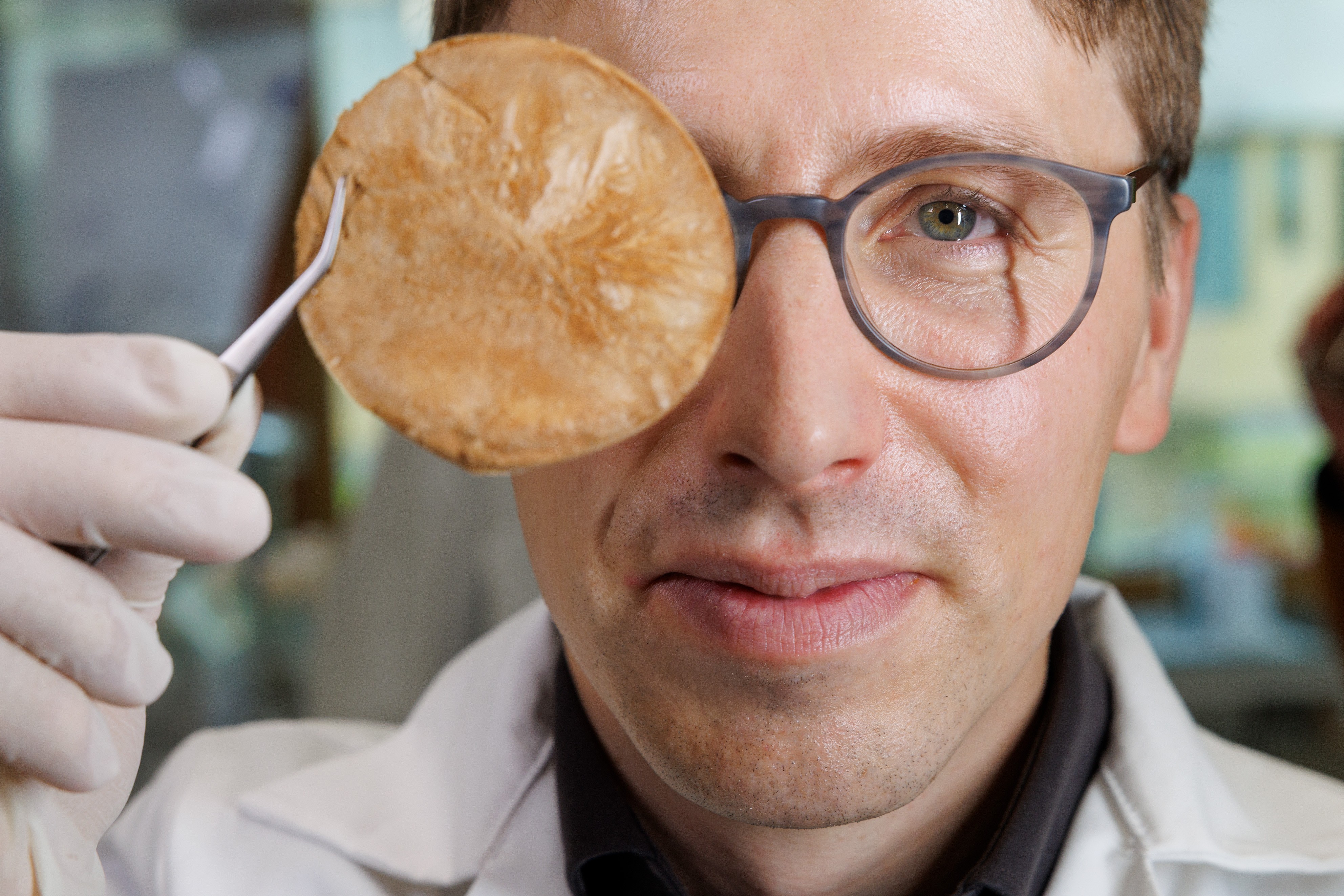
Chemist Mika Sipponen searchs for new uses for the residual product lignin from the forest industry. Photo: Magnus Bergström/KAW
When Mika Sipponen was a doctoral student at Aalto University in Finland, he worked on developing new methods of separating lignin from biomass. The aim was to lay the foundation for more sustainable development of biofuels. But he could not let go of the idea that lignin could be used in some way.
“For me the holy grail was to find an application where lignin could be used as a raw material. That’s why I started experimenting,” he says.
Complex molecule
Lignin is a highly complex molecule found in the cell walls of trees and plants, giving them structural strength. At present, lignin is a by-product in the wood and pulp industry and is mainly used as fuel to provide energy for pulp mills. But the molecule has several properties that offer potential for new applications – and it is completely biodegradable. The rigid lignin can absorb ultraviolet light, has antioxidant properties and is biocompatible with many microorganisms.
These properties make lignin perfect as a basis for “living hybrid materials,” which combine living microorganisms with polymers to form a new type of material with properties from both the organisms and the polymer structure.
“Most current living hybrid materials are based on synthetic polymers that are not biodegradable and are developed using fossil resources. Lignin, by contrast, is extracted from biomass and is itself biodegradable, making it a better base from the outset,” says Mika Sipponen, now Associate Professor of Materials Chemistry at Stockholm University and Wallenberg Academy Fellow.
The microorganisms in the material have the potential to drive a range of chemical processes, such as breaking down various pollutants, but also capturing carbon dioxide or producing energy.
Read full article at the Knut and Alice Wallenberg Foundation web
Last updated: 2026-06-23
Source: Communications Office