


Master’s programme in Evolutionary Genomics
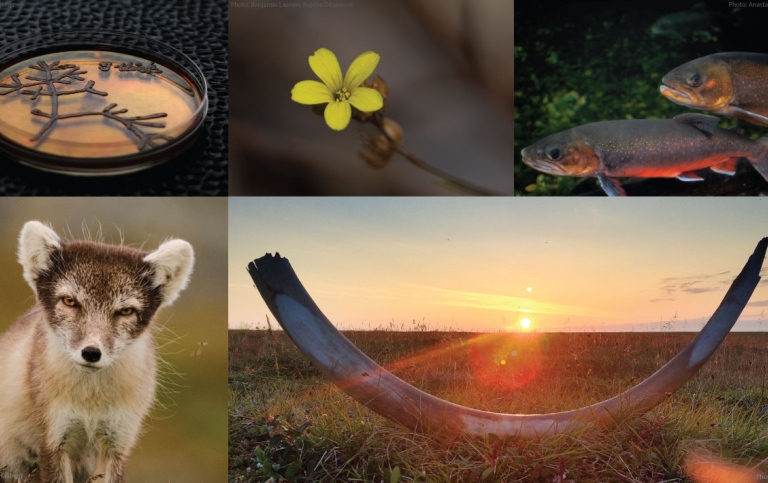
In the Evolutionary Genomics Master's programme you will learn how evolutionary processes shape genetic variation in natural populations across a wide range of organisms. The pictures illustrate the diversity of possible study organisms, ranging from yeast to wild plant and fish populations, to arctic fox and extinct woolly mammoths. Photo: Rike Stelkens, Benjamin Laenen, Aurélie Désamoré, Anastasia Andersson, Petter Hellberg and Love Dalén
Are you intrigued by the rapid growth of genomic data and want to explore the genetic variation at the level of DNA sequences? Are you interested in understanding the genetic differences between individuals, populations, or species? Do you want to learn bioinformatic tools to analyze DNA sequence data? This Master’s programme will provide the tools and knowledge to explore these questions through the analysis of genes and genomes.
You will receive training in:
- Population Genetics: You will study the genetic diversity within and between populations and learn how to analyze and interpret genetic variation (e.g. determine which genetic variants are beneficial, harmful, or neutral, or infer past population size changes from DNA sequence variation)
- Molecular Evolution: You will dive into how small differences in DNA, RNA, and proteins contribute to evolutionary processes.
- Phylogenetics: You will investigate the evolutionary relationships between species, populations, and genes, building phylogenetic trees to understand these connections.
- Genome Evolution: You will explore larger, structural changes in genomes over time, understanding how entire genomes evolve and what drives these changes.
- Paleogenetics: You will study the evolutionary past of our planet by investigating of preserved genetic material from the remains of ancient organisms.
Knowledge of evolutionary genomics has applications beyond the scientific world. In the programme, you will gain skills needed in many different professions. For instance, after completion of this programme, you may work with wildlife agencies to study genetic diversity in endangered species or aid in breeding programs by managing and analysing genetic data. You can apply evolutionary theory to understand the impact of environmental changes on species and ecosystems, or how genomes evolve in response to climate change or human interference. You can also use your expertise to improve crop yields, pest resistance, or disease tolerance in agriculture through the study of evolutionary genomics.
Reasons to choose the Master's Programme in Evolutionary Genomics:
- Broad education in evolutionary genomics suitable for diverse careers in biotechnology, bioinformatics, medicine, forensics, agriculture, food security, and wildlife conservation.
- Excellent opportunities to gain hands-on experience in both experimental and computational research
- A flexible programme that allows you to tailor your studies to your interests and career goals
The compulsory courses within the Master’s programme in Evolutionary Genomics will give you a strong foundation in evolutionary biology, genetics, statistics, and bioinformatics. Specifically, the Master’s programme in Evolutionary Genomics includes courses in theory and practice of evolutionary genomics, hands-on exercises in DNA sequence analysis, advanced statistics for biologists, evolutionary ecology, and paleogenetics.
There is plenty of space within the programme to allow you to choose optional courses, so you can pursue a programme adapted to your interests and career aims. You can include at least 15 credits of optional courses, and these can be in other subjects or taken at another university.
During the compulsory independent project, the degree project, you will apply the knowledge and skills you have developed in conducting a scientific study within evolutionary genomics.
Year 1
Year 2
Compulsory courses
Degree project in Evolutionary Genomics
(instructions apply to all degree projects at the department)
Optional courses depending on scope of degree project
Independent project
Degree projects, which are 30, 45 or 60 credits, are carried out within ongoing research projects at either the Department of Zoology or Department of Ecology, Environment and Plant Sciences. It is also possible to conduct the degree project externally, at a research institute, organisation, or company.
Examples of possible degree projects
- Testing for the effect of extreme temperature events (e.g. repeated heat waves) on population survival, and resolving the genetic basis of adaptation, using experimental evolution and whole genome sequencing with yeast
- Population genomic responses to soil warming in Icelandic Arabidopsis lyrata – Geothermal soil heating as a natural experiment to study adaptation to heat stress
- Understanding how environmental change has shaped the evolution and distribution of wildlife populations using DNA from ancient animal remains (e.g. cave lions, wolves, bears and woolly mammoths).
- Reconstructing phylogenetic relationships to resolve the evolutionary history of a species of extinct megafauna, using ancient DNA and palaeogenomic approaches
- Combining modern samples of bumblebees and samples from museum collections to study how populations adapt to human-induced environmental change (agriculture and pesticide use).
The Master's programme in Evolutionary Genomics is only open for application in the first round, with deadline for applications in mid-January.
Specific eligibility
This programme requires previous university-level studies in specific subject areas. Read more about the entry requirements and see examples of academic backgrounds that typically meet them.
Selection process
Applicants that meet the eligibility requirements are ranked based on their merit rating. Only students with the highest merit ratings are selected for our programmes. The merit rating is based on the following four selection criteria, with equal weight:
- relevance of previous studies in relation to the programme
- grades of academic courses
- motivation letter
- research ideas
Required supporting documentation
To submit your motivation letter and research ideas you must use our cover letter form (updated yearly, only latest version accepted).
Note! The form is only available during the application period, up to the supporting documentation deadline.
After submitting the form, download the generated PDF. Do not make any changes to the resulting PDF!
To be considered your cover letter must be uploaded to you application at University Admissions before the supporting documentation deadline.
Recommendation letters and CVs are not considered.
A Master’s degree in Evolutionary Genomics opens up many career possibilities within academia or the public sector. On completion of this programme you will be eligible to apply for PhD studies. The programme also gives a sound background for work in the applied fields of biotechnology, bioinformatics, medicine, forensics, agriculture, food security, and wildlife conservation.


