


Strategic marine research environment
The Baltic Sea Centre coordinates Stockholm University’s strategic funds for Marine Environment Research. Since 2009, these funds have supported networks, infrastructure and interdisciplinary projects that have strengthened marine research across the entire university. It has also been anchored internationally in the strategic partnership with University of Helsinki.
ABOUT STRATEGIC RESEARCH AREAS
National Strategic Research Areas (SRA/SFO) is a government initiative, launched in 2009, aimed at providing leading research with the long-term conditions necessary to maintain high international quality.
In 2010, Stockholm University’s high-profile marine environment research (SU Marine) was designated a strategic research area and has since been awarded funding to both maintain and strengthen its quality.
2010-2014 Baltic Ecosystem Adaptive Management (BEAM)
Until the late 2000s, the strong marine community at Stockholm University was spread across departments with little coordination. A first step towards integration was the SRA funded research program BEAM, which investigated ecosystem-based management of the Baltic Sea environment. The program, involving three faculties and ten departments, focused on how five key areas interact: ecosystem function, eutrophication, hazardous substances, legislation and management, and climate change. The aim was to develop an interdisciplinary understanding of the Baltic Sea’s environment and management and to translate that knowledge into recommendations on how policymakers and managers can apply an ecosystem-based approach in practice.
The BEAM program was led by researchers at the former Department of Systems Ecology (now the Department of Ecology, Environment, and Plant Science) and an interdisciplinary steering committee, but the Baltic Sea Centre was responsible for its administration from its establishment in 2013.
In 2015, the program was successfully evaluated, leading to the establishment of a permanent strategic research area for Baltic Sea research at Stockholm University.
Read more about the members, projects and results of BEAM pdf, 1.3 MB.
2015: Baltic Sea Centre leads the coordination
After the evaluation of BEAM 2015, the Baltic Sea Center was assigned the coordination of the SRA. These—together with other funding sources—have enabled investments in research projects, infrastructure, and networks designed to strengthen the university’s entire marine research environment. The purpose has been to address the triple planetary crisis of climate change, biodiversity loss and pollution in coastal seas, and to convey the resulting science to society.
Stepwise, these initiatives have turned a strong but dispersed community into a coherent environment of 17 research fellows from seven departments and units, organised in four research themes:
- Ocean and Atmosphere Dynamics / Atmospheric Sciences, Marine Physics
- Biogeochemical Cycles and Land–Sea Interactions / Marine Biogeochemistry, Ecosystem Modelling
- Marine Ecosystems and Biodiversity / Marine Ecology
- Pollution, Regulation and Governance / Decision Support
2016: Increased interdisciplinary work at sea
During this interim year, strategic funding was directed toward fostering interdisciplinary research collaborations aboard the university’s newly built research vessel, the R/V Electra. The vessel has been carefully adapted to enable both basic and advanced sampling across multiple research fields, both far out at sea and in coastal waters.
Fully funded ship-time on R/V Electra was offered to all 300 marine researchers at Stockholm University, with the condition that at a project would involve researchers at least two departments. This resulted in 17 collaborative projects lead by six departments.
2017: A new generation of promising researchers – Baltic Sea Fellows
As a capacity building step for the university, the SRA was invested in early-career scientists that would constitute the core of the SRA-research environment with tenure-track positions designed as bridges between the Baltic Sea Centre (BSC) and another home department. The funding was a targeted intervention with two goals: building scientific excellence and conveying science to society in a new way.
Most of the grant went to scientific capacity, but a smaller yet significant share was used to continue and further develop the centre's policy and communication work. This working model connects researchers with decision-makers through regular dialogue, seminars and policy briefs timed to policy processes.
Most Fellows are based in a home department outside BSC and a few are based at the BSC. Nearly all work in both settings, combining departmental research, for instance on the Arctic, the cryosphere, hydrology, contaminants or law, with Baltic Sea research supported by the centre.
The Baltic Sea Fellows—who at the time consisted primarily of assistant professors, but also included associate professors and postdocs —have undertaken projects ranging from pure basic research to the development of knowledge that can be used to inform decision-making in Baltic Sea management and environmental legislation. Gradually, the network also expanded to include researchers primarily responsible for establishing new SFO initiatives, such as a Baltic Sea Observatory.
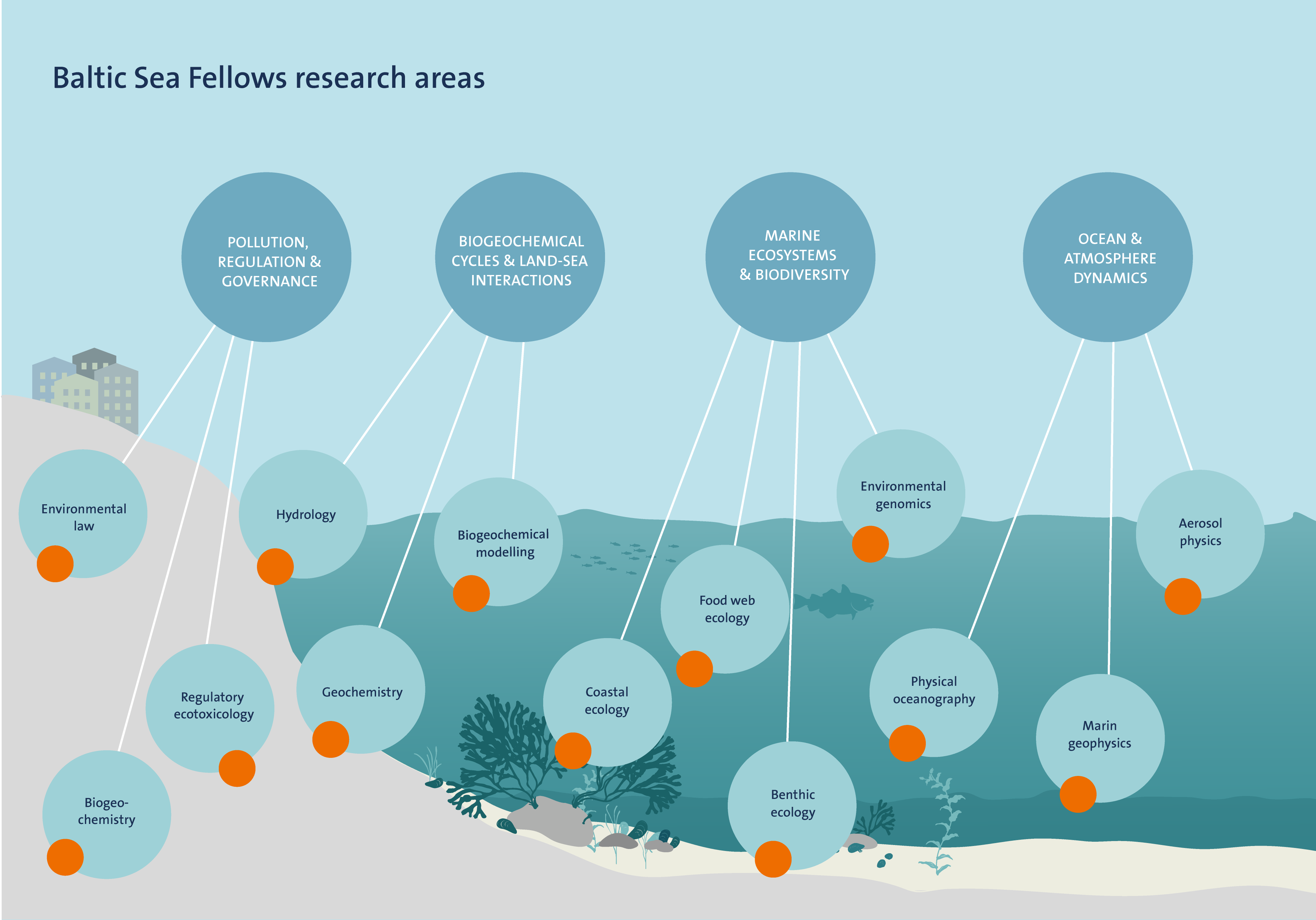
2018 the SRA funds were invested in research fellows from seven departments (JUR, IGV, NG, DEEP, MISU & ACES). Each orange dot represents a fellow. Illustration: Azote, modified version.
2021: CoastClim links sea and atmosphere
Stockholm University conducts internationally renowned research in atmospheric science, and significant efforts have been made to develop the infrastructure needed to conduct long-term, accessible, and quality-controlled observations of atmospheric processes.
When the Baltic Sea Center received a substantial infrastructure grant from the Swedish Research Council, this funding, together with SFO funds, was directed toward establishing a Baltic Sea Observatory for coastal ecosystems and climate change. This initiative, which enables a new method for measuring the exchange of gases and particles between the sea and the air, became an important complement to the existing infrastructure at the Askö Laboratory and the R/V Electra. The facility and its research capabilities have not only served as a bridge to more departments within the university but have also deepened the international collaboration CoastClim, where researchers at Stockholm University and the University of Helsinki are investigating the connections between climate and marine biodiversity.
A Baltic Sea Fellow with expertise in integrated measurements of greenhouse gases, aerosols, clouds, and trace gases at sea was recruited for the new atmospheric facility to establish, plan, and coordinate the daily work within CoastClim at Askö, R/V Electra and the Laboratory for Atmospheric Sciences at the Department of Environmental Sciences (ACES).
2022: Research school delve into coastal seas in a changing climate
Following successful performance and evaluations, all Baltic Sea Fellows were promoted and became fully integrated in their respective departments. Based on this, the Baltic Sea Center proposed a continuation of the network by establishing a graduate school with close ties to both the fellows and to CoastClim. The research areas for the doctoral students were developed by the BSC and BSF, ensuring alignment with the various departments. The ten doctoral students and the research school “Perspectives on Climate Change Science in Coastal Seas” were jointly announced and recruited by the departments.
The BSF members form a joint supervisory collegium and have all teached within their respective research areas. An additional non-fellow researcher from the Stockholm Business School joined the supervisor team, along with a doctoral student who was included in the research school. The research school welcomed other doctoral students within relevant fields, admitted during the same period. This led to seven additional doctoral students, funded externally by the departments.
In total, 17 doctoral students have joined this educational programme that cover seminars and summer schools on different ascpects of coastal-, climate- and societal issues. All components, from presenting the latest research to working with policy and communication aims to prepare them for careers in academia, public agencies and the private sector. Within CoastClim, there has also been a natural exchange between the doctoral students at Stockholm University and University of Helsinki.
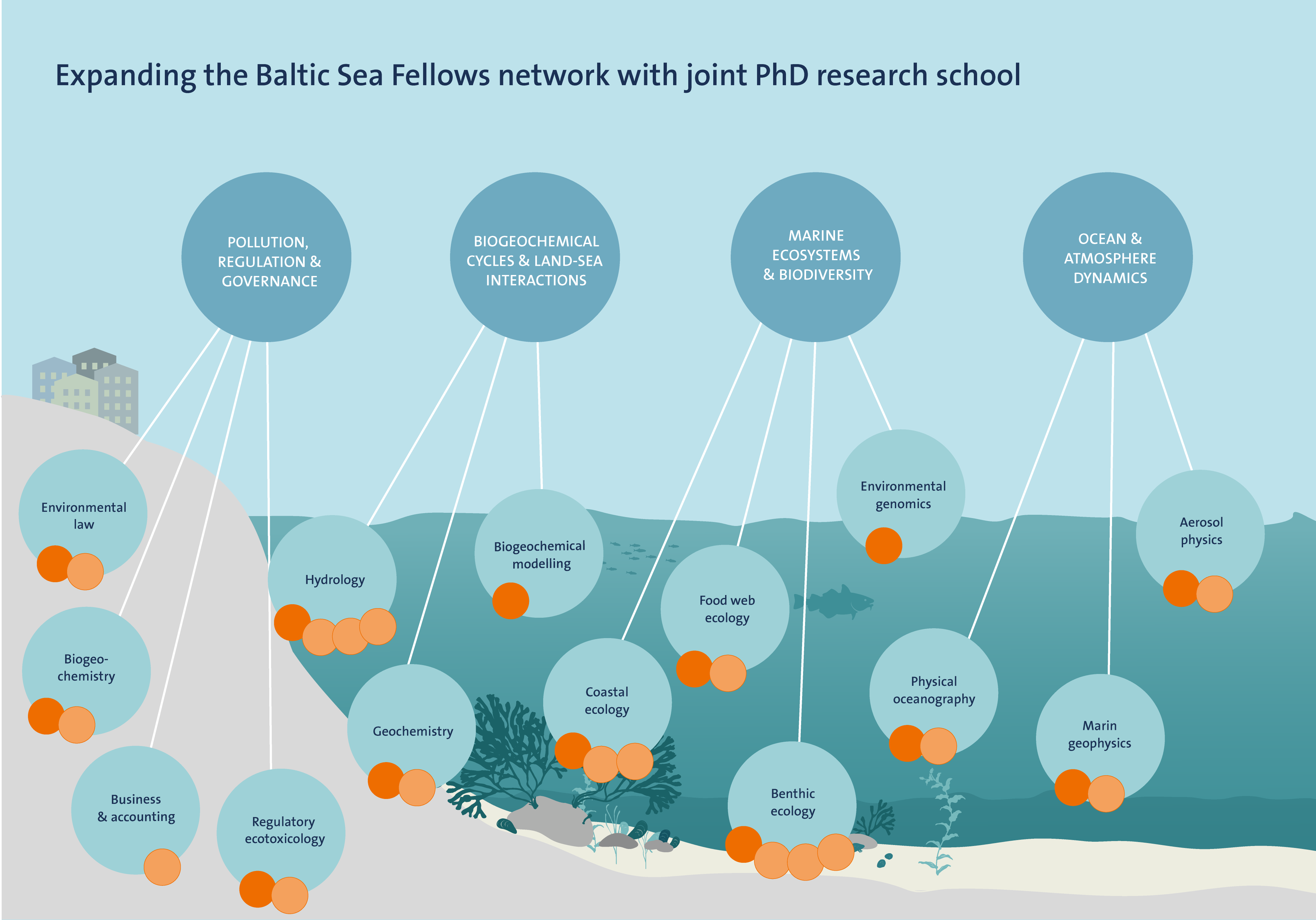
The establishment of the research school "Perspectives on Climate Change in Coastal Seas" is the research environment's main investment in doctoral education. Ten doctoral students funded by the SRA are employed by the departments. Seven more, funded externally, have joined, which give the school 17 students in all. Dark orange dots indicate supervising Baltic Sea Fellow, light orange dots indicate affiliated PhD student. Illustration: Azote, modified version.
2025: Microbes and large scale DNA-analyses provide clues
There is a major knowledge gap when it comes to understanding how microorganisms affect the Baltic Sea environment through the cycling of substances that, for example, influence eutrophication, oxygen levels, or the emission and uptake of greenhouse gases along the coast. In 2025, a senior scientis, specialized in metagenomics, was recruited to the fellows team through another external donation . This fellow is now building a molecular SeaLab at the Baltic Sea Centre together with two recruited postdocs. The team works har BSC as home base and does also work at SciLifeLab with studies on microbial activity using large-scale DNA analyses. Their focus is on understanding fundamental microbial processes in coastal ecosystems by combining expertise in ecology, biogeochemistry, bioinformatics, and omics.
Last updated: 2026-11-09
Source: Stockholm University Baltic Sea Centre