


Researchers: “Wait before increasing quotas until stocks show a sustained increase over time”
Scientific assessments that herring and sprat stocks are growing prompted EU fisheries ministers to agree on substantial quota increases for next year. If the ministers are serious about the EU’s policy objectives for fish stocks, they should have opted for lower quotas and taken greater account of scientific uncertainties, argue researchers and a policy officer at the Baltic Sea Centre.
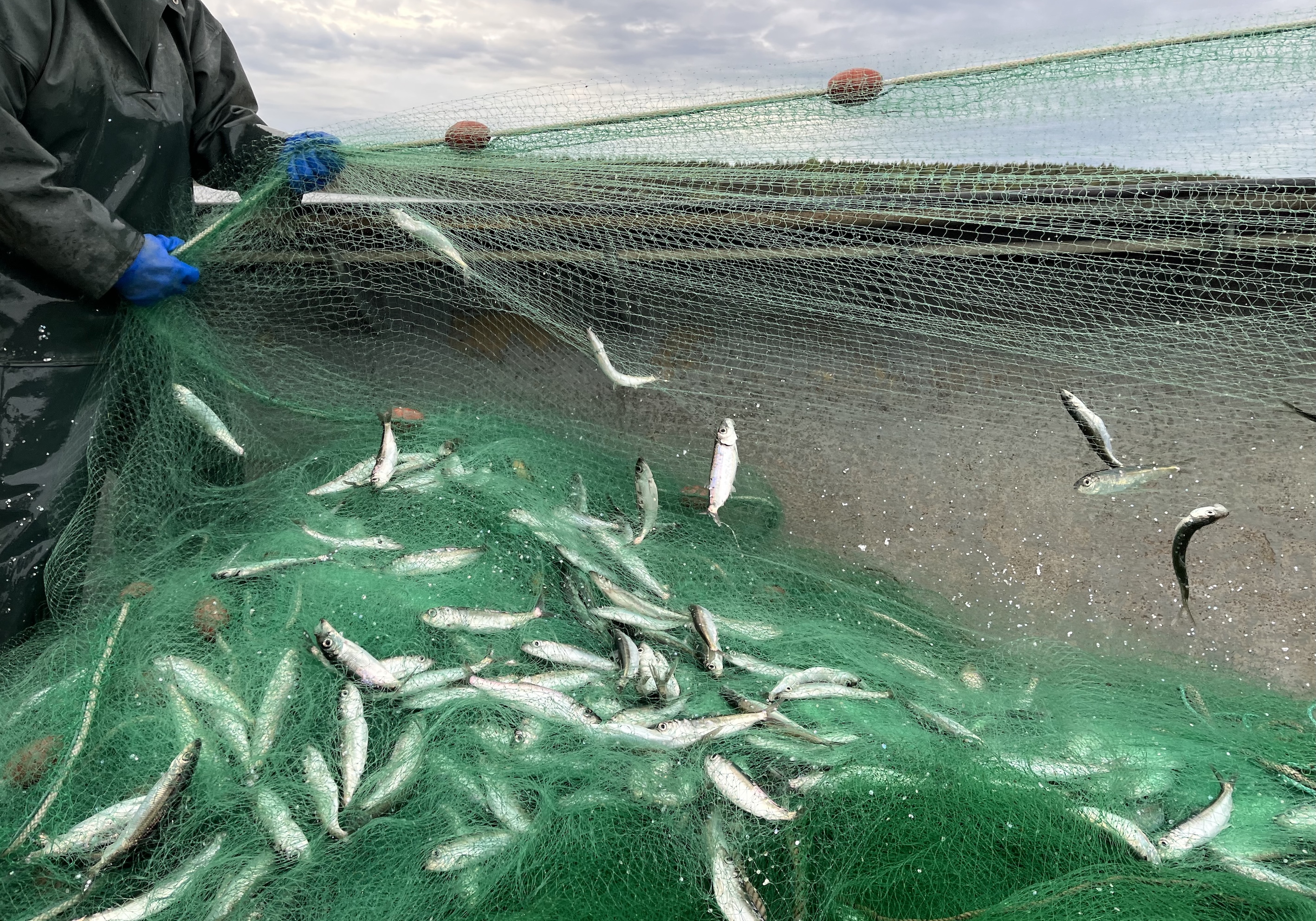
Photo: Henrik Hamrén
Ahead of Monday’s EU negotiations in Luxembourg on fishing opportunities in the Baltic Sea for next year, Sweden’s position was to “dig in its heels and try to keep quotas as low as possible” for the two largest herring stocks.
However, the Council of Ministers as a whole had other ideas. Following unusually brief negotiations, the ministers announced a decision that same evening that will result in a substantial increase in herring and sprat fishing next year:
- The quota for herring in the central Baltic Sea will increase by 71 % compared with last year, to 165,228 tonnes (the European Commission proposed an increase of 49 %).
- The quota for herring in the Gulf of Bothnia will increase by 12 %, to 62,500 tonnes (the Commission proposed an increase of 3 %).
- The sprat quota will increase by 44 %, to 291,590 tonnes (in line with the Commission’s proposal).
The decisions were based on positive signals presented by the International Council for the Exploration of the Sea (ICES) in its latest advice, published in May this year. After several years of relatively restrained catches, the central Baltic herring stock and the Gulf of Bothnia herring stock appear to have increased. In addition, sprat biomass also seems to have made a substantial recovery following a worrying decline.
“It is very encouraging that the stocks appear to be growing, but there are always uncertainties in this type of assessment. It is difficult to say exactly how much the stocks have increased and whether the increases will be sustained. A responsible fisheries management, that takes the recovery of vulnerable fish stocks seriously, should wait until stocks show a sustained increase over time, rather than immediately raising quotas at the slightest sign of growth,” says Sara Söderström, fisheries researcher at the Baltic Sea Centre.
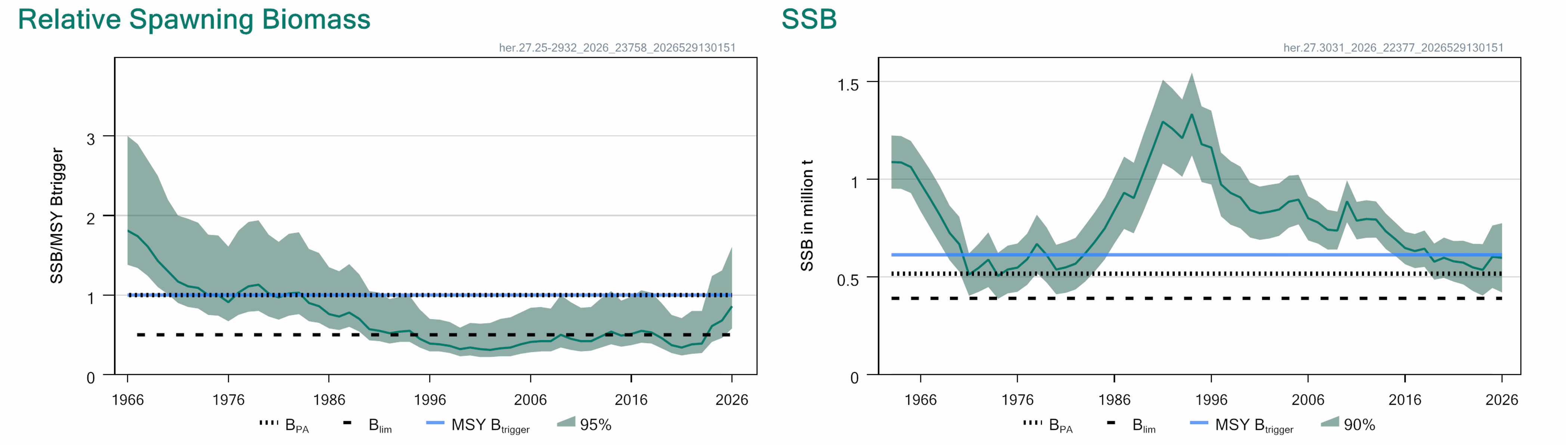
Development of spawning-stock biomass for central Baltic herring (left) and Gulf of Bothnia herring (right). Source: ICES.
EU policy objectives were not prioritised
The overarching objectives of the EU’s Common Fisheries Policy (CFP) are to ensure that fish stocks remain productive and to minimise the negative environmental impacts of fishing. These objectives are set out in the Baltic Sea multiannual management plan, adopted in 2016. The plan requires spawning-stock biomass to be restored and maintained above levels capable of producing maximum sustainable yield. The lowest spawning-stock biomass level consistent with this objective is known as MSY Btrigger.
These objectives are also set out in the underlying 2013 regulation establishing the Common Fisheries Policy (CFP). It emphasises that fisheries policy must be consistent with EU environmental legislation, particularly the objective of achieving good environmental status under the 2008 Marine Strategy Framework Directive by 2020 at the latest.
The spawning-stock biomass of the Gulf of Bothnia herring has remained below MSY Btrigger since 2019. It came close to the threshold in 2025, but is estimated to have declined slightly in 2026. According to ICES calculations, catches in the Gulf of Bothnia must not exceed 45,544 tonnes next year to give the stock a 50 % chance of rising above MSY Btrigger by 2028. Earlier this year, the European Commission proposed setting the quota at approximately 7,000 tonnes above that level. At Monday’s Council meeting, EU ministers added a further 10,000 tonnes or so.
“The Commission does not appear to have taken the stock objective seriously. Next year’s quota will now be 17,000 tonnes higher than the catch level that would have given the stock at least a 50–50 chance of meeting the target. This means that the objective, which should have been achieved by 2020, is likely to be postponed even further,” says Baltic Sea Centre's policy officer Charles Berkow.
According to Berkow, Monday’s Council decision shows that EU ministers appear to have chosen to set aside several of the EU’s fisheries policy objectives.
“The ministers are continuing to prioritise high quotas for the coming year without taking environmental consequences into account. They are also prepared to take substantial risks, despite the scientific uncertainties highlighted by researchers and relatively recent experience of stock collapses. We need look no further back than 2018 to see how overly optimistic quota decisions for herring and cod stocks in the western Baltic Sea were followed by stock collapses just a few years later,” he says.
"Optimistic gamble” with the Gulf of Bothnia herring
At the top of its advice documents, ICES provides what is known as its headline advice, which sets out quota ranges based, under an agreement with the European Commission, on long-term projections of catch levels under the maximum sustainable yield (MSY) approach. Fishing at these levels should, over time and under certain assumptions, result in stocks large enough to produce maximum sustainable yield.
Further down in its advice, however, ICES also discusses other potential uncertainties and warnings that may be relevant when quotas are set, as well as calculations of the probability of meeting the stock objectives in the management plan under different levels of fishing pressure.
With regard to herring in the Gulf of Bothnia, ICES emphasises, among other things, that the actual size of the stock is uncertain. Over the past ten years, the proportion of older, larger fish has declined sharply. The stock is now dominated by the youngest age classes, making it very difficult for researchers to assess recruitment (the number of young fish entering the stock each year).
Because of this uncertainty, spawning-stock biomass could in fact be either above the target level of MSY Btrigger (in the best-case scenario) or below it, potentially even dangerously close to the critical limit Blim, below which the stock’s reproductive capacity is at risk.
ICES also notes that the Gulf of Bothnia stock consists of several distinct herring subpopulations, which likely makes it vulnerable to the loss of biodiversity. In addition, a deteriorating age structure, with fewer older fish, and declining biodiversity could negatively affect the stock’s future productivity.
“Given the objective of avoiding a stock collapse, these uncertainties should lead to a more precautionary approach, with priority given to reaching as quickly as possible the stock target that should have been achieved in 2020. The ministers have indeed set a catch level below the quota range presented by ICES, but they have gambled on reaching the target at some unspecified point in the future. It is a gamble that might pay off, but it could also fail,” says Charles Berkow.
Uncertain forecasts for central Baltic herring
For the central Baltic herring stock, spawning-stock biomass also remains below MSY Btrigger, according to ICES. However, the stock is estimated to have increased for three consecutive years, with a particularly large increase this year. ICES is optimistic about the stock’s future development and forecasts further growth next year. This was reflected in higher quota ranges in its headline advice compared with last year.
The Commission, in turn, urged some caution and proposed a considerably smaller quota increase of 49 %.
The Council of Ministers nevertheless focused on ICES’s positive assessment and agreed to a quota increase of as much as 71 %. The increase is below the projection in ICES’s headline advice and is estimated to give the stock a 72 % probability of meeting the target — spawning-stock biomass above MSY Btrigger — by 2028.
Further down in its advice, however, ICES stresses that the forecast is uncertain because it is not based on actual observations, but on an assumption about the relationship between spawning-stock biomass and the two most recent year classes.
Following the negotiations, Sweden’s Minister for Rural Affairs, Peter Kullgren, was not entirely satisfied, although he remained cautiously positive:
“We would have preferred even more cautious quotas, but there was no support for that. The agreed quotas will lead to growth in herring stocks,” he said in a government press release.
"There are grounds for a lower sprat quota"
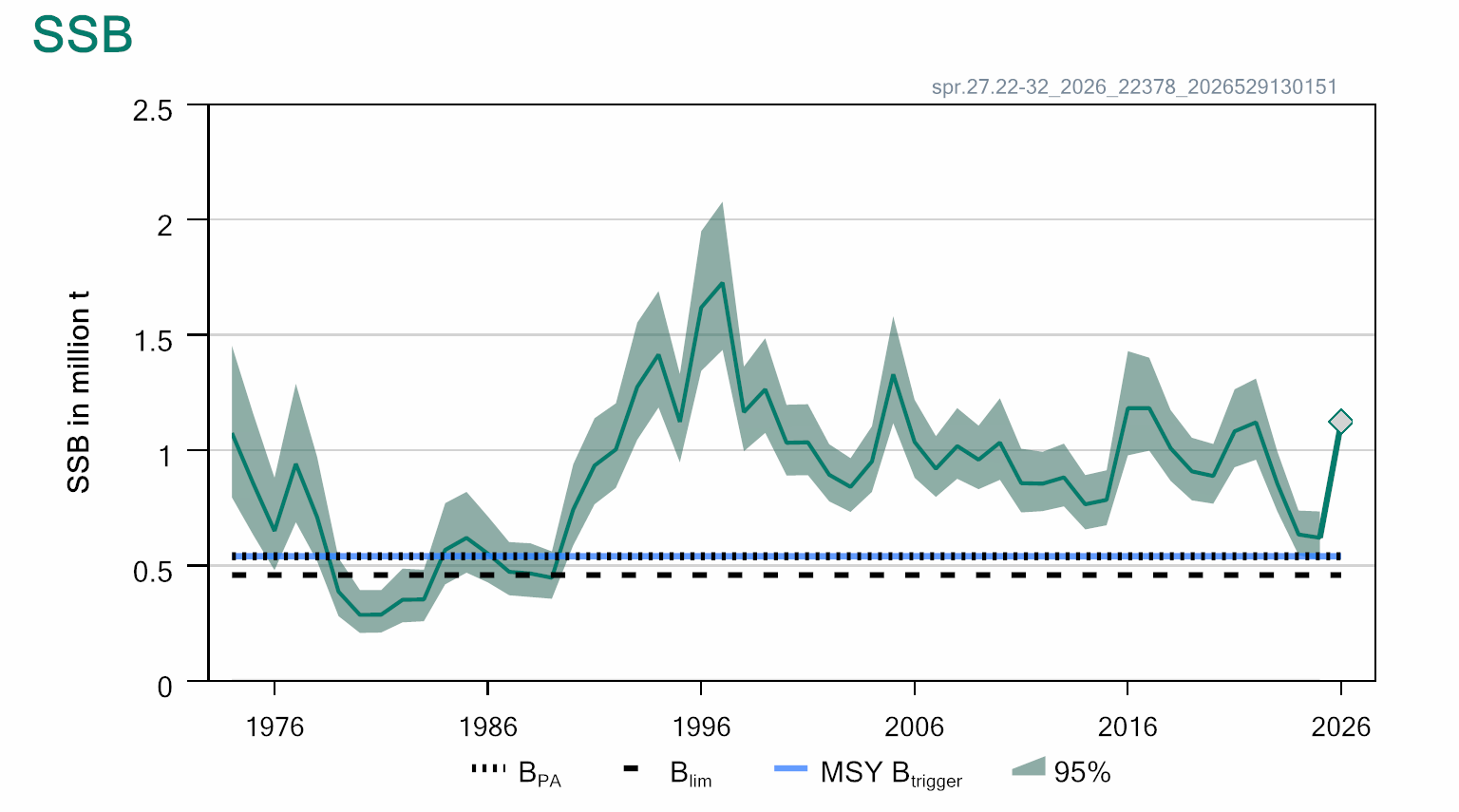
Development of spawning-stock biomass for sprat in the Baltic Sea. Source: ICES.
Sprat fishing will also increase substantially next year, by 44 per cent, on the basis of an increase in spawning-stock biomass. However, Baltic Sea Centre's fisheries researcher Åsa Nilsson Austin believes that a more responsible approach would be to fish somewhat more cautiously next year to ensure that the stock is genuinely recovering.
“The 2021–2023 year classes were among the smallest in the time series, and spawning-stock biomass has fluctuated quite considerably. There are therefore clear grounds for setting a more precautionary quota for sprat next year as well,” she says.
Continued exemption for small-scale fishing for western spring-spawning herring
One of Sweden’s main sticking points in the negotiations concerned the collapsed western Baltic herring stock. ICES has recommended a fishing ban (zero catch quota) every year since 2019. For several years, the EU has decided to prohibit targeted fishing for this stock, with an exception for coastal small-scale fishing with passive gear, where the catch is intended for human consumption, alongside a by-catch quota of just under 800 tonnes per year. The stock has not recovered, however, and remains well below the limit reference point Blim.
This year, the Commission proposed reducing the by-catch quota to 437 tonnes and abolishing the exemption for coastal gillnet fishing. The rationale was that some by-catch quota is still needed to avoid having to halt sprat fishing in the western Baltic Sea, thereby preventing serious socio-economic consequences.
“This argument can certainly be challenged, because very little sprat is caught in the western Baltic Sea in the first place,” says Charles Berkow. “Sweden and Denmark, which together account for roughly one-third of the by-catch quota, do not fish for sprat there at all.”
Sweden’s objective was to retain both the by-catch quota and the exemption for small-scale coastal fishers. Before the negotiations, Minister for Rural Affairs, Peter Kullgren, said he wanted to ensure that small-scale fishers in the south of Sweden would be allowed to continue fishing for western Baltic herring by “taking from a by-catch quota and allocating it to small-scale fishers who use gillnets”.
Charles Berkow points out that the Court of Justice of the European Union has ruled that different rules apply to by-catch stocks than to target stocks under the management plans. Western Baltic herring is, however, classified as a target stock under the Baltic Sea management plan.
“What has happened is that the ministers have mismanaged the stock, which subsequently collapsed. Starting to call it ‘by-catch’ is a way of circumventing the rules of the Common Fisheries Policy and prioritising the continued fishing of relatively small quantities of sprat over giving the herring stock a better chance to recover,” he says.
Stock objectives under the Common Fisheries Policy
Under the Baltic Sea multiannual management plan, fishing must be managed in such a way that stocks are maintained “above levels capable of producing MSY” (i.e. maximum sustainable yield). Some researchers consider the spawning-stock biomass required to “produce MSY” to be represented by a value known as Bmsy. ICES instead uses the threshold value Btrigger, defined as the fifth percentile of Bmsy. As long as a stock’s spawning-stock biomass remains above Btrigger, it is considered capable of producing MSY under the EU framework.
In recent years, several studies, including this one, have advocated a shift to the (generally higher) Bmsy reference point to reduce the risk of overfishing.
Last updated: 2026-10-28
Source: Stockholm University Baltic Sea Centre