


DNA from marine microbes can predict the status of the sea
The microorganisms found in one litre of sea water can reveal a lot about their environment. In a new methodological study, researchers demonstrate how DNA sequencing and AI can be used to predict the biological and chemical properties of the sea.
Photo: John Samuel, CC BY-SA 4.0 and Michaela Lundell. The image is a photomontage.
”Logically it should work, but I was surprised it worked so well!” says Emma Bell, leader of the research group Molecular SeaLab at the Baltic Sea Centre, and one of three shared first authors of the new study.
For some time now, marine researchers have been discussing the potential of “decoding the ocean in reverse”, made possible by the revolutionary gene technology that has allowed scientists to detect and identify the ocean’s smallest inhabitants. There are many species of microorganisms, and each has specific preferences regarding for example salinity, temperature, pH, nutrient availability, and the presence of other plankton. So, if you simply learn the pattern of which species composition reflects which environment – or better yet, let an AI learn it, which can rapidly process enormous amounts of data – you should be able to predict the water’s chemical and biological properties if you know which organisms live there.
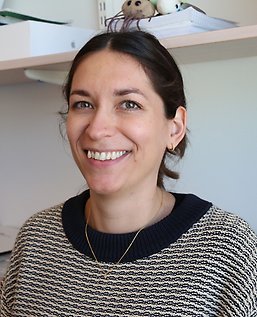
Environmental microbiologist Emma Bell, leader of the Molecular SeaLab research group at the Baltic Sea Centre. Photo: Michaela Lundell
Since it has become relatively easy and inexpensive to DNA-sequence entire environmental samples, such as a few decilitres of seawater, this has been regarded as a promising upcoming method for modern environmental monitoring. Now, researchers from Stockholm University, KTH/SciLifeLab, and SMHI have shown, through their careful methodological study, that it actually works, and how to do it best.
“The goal of our study is to be able to give practical advice on how to build the AI models to predict environmental parameters in seawater from environmental DNA”, says Karin Garefelt, PhD student at the Environmental Genomics group at SciLifeLab and another of the study’s first authors.
Three different AI models trained
The research group tested three different AI models: a simpler one called Random Forest, and two more complex ones. They were trained on data from almost 400 seawater samples, collected between 2015 and 2020 from different parts of the Baltic Sea, the Kattegat, and the Skagerrak.
Each microbial sample consists of around half a litre of seawater, analysed using so-called metabarcoding to determine which microorganisms were present in the sample. The AI models then compared the microbial community with the values of the environmental parameters measured at the same locations.
How the AI model is trained
The available data is divided into “training data” and “test data”.
The training data consists of both genomic data (i.e. which DNA-sequence variants are present, and in what quantities) and the actual measured environmental parameters (such as salinity, temperature, the nutrients nitrogen and phosphorus in various forms, chlorophyll levels, and various phyto- and zooplankton identified through microscopy) – in other words, the “ground truth”. The AI compares the two and looks for statistical patterns.
The AI model is then given the test data, in which it only sees the genomic data, not the measured environmental parameters, and is asked to guess: “Based on what you have learnt, what do you think the temperature/nitrate level/visibility depth, etc. is in this sample?”
The model’s guesses are then compared with the real, measured values. The closer the model’s guess is to reality, the more accurate the model is considered to be.
High accuracy – but not for chlorophyll
All three models could predict several parameters very well, such as silicate, phosphate, and humus levels. Prediction accuracy was highest for salinity, temperature, and alkalinity (the water’s ability to resist acidification), while the results were considerably poorer for ammonium and chlorophyll, which puzzles the researchers.
”It’s not clear to us why it performed so poorly. It opens questions on why, that we have to figure out. You would expect the microbiome to predict those parameters quite well, but apparently it is not that simple”, says Emma Bell.
When it comes to chlorophyll, the researchers reason that the explanation may lie in fluorescence, the property actually being measured. Chlorophyll fluorescence fluctuates depending on if it’s sunny or cloudy, much faster than the microbial community composition changes, which happens over days and weeks. But that is just one possible explanation.
The simplest model performed best
The model tests showed that the simpler, somewhat older AI model, Random Forest, made predictions with almost as high accuracy as the more accurate of the two more complex models. Since the simpler Random Forest model was considerably faster (it required 14 seconds of computing time per parameter, compared to 1–1,5 hours for the best of the heavier models) and also requires less memory, it is the model the researchers recommend.
“In Random Forest many smaller so-called decision trees work together to reach a decision. You can run it on an ordinary laptop, unlike the more complex models, which rely on heavier computational approaches and require access to a considerably more powerful computer. Given that training machine learning models is associated with certain emissions, it’s both more practical and better for the environment to use a lighter model”, says Karin Garefelt.
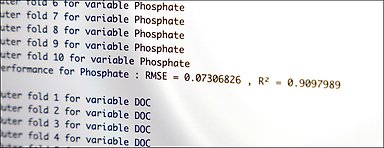
Screenshot of one of the models
The computer is training the AI model XGBoost on DNA data from the Baltic Sea. Each line is part of what is called cross-validation – one of several validation methods the researchers in the study used to test the accuracy of the AI models.
In this excerpt, the model is being trained and tested to predict the phosphate level in the water, based on which bacteria and other microorganisms are present in a water sample. The result is shown as an R²-value, in this case 0.9097989, meaning that the model explains about 91 percent of the variation in the water's phosphate level based on the DNA data. The computer then moves on to train and test the model for DOC (dissolved organic carbon).
Able to predict phyto- and zooplankton
She was surprised by the model’s strong ability to also predict which phyto- and zooplankton were present in the water. This is traditionally investigated through microscopy, which requires collecting large volumes of water using hose sampling (for phytoplankton) and vertically towed nets (for zooplankton) This sampling method is both labour-intensive and sometimes impossible in rough weather at the sea.
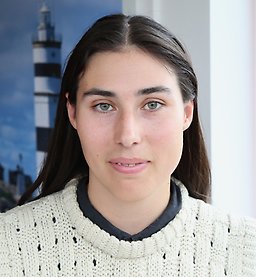
Karin Garefelt, PhD student at the Environmental Genomics group at KTH/SciLifeLab. Photo: Michaela Lundell
The AI models, on the other hand, needed less than a litre of water with a DNA-sequenced microbial community to accurately predict which phyto- and zooplankton were present in the sea at the same place and time.
“Based on which bacteria are present in the sample, the model works out the season, the geographical location, and the nutrient conditions. From that, it can draw conclusions about which phyto- and zooplankton are likely to be present”, explains Karin Garefelt.
Simple sampling
There are clear advantages to using genomic data and AI models in the environmental monitoring. In several ways, it is easier and cheaper than traditional monitoring. It also yields more information – not least about the important but often overlooked bacteria that drive many of the ocean’s biogeochemical cycles, yet appear as nothing more than tiny black dots under a microscope.
However, some information is lost compared with microscopy, such as being able to see what life stage the plankton are in, how large the cells are, and whether they form colonies.
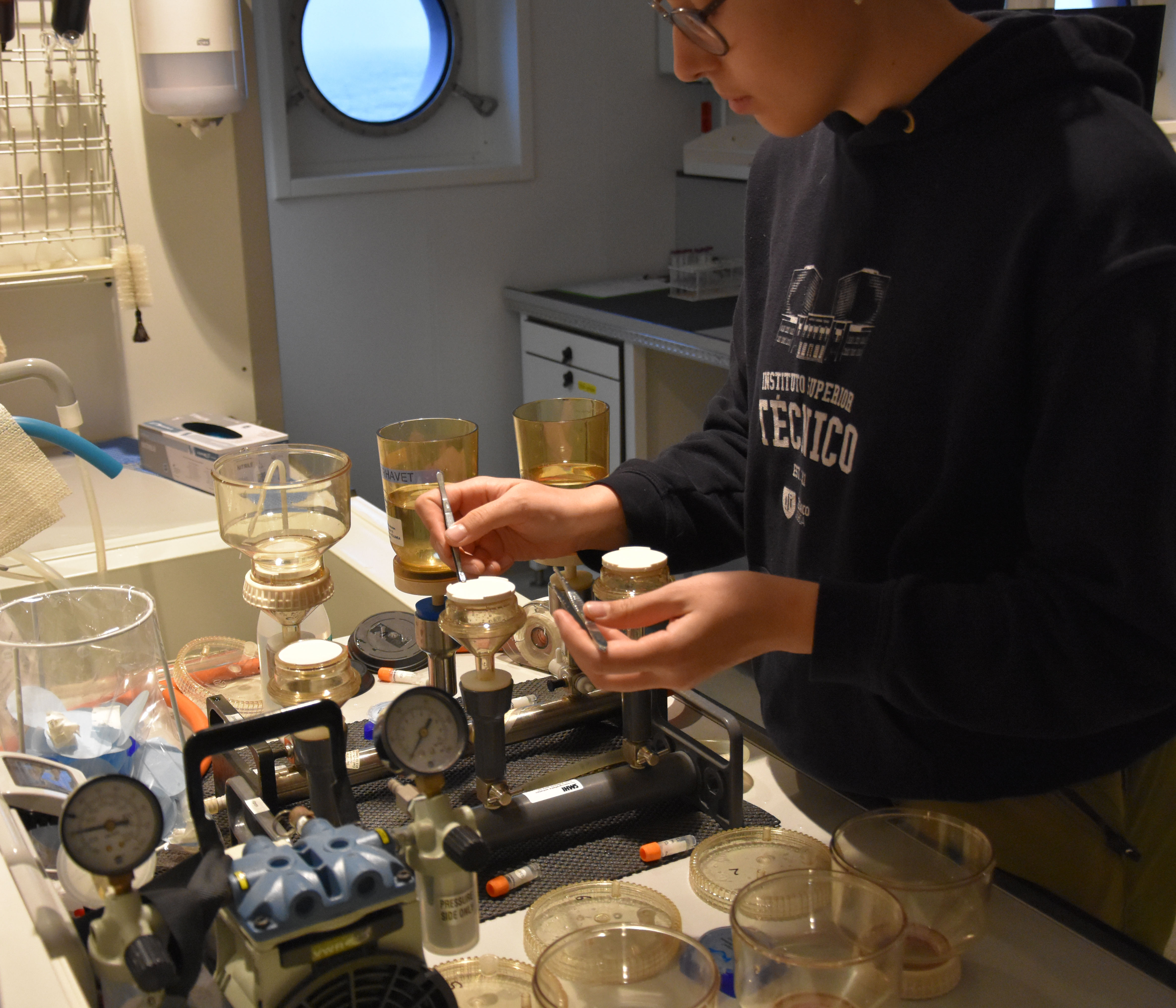
Karin Garefelt filtering seawater samples for DNA analysis of the microbial community, aboard the research vessel Svea. Photo: Mikael Hedblom/SMHI.
Metabarcoding
Metabarcoding is a method for identifying which species are present in a given location. It involves extracting DNA and searching for a short, specific section of a gene (a “marker”) that can be used to distinguish between different types of organisms.
The current study used two DNA markers: one for prokaryotes, such as bacteria (16S rRNA), and one for single-celled eukaryotes, such as algae and protozoa (18S rRNA).
Using PCR technology, the DNA markers are “amplified”, producing enough copied to be sequenced, i.e. analysed base by base. The sequences are then compared with reference databases to determine which organisms are present in the sample. It is also possible to see the relative abundance of each type of organism.
A complement to environmental monitoring
The researchers behind the study emphasise that the method they have tested and advocate for is a complement to ongoing marine environmental monitoring, not a replacement for it. Building reliable AI models is also dependent on the availability of large amounts of environmental monitoring data.
“There are long time series that must not be broken, and the environment constantly changes. You continuously need to validate the models, and for that you need actual measurements. The more data, the better models”, says Emma Bell.
Beyond filling gaps where environmental monitoring measurements are missing for various reasons, the researchers predict that the method could also be developed to forecast other environmental factors, such as pollutants, plastic contamination, and greenhouse gases.
“In theory you can simply take a small microbial sample, and it can tell us what the environment is expected to be, says Emma Bell.
Another exciting application on the horizon is being able to determine which microbes do what in the water, and how they do it. Which ones, for example, drive the emergence of algal blooms?
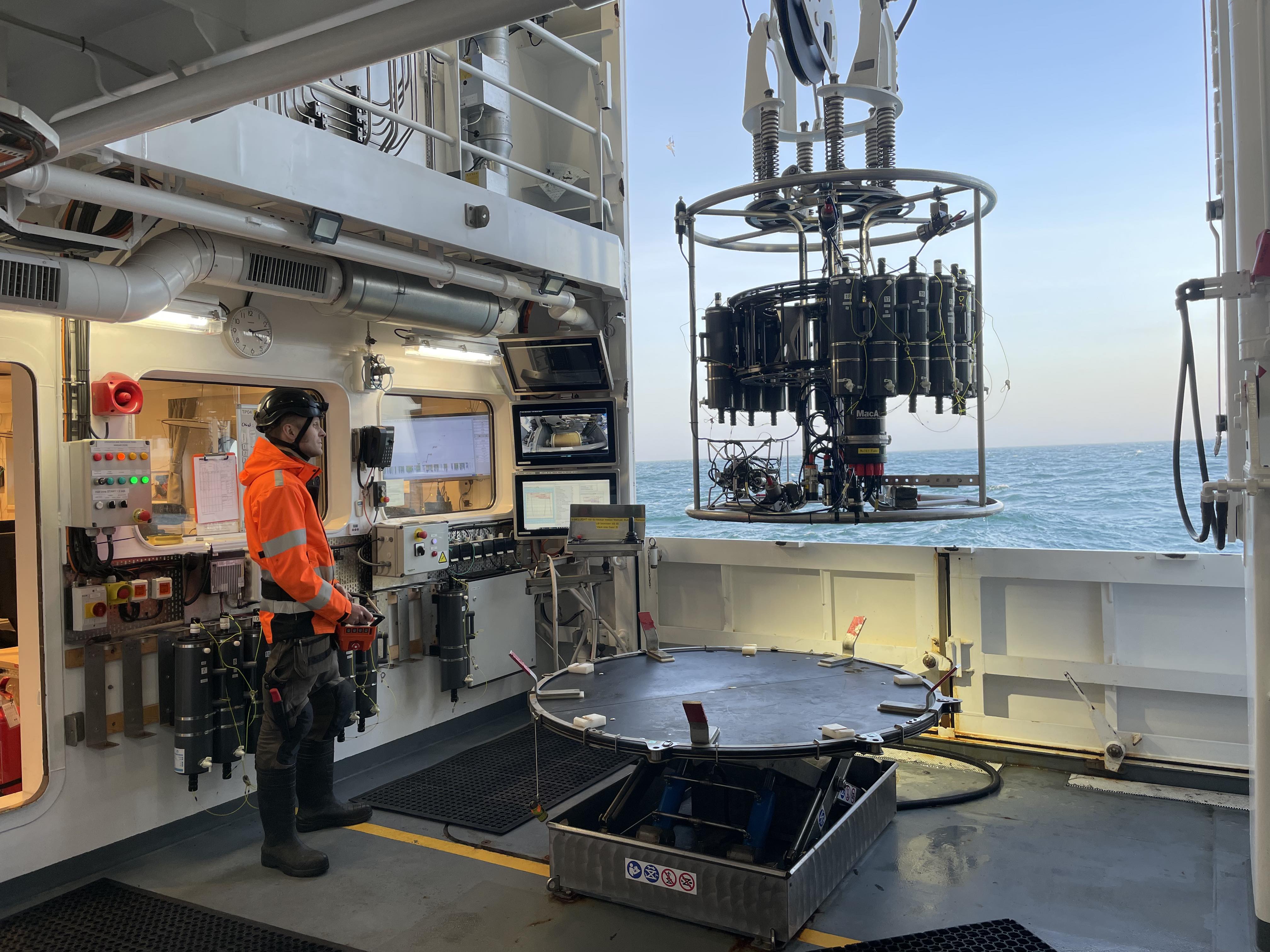
Marine environmental monitoring of the pelagic zone (open sea) with the research vessel Svea, from which the data for the method study was obtained. The instrument in the photo is what’s known as a rosette sampler, which can be used to collect water samples from different depths. Photo: Johanna Kozak/SLU.
Should be incorporated into environmental monitoring
Sampling of microorganisms is not currently part of standardised marine monitoring. This is something the researchers hope will change.
“Collecting the small samples you need for DNA analysis is relatively easy, and it can stay in your freezer for years”, says Emma Bell. “Microbes should definitely be included in environmental monitoring. Technology is developing quickly and you never know how it can be used. Keep monitoring, and involve microbes, there is so much information in there!”
Data based on the marine environmental monitoring
The methodological study is based on environmental data from the Swedish marine pelagic monitoring programme, which includes biological, physical, and chemical properties of seawater, and is freely available in the SHARK database.
Microscopy-based counts of phyto- and zooplankton are also retrieved from SHARK.
The genomic data – the DNA sequences from the marine microorganisms – likewise comes from water samples taken within the marine pelagic monitoring programme. The samples were analysed using so-called metabarcoding in two earlier studies, and the results are freely available in the European Nucleotide Archive database.
Text: Michaela Lundell
The scientific article can be read here:
Authors: Emma Bell, Karin Garefelt, Krzysztof T. Jurdzinski, Luis F. Delgado, Fanny Lindrooth, Bengt Karlson and Anders F. Andersson.
Read more about the importance of microorganisms in the marine biogeochemical cycles:
Invisible inhabitants of the sea – unknown microbes with huge impact
Last updated: 2026-09-30
Source: Stockholm University Baltic Sea Centre