


EU Commission proposes more cautious TAC-levels for Baltic herring next year
The European Commission wants to see more cautious fishing on the two largest Baltic Sea herring stocks next year, proposing TACs (total allowable catch) well below the International Council for the Exploration of the Sea (ICES) headline advice. But for the collapsed herring and cod stocks, socioeconomic considerations are being prioritized over rebuilding the populations.
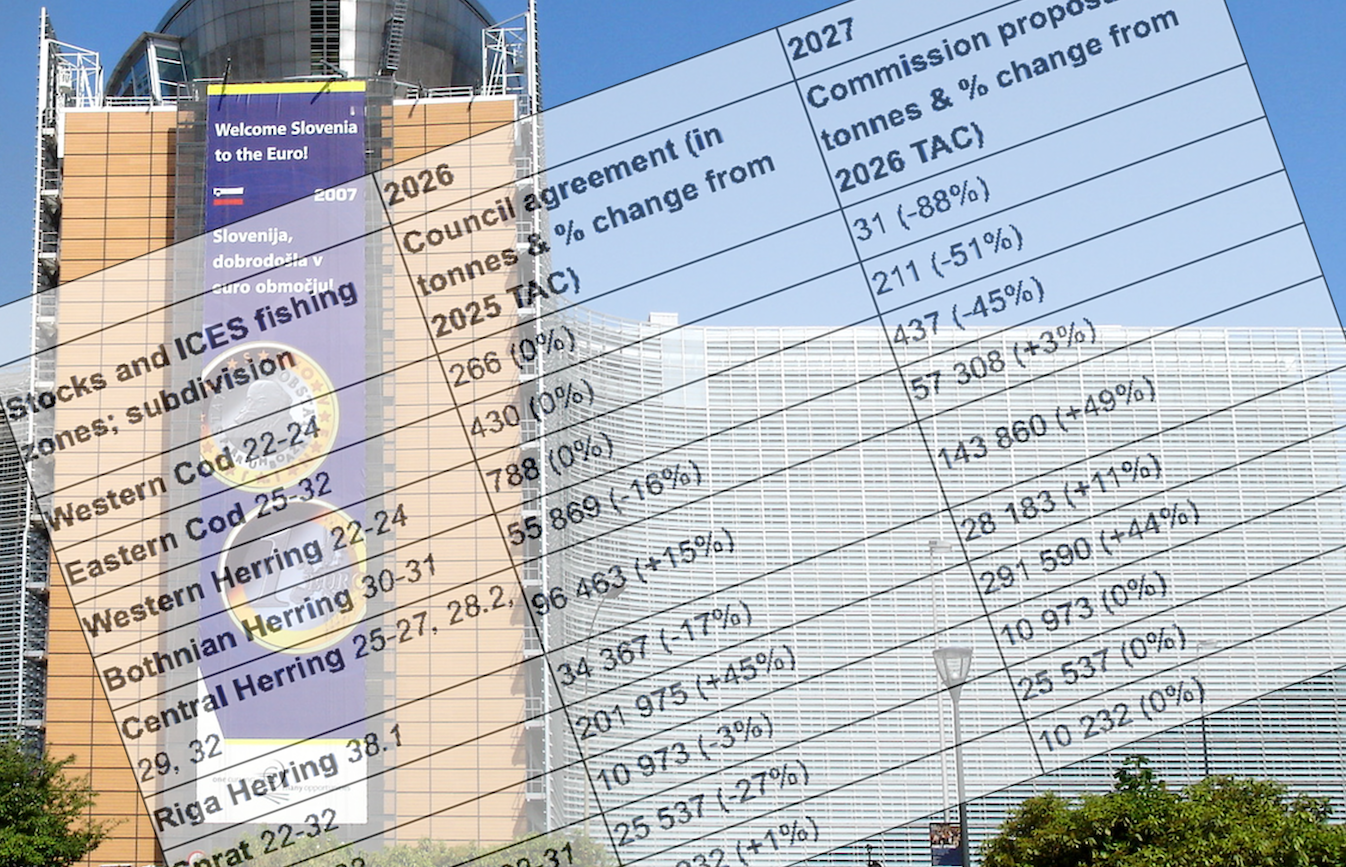
Original photo: Nuno Nogueira, CC BY-SA 2.5, Wikimedia Commons. The image is a montage.
2026.08.27
”It is clear that the Commission has looked beyond just the TAC-ranges in ICES’ headline advice, and is taking some account of the uncertainties and precautionary signals that are also included. They recognize that stronger measures are needed to rebuild the herring stocks,” says Sara Söderström, a fisheries researcher at Stockholm University’s Baltic Sea Centre.
According to ICES’ latest scientific advice, herring stocks in the central Baltic Sea and the Gulf of Bothnia have increased over the past year. Against this backdrop – and with recruitment forecasts looking positive – ICES’ headline advice calls for substantially increased herring TACs next year: by as much as 122%* (274,332 tonnes) for the central Baltic herring stock and 62% (90,391 tonnes) for herring in the Gulf of Bothnia.
* Calculated based on this year’s total TAC for herring in the Central Baltic Sea (123,463 tonnes), including Russia’s estimated catches. The EU TAC is 96,463 tonnes, of which Sweden’s share is 32,264 tonnes.
Uncertain forecasts
When EU fisheries ministers meet in October to decide on next year’s fishing opportunities in the Baltic Sea, they will have to choose between two approaches:
Take advantage of the fact that the herring stocks have started to grow and immediately increase the herring TACs?
Or maintain, or even reduce, current TACs to help the herring stocks recover to biologically sustainable levels – and thereby meet the objectives set out in EU fisheries legislation?
The European Commission is advocating the more cautious approach, to ”continue the rebuilding trajectory“. In its recently published proposal for next year’s fishing quotas, the Commission proposes an increase of no more than 49% (143,860 tonnes) for central Baltic herring, while essentially maintaining the current quota for herring in the Gulf of Bothnia (57,308 tonnes, +3%).
“Among other things, the Commission points to the substantial scientific uncertainties involved in estimating recruitment and forecasting how the stocks will develop over the next few years,” says Sara Söderström.
Risk of “phantom recoveries”
ICES’ increased headline advice for the central Baltic herring stock is based largely on expectations of strong recruitment in the years ahead. But estimating how many fish are added to the stock each year—and how this will eventually affect the spawning-stock biomass—is extremely difficult. Placing too much confidence in these forecasts can carry significant risks.
“There are several examples of so called ‘phantom recoveries’ – that is, cases where the models used have overestimated stock growth,” says Sara Söderström, noting that this has happened in the past with, among others, the western Baltic cod stock and the central Baltic herring stock.
“They believe that the stocks are on the way to recovery and that recruitment will lead to substantial increases in stock size, prompting politicians to immediately raise fishing quotas. But a few years later, retrospective analyses show that things were not nearly as positive as initially thought, and that fishing pressure has in fact been higher than it should have been,” says Sara Söderström.
In its proposal, the Commission emphasizes these risks for the central Baltic herring stock, arguing that the TAC can only be increased moderately in order to ”strike the right balance between rebuilding stocks and providing fishing opportunities.”
Poor stock status becomes the new normal
The stated goal of the EU’s Common Fisheries Policy is to restore and maintain fish stocks above levels capable of producing maximum sustainable yield (MSY). Under current EU practice, this means that spawning-stock biomass should remain above MSY Btrigger.
For many of the historically most important fish stocks in the Baltic, that target remains a long way off. The central Baltic herring, for example, has been below MSY Btrigger since the 1980s, while the Gulf of Bothnia herring has remained below MSY Btrigger for at least a decade.
The longer this situation persists, the greater the risk that it becomes normalized and that a phenomenon known as ’shifting baselines’ takes hold, both in science and in fisheries management, argues Henrik Svedäng, fisheries researcher at Stockholm University’s Baltic Sea Centre.
“People start to perceive the low levels of recent decades as normal and natural – as if that is where the stocks are supposed to be – when in fact they have the potential to be much larger,” he says, pointing out that the central Baltic herring stock, for example, has been 80% below its previous levels over the past 40 years.
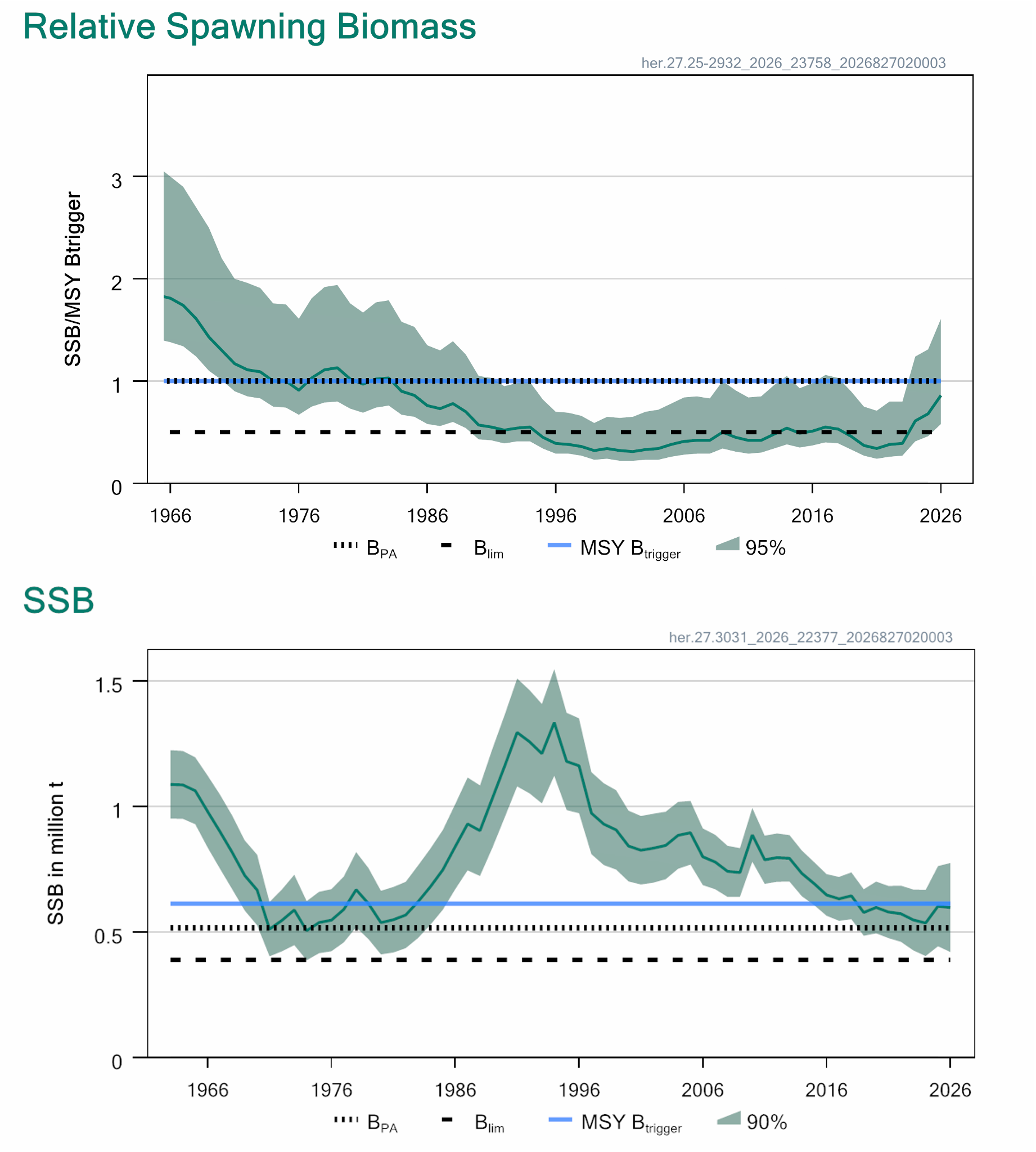
Trends in spawning biomass for the central Baltic Sea herring (above) and the Gulf of Bothnia herring (below). Source: ICES, 2026.
Half of FMSY can meet EU stock targets
If spawning-stock biomass falls below MSY Btrigger, “all appropriate remedial measures shall be adopted to ensure the rapid return of the stock concerned to levels above those capable of producing MSY,” according to Article 5.1 of the Baltic Sea multiannual management plan.
The fastest way to increase a stock’s spawning-stock biomass and accelerate its recovery towards the EU’s target level is to reduce fishing pressure, notes Charles Berkow, policy expert at Stockholm University’s Baltic Sea Centre:
“There have long been scientifically supported proposals to fish at half of FMSY – in other words, to set quotas at half the level of catches that, according to ICES projections, can sustain productive stocks in the long term. Especially when the stock target is not being met,” he says.
Striking the "right balance”
For the central Baltic herring, fishing at ’half of FMSY’ would mean an EU TAC approximately 20,000 tonnes lower than the TAC now proposed by the Commission – and around 150,000 tonnes lower than the maximum quota in ICES’ latest headline advice (including Russia’s catch).
For the herring stock in the Gulf of Bothnia, the differences are smaller.
“To achieve at least a 50% probability that the Bothnian herring will reach the stock target by 2028, ICES’ forecast indicates that the quota must not exceed 45,544 tonnes. This also happens to correspond to roughly half of FMSY,” says Charles Berkow.
The Commission is nevertheless proposing a somewhat higher TAC (57,308 tonnes), with the aim of “striking the right balance between rebuilding the stocks and providing fishing opportunities.”
“According to the EU regulations, special measures should also be taken to reach the stock target quickly. Instead of closing the fishery during periods when fishing would not take place anyway, as has been done in the past, it would be possible to prevent unused quota from being carried over to subsequent years. This has, for example, been done in the North Sea under the agreement between the EU, the UK and Norway,” says Charles Berkow.
Stocks above MSY Btrigger is a minimum requirement
European fisheries policy is a constant tug-of-war between safeguarding fish resources and meeting socioeconomic needs – particularly when stocks are in decline. At the same time, healthy and well-functioning fish stocks are a fundamental prerequisite for sustainable (and profitable) fisheries.
The recovery and long-term sustainability of fish stocks must therefore be given priority, argues Henrik Svedäng.
“It seems that the politically driven management culture in the Baltic Sea is less capable of recognizing this than the management around the North Sea. Unlike in the North Sea, Baltic stocks have shown no signs of sustained recovery,” he says, continuing:
“One might argue that environmental conditions are generally worse in the Baltic Sea than in the North Sea. But that simply means that precautionary margins need to be greater and fishing pressure needs to be reduced even further, in order to minimize risks and promote stock recovery.”
Another important aspect, according to Svedäng, is that the two dominant fish species in the Baltic, herring and sprat, are prey for many other animals, not least predatory fish, and thus form the foundation of the marine ecosystem.
“If the Baltic Sea countries are serious about their stated commitment to managing fish stocks according to the ecosystem approach, it is a minimum requirement that the stocks have remained above MSY Btrigger for several consecutive years before allowing to step on the gas and increase fishing pressure,” says Svedäng.
Sprat appears to be increasing again
For next year’s TAC for sprat, the Commission’s proposal and ICES’ headline advice are considerably closer to each other. Following three disastrous recruitment years in 2021–2023 and the lowest spawning-stock biomass in more than 30 years, the two most recent year-classes are now estimated to be larger.
ICES expects spawning-stock biomass to continue increasing in 2027, prompting the Commission to propose a 44% increase in the EU quota next year, to 291,590 tonnes.
Bycatch quotas for collapsed stocks
For the three Baltic Sea stocks in the worst condition – the western Baltic herring and the two cod stocks – the Commission is taking a somewhat different approach, proposing TAC-levels that are higher than ICES’ advice. Once again, socioeconomic considerations are the driving factor.
For several years, ICES’ headline advice has been ’zero catch’ for all three stocks. Because both cod and western Baltic herring are inevitably caught as bycatch in other fisheries, such as pelagic sprat fisheries and bottom trawling for flatfish, the Commission considers some bycatch quota necessary to avoid having to close those other fisheries altogether. The proposed bycatch quotas are based on the commercial fishing sector’s own reported bycatch figures from the previous year:
- 211 tonnes for eastern Baltic cod
- 31 tonnes for western Baltic cod
- 437 tonnes for western spring-spawning herring.
The Commission gives particular consideration to the long-collapsed western spring-spawning herring stock. The stock is in such poor condition that the Commission proposes removing the current exemption from the fishing closure for small-scale coastal fisheries next year. At the same time, the Commission wants the sprat trawl fishery in the southwestern Baltic to continue.
“The stated purpose of the bycatch quota is to allow large-scale trawling to continue. But there are no requirements to regulate where and when this sprat fishery may take place in order to minimize bycatch,” says Charles Berkow.
There is also no analysis of how large the expected catches of western herring would be in small-scale herring fisheries compared with large-scale sprat fisheries, or of how severely the different segments of the fishing industry would be affected by the respective measures.
“The result is that industrial fishing is being prioritized at the expense of other fisheries, despite the stated objective of promoting small-scale fishing,” says Charles Berkow.
Text: Henrik Hamrén
Last updated: 2026-08-27
Source: Stockholm University Baltic Sea Centre