


Lövin’s Baltic Sea Report – a political tool for more precautionary fishing quotas
2026.06.04 Industrial fishing for Baltic herring and sprat will not be halted immediately, as suggested in the European Parliament’s ‘Baltic Sea Report’. However, in the long term, the report could serve as a political tool to make the EU’s fisheries management less risk-prone and more focused on stock recovery, according to fisheries experts at the Baltic Sea Centre.
Photo: Ellen Bruno/Baltic Sea Centre
“I am very proud of the strong message the Parliament is now sending to EU governments and to the Commission,” said MEP Isabella Lövin (Green Party) on 21 May, when the Parliament adopted the Baltic Sea report she had spent almost two years negotiating.
The report contains 59 points setting out measures to reform the current fisheries management system and scientific recommendations for the setting of fishing quotas.
The question is what happens next.
’A political tool’
The report is what is known as an own-initiative report, in which the Parliament sets out its common political position – and call on the other EU institutions to take action. It is therefore not a formal legislative proposal, nor does it impose any binding requirements on the European Commission or the Member States.
"I see the report primarily as a political tool, which can be used, for example, to press the Commission to act, or to shape public opinion, or to try to influence individual decisions in the future," says Charles Berkow, policy analyst at the Stockholm Universitys’ Baltic Sea Centre.
How powerful could this ’tool’ be for Baltic Sea fisheries policy?
"It depends first and foremost on whether anyone wants to use it. It also depends on how skilfully it is used and how much political weight the person using it is carrying," says Charles Berkow.
Wants to put industrial fishing on hold
The most controversial aspect of the report is a proposal to suspend large-scale industrial fishing for fish meal and oil until the Baltic herring and sprat stocks have recovered.
– Industrial fishing currently accounts for the largest catches of herring in the Baltic Sea. The two largest herring stocks – the central Baltic herring and the Gulf of Bothnia herring – are at very low levels compared to what they used to be, and are in need of recovery,” says Sara Söderström, researcher at the Baltic Sea Centre.
MOST BALTIC HERRING IS TURNED INTO FISHMEAL
- The Swedish commercial fishing industry caught just over 56,800 tonnes of forage fish (mainly herring, sprat and sandeel) in 2025 – equivalent to 68% of Swedish fishermen’s total catch in all EU waters (including the North Sea and the Atlantic).
- In the same year, just over 19,600 tonnes of herring were caught for human consumption – mostly in the North Sea and the Skagerrak.
- Approximately 90% of Swedish herring and sprat catches in the Baltic Sea are fished by industrial trawlers and used to produce fishmeal and oil.
Source: Swedish Commercial fishing at sea, December 2025. Preliminary data. Official Swedish statistics, statistical reports JO 50 SM 2602. (HaV)
Lowered standards for sustainability
The report does not specify exactly what ‘recovery’ means in practice. Under current legislation, Baltic Sea commercial fish stocks must be large enough to be able to deliever MSY (maximum sustainable yield).
Previously, management and science used the median value Bmsy to define how large the spawning biomass needed to be to meet the MSY target. However, since the mid-2010s, a so-called “trigger” MSY threshold (MSYBtrigger), has been used. In practice, this has lowered the bar for what can be considered sustainable.
Earlier this year, an analysis of 73 EU-managed fish stocks in the North-East Atlantic (including 7 stocks in the Baltic Sea) showed that the reference value MSYBtrigger is on average 40 per cent lower than Bmsy. This means that a stock can be classified as ‘within safe biological limits’ – even though the spawning biomass is 40% lower than what is required to produce MSY.
The Parliament’s Baltic Sea report addresses this issue with the MSYBtrigger limit, and calls on the Commission to “base all stock assessments used to implement EU legislation on Bmsy biomass reference points.”
Over-optimistic forecasts
Lower sustainability limits can lead to over-optimistic assessments of stock status, which in turn opens for increased risk-taking in fisheries management, according to Henrik Svedäng, a fisheries researcher at the Baltic Sea Centre.
"As soon as ICES forecasts indicate that a stock may grow beyond the sustainability limit, this is usually followed by increased quotas and greater fishing – even if the forecasts are uncertain," he says.
If the forecasts prove wrong, which sometimes happens, it can have devastating consequences.
"It is not a sound system to leave the future hanging by such a thin thread. Instead, we must allow the stocks that are most critical to the stability of the ecosystem to recover some of their former size, to ensure that increased catches do not once again lead to overfishing, as was the case in the late 2010s," says Henrik Svedäng, and continues:
"Unlike other parts of the EU’s fishing waters in the North Atlantic, the Baltic Sea shows no signs of improvement; for example, cod stocks in the Western Baltic have been depleted precisely because of over-optimistic forecasts. The countries around the Baltic Sea must manage their fishing waters better in the future."
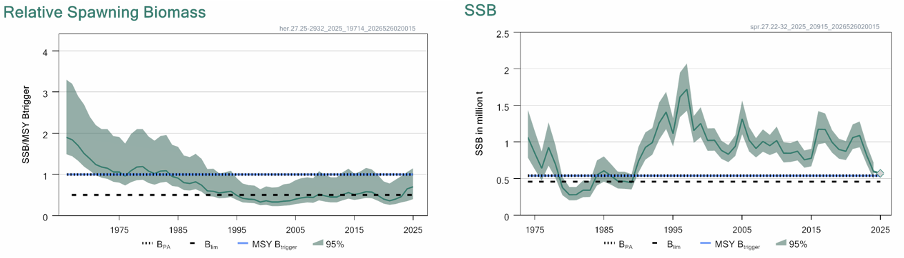
Spawning stock biomasses for central Baltic herring (left) and sprat (right). Source: ICES, 2025.
Call for a precautionary buffer
Several other proposals for action in the Baltic Sea report are directly aimed at reducing risk-taking. Among other things, it calls on the Commission to ask ICES for annual advice that takes better account of the significant uncertainties surrounding stock assessments, for example regarding recruitment and how spawning stock biomasses develop over time
"My overall impression of the report is that Parliament wants to see reduced risk-taking in the management of our fish stocks, for example by introducing a precautionary buffer when setting quotas," says Sara Söderström.
She also welcomes the fact that Parliament is calling for a more holistic approach to scientific advice, with a focus on the entire marine ecosystem and how species interact with one another.
"A key point is that Parliament wants ICES to improve its reporting of uncertainties in scientific forecasts and to include environmental factors and ecosystem considerations," says Sara Söderström.
Would benefit commercial fisheries
Among other proposals, the report also highlights:
- the need to fully implement the Marine Strategy Framework Directive’s requirements for healthy fish stocks, including a healthy age and size structure
- that ICES advice should include clear safety margins
- that ICES should develop advice on the recovery of particularly weak stocks, as well as references to measures that are automatically triggered when stocks fall below critical levels.
Several of the commercial fish stocks in the Baltic Sea are currently at very low levels compared to just 10–20 years ago. Åsa Nilsson Austin, a fisheries researcher at the Baltic Sea Centre, hopes that the Baltic Sea report will lead to new discussions on how fisheries management can be made more sustainable in the long term.
"Many of the Parliament’s proposals are concrete – and fully feasible. They aim to rebuild our fish stocks and, in the long term, restore large and viable stocks, which would benefit both commercial fishing and the marine environment," says Åsa Nilsson Austin.
Text: Henrik Hamrén
Last updated: 2026-06-04
Source: Stockholm University Baltic Sea Centre