


Robotic microscope counting and photographing the smallest marine organisms
The Askö laboratory is being equipped with an Imaging FlowCytobot, an autonomous, submersible microscope that can capture detailed images of the sea's phytoplankton communities.
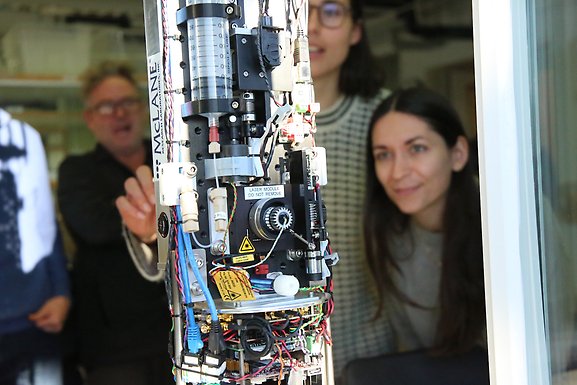
The automatic microscope consists of hundreds of components, including pumps and tubes (that draw in seawater), filters and sensors, a flow cell where particles pass through a laser beam, and a computer that controls the flow, triggers the camera to take pictures at the right moment, and stores all collected data.
"When we’re done, you will be able to take it apart and put it back together, know when something is wrong, and, if necessary, repair it yourselves," says Thomas Fougere from McLane Research Laboratories, who will teach the research team from the Baltic Sea Centre how the new robotic microscope works.
He removes the housing – a steel pressure chamber that allows the microscope to be submerged to a maximum depth of 40 metres. The hands-on learning begins with lifting the instrument. It is about one metre long and with the housing it weighs over 30 kilograms.
An Imaging FlowCytobot (IFCB) is an automatic microscope designed to continuously sample seawater, detect and count plankton cells, and take high-resolution images. The instrument can be connected to machine learning–based software in order to automatically classify plankton images. The technology allows researchers to observe and quantify plankton communities with unprecedented temporal resolution. It is undeniably impressive, and the researchers are eager to see what this instrument will enable them to discover.
Facts: Imaging FlowCytobot (IFCB)
- The instrument is a submersible plankton microscope that can be configurated to autonomously draw in seawater, count and photograph cells. It can be connected to software that can be trained for machine learnt image recognition.
- The microscope can take up to 30,000 images per hour.
- Its optics are optimized for high-resolution images of particles sized 10-150 micrometres.
- Particles are illuminated with a laser beam. Highly sensitive detectors measure fluorescence (from chlorophyll and other pigments) to distinguish living microorganisms from mineral particles, air bubbles, plastic fragments and other debris. If the signal is strong enough, the camera is triggered and takes a photo. Light scattering is also measured, and the patterns provide information about particle morphology and inner structure, which aids classification.
Laborious start-up period
But operating an IFCB requires careful preparation. Installation in the field, calibration, and test runs are needed, as is the management of the large volume of image and flow cytometry data. To get the automatic image classification going a machine learning model needs training with thousands of expert-labeled images. While the instrument cannot replace traditional taxonomic expertise or environmental monitoring, it serves as a powerful complementary tool, enabling near real-time monitoring of plankton dynamics.
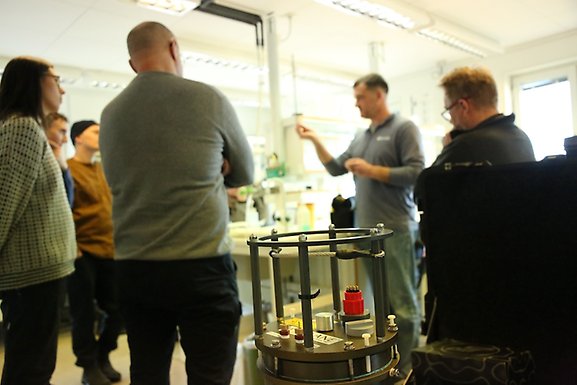
Thomas Fougere, from the company that developed the research prototype into a robust field instrument, demonstrates its operation to the team.
Currently, only a few IFCBs are deployed in the seas around Sweden, including at Utö in Finland’s southern Archipelago Sea and aboard SMHI’s research vessel Svea. High-quality images from these operational instruments will be valuable to train and validate the image classification model of the new Askö IFCB. Plankton researchers at the university's Department of Ecology, Environment and Plant Sciences will also be involved in the work.
Connecting to genetic data – and climate-relevant gases
Emma Bell, an environmental microbiologist, leads the new Molecular SeaLab research group at the Baltic Sea Centre. Using modern molecular biological methods (so called meta-omics), her team studies the Baltic sea's microbial communities and their metabolic activity. Microbial presence and activity – including single-celled eukaryotes, bacteria, archaea, and viruses – drive nutrient and carbon cycling, influencing both ecosystem function and climate.
"Through metagenomics, which analyses DNA, we can see which microbes are present in the water and their relative abundances. The IFCB can count cells, allowing us to determine the actual biomass of different species," she says.
"We can also collect data at very high temporal resolution. The IFCB can sample around the clock, which a human cannot. This is valuable because plankton communities vary so much, both over the day and between seasons."
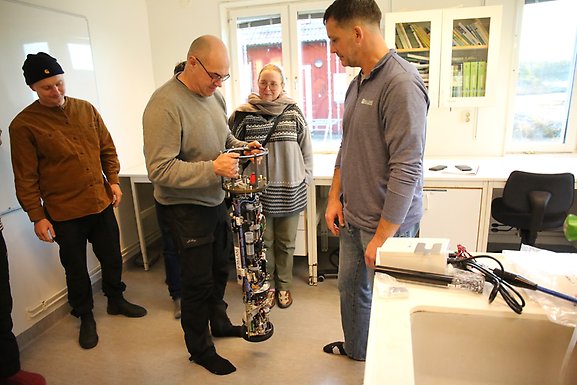
The team is introduced to the instrument. The IFCB is usually mounted in a pressure chamber to allow submersion to 40 metres. From left: Elias Strandell Erstorp, engineer/technician; Christoph Humborg, professor of coastal biogeochemistry and scientific director of the Baltic Sea Centre; Tina Elfwing, director of the Baltic Sea Centre; and Thomas Fougere from McLane Research Laboratories.
The robotic microscope will be installed on a floating platform, currently located in a bay at Askö, where other instruments measure greenhouse gases and volatile organic compounds (VOCs) emitted from the sea.
"We want to link the biology in the water to what is emitted into the atmosphere," says Matthew Salter, marine biogeochemist and aerosol researcher in charge of the floating laboratory.
By combining several different measurements of biological and chemical parameters, the researchers aim to understand how microbial activity influences gas and aerosol formation, with implications for the climate.
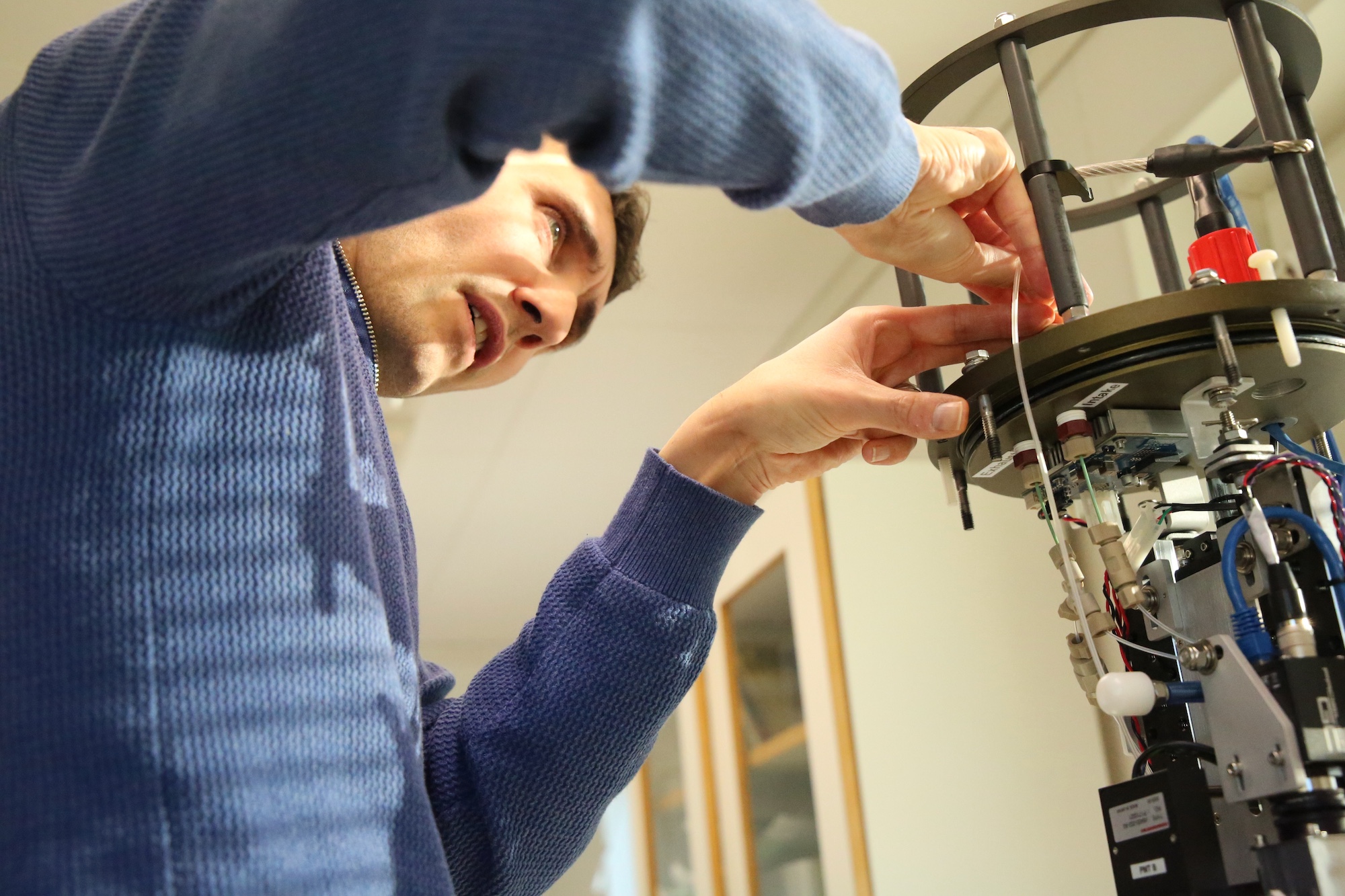
Matthew Salter, marine biogeochemist and aerosol researcher, mounts the narrow silicone inlet tubing through which water is drawn into the IFCB.
Black-and-white images containing a wealth of information
Although images from the IFCB are black-and-white, they contain detailed morphological information, showing plankton shape, size, life stage, and condition.
"You can see, for example, whether cells are about to divide, or hosting parasites," says PhD student Karin Garefelt. In her doctoral research project with the Environmental genomics group at SciLifeLab and Molecular SeaLab at the Baltic Sea Centre, she combines marine biology, genetic engineering, and AI, and will integrate data from the environmental metabarcoding with image data from the IFCB.
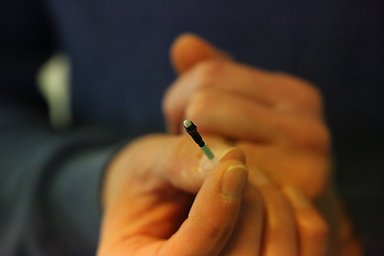
At the end of the inlet tube, a tiny fine-mesh filter prevents particles larger than 150 micrometres from entering the instrument.
Debubbling and focusing
Priming up the instrument begins with an hour of "debubbling", flushing the flow channel to remove all air. The flow is very narrow and must be completely smooth to capture good images. A sheath flow surrounds the sample stream to reduce shear and allow particles to flow gently without bouncing off the walls. Even small bubbles can interfere.
Next, the optics must be adjusted so that the focus is exactly in the centre of the flow channel, ensuring sharp images.
"We're running milk right now," says Thomas Fougere, pumping in "ghost water", i.e. water with a few drops of milk, through the narrow inlet tube. The ghost water makes the laser beam visible inside the flow cell. Team members take turns looking through the alignment tube, learning how to adjust the focus.
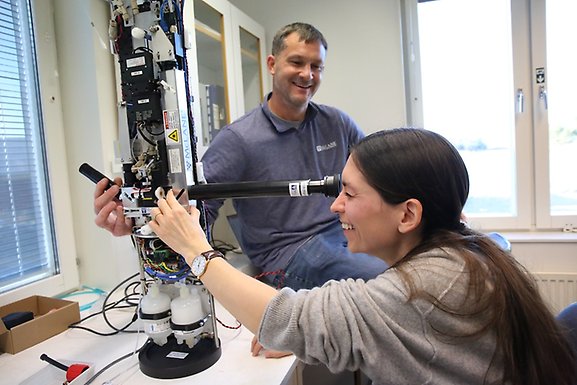
Emma Bell, environmental microbiologist and leader of Molecular SeaLab, peers into the IFCB flow cell through the alignment tube. With the help of this tube, it is possible to control that the narrow flow channel is centred in the field of view, for sharp images.
Soon, real seawater samples from right outside the laboratory are processed, and before long, the first black-and-white images appear on the screen connected to the microscope.
"Mesodinium, maybe a Mesodinium rubrum", says Karin, who recognises the species. "And there were some other ciliates. And there was a diatom!"
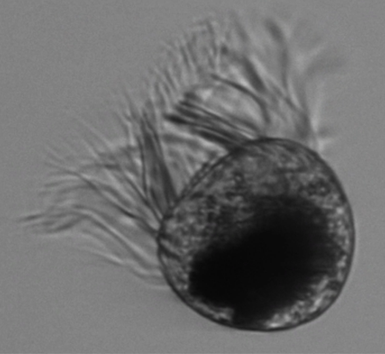
Black-and-white image of a ciliate (species not identified) taken by the IFCB. Ciliates are single-celled organisms that can swim using hair-like projections (cilia).
Part of Askö laboratory’s mobile resources
The IFCB will be placed at the Askö laboratory in the Trosa archipelago. Pioneering marine research has been conducted here for over 60 years. In recent years, cutting-edge studies of atmosphere-ocean interactions are ongoing.
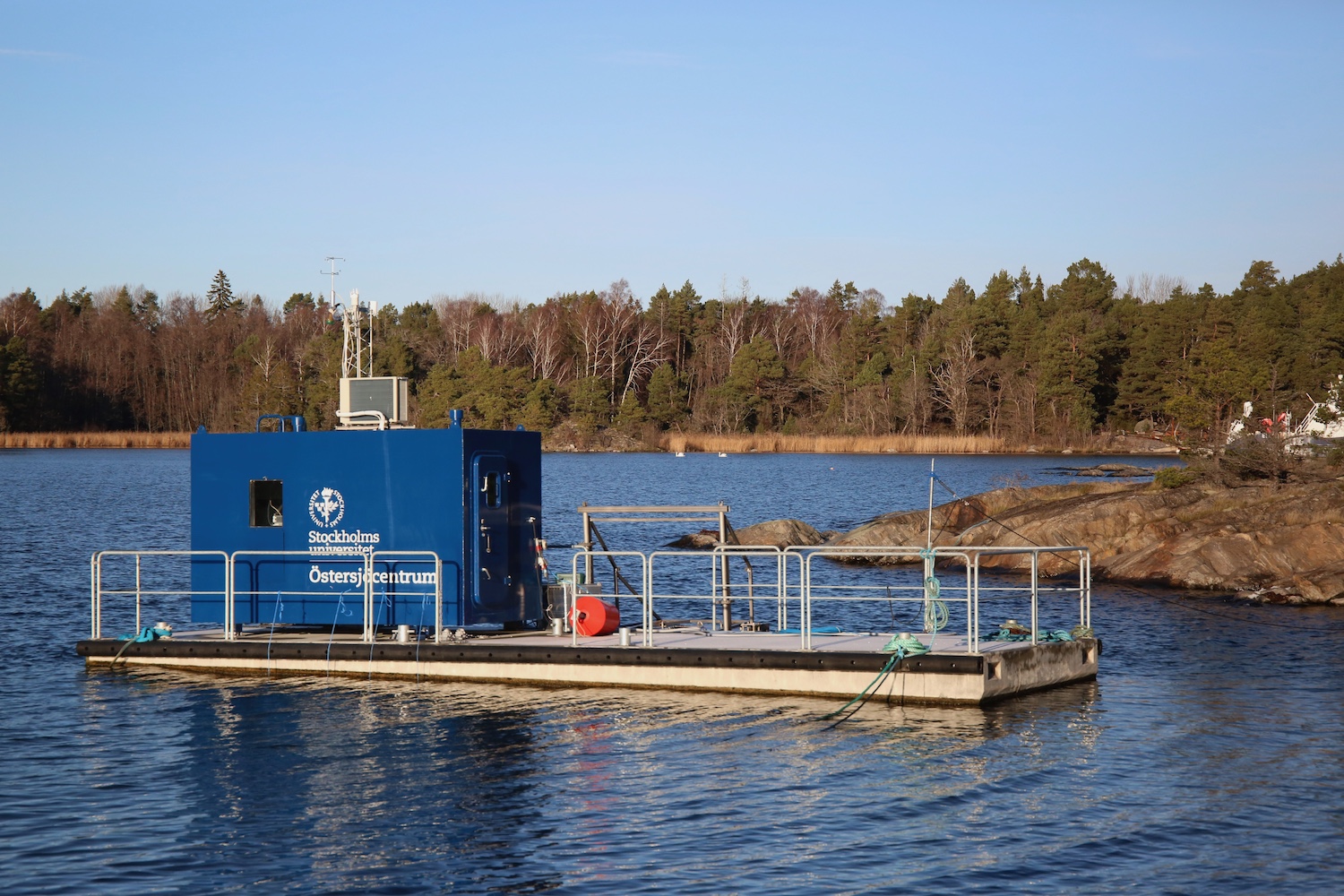
The floating, movable laboratory monitors air–sea interactions, measuring gases, particles, and various environmental parameters in both air and water. The IFCB will be installed here.
Text and photos: Michaela Lundell
Last updated: 2026-03-31
Source: Stockholm University Baltic Sea Centre