


OceanEye, Ocean Pact and Ocean Act – can these new initiatives help the marine environment?
During the European Ocean Days last week a new marine initiative was launched. However, it is unclear how the so-called OceanEye will contribute to a better marine environment, writes Ellen Bruno, policy analyst at the Baltic Sea Centre, who participated in the conference. She also notes that hopes for the upcoming Ocean Act bill are sky-high, but that the result risks being a disappointment.

European Commission President Ursula von der Leyen opened this year's edition of the European Ocean Days, which took place last week in Brussels. Photo: Dati Bendo © European Union, 202X, licensed under CC BY 4.0
This year's European Ocean Days took place in Brussels last week. As usual, the speakers included general directors and middle managers from the Commission's various general directorates, as well as senior ministers and dignitaries from many EU countries. New for this year was the fact that the conference was opened by the President of the European Commission; Ursula von der Leyen. Like many others, she emphasised the importance of the sea for Europe's self-image, culture, food and energy production, as well as for carbon sequestration. Like many others, she also made it clear that the sea is under threat from fishing, pollution and climate change.
In response to these threats, von der Leyen launched a new international alliance at the conference. This alliance will strengthen marine monitoring and observation, as well as supporting the existing European Ocean Observation Initiative, which is now known as OceanEye. This initiative will receive €50 millions of funding over two years. While the conference did not fully clarify exactly how the new initiative will solve the problems facing the oceans, all speakers emphasised that more reliable data leads to better decisions.
Ursula von der Leyen also revealed that she had always dreamed of having a European marine research vessel. 'We believe in science,' she said. While these are admirable sentiments, it is unfortunate that the President of the Commission needs to express them.
Ocean Pact praised
Many of the conference speakers also praised the Ocean Pact, the marine strategy launched by the Commission last June. The strategy was described as a 'turning point' and, at one point as, 'one ring that unites them all'.
The Ocean Pact has six priorities: restoring ocean health and productivity; boosting the sustainable competitiveness of the blue economy; supporting coastal and island communities; advancing ocean research knowledge, and innovation; enhancing maritime security and resilience and strengthening EU Ocean diplomacy and international ocean governance.
These priorities will be familiar to those who have been around for a while from an initiative launched in 2007: the European Maritime Policy. This policy also aimed to adopt a broader approach to the sea, but it was introduced alongside the Marine Strategy Framework Directive, which aimed to ensure its sustainability. Consequently, many people are wondering what new developments the Ocean Pact will bring that can actually help the marine environment.
Hopes are pinned on the legislative initiative known as the Ocean Act, for which consultation has recently been completed.
Several organisations want it to be designed in a similar way to the EU's climate laws, with binding targets for biodiversity. The Stockholm University Baltic Sea Centre, which also responded to the consultation, emphasises that the primary objective of the Ocean Act should be to restore and maintain good environmental status in the sea. Therefore, the issue of conflicting objectives needs to be addressed in the draft legislation. However, no such ambition could be discerned from the Commission during the conference, nor from the consultation, which in principle only mentioned information gathering and marine spatial planning. The plan is for the Ocean Act to be launched later this year.
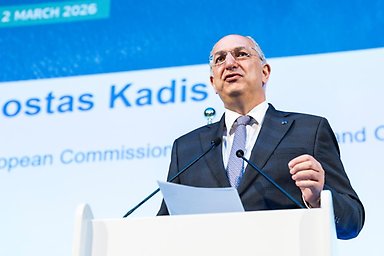
Fisheries Commissioner Costas Kadis emphasised the importance of awaiting the evaluation of the Common Fisheries Policy before discussing changes. Photo: Lukasz Kobus © European Union, 201X, licensed under CC BY 4.0
Call for a simplified fisheries policy
During the conference, representatives of the fishing interest repeatedly called for a 'fisheries omnibus', i.e. a simplified common fisheries policy.
Omnibuses currently seem to be the favourite tool of right-wing forces in the European Parliament, who aim to abolish what they consider to be unnecessary regulations. However, during the conference, Fisheries Commissioner Costas Kadis made it clear that the current fisheries policy must first be evaluated (the evaluation is currently underway), and that depending on the outcome, the Commission may take action.
Instead, the Commission highlighted an upcoming strategy for fisheries and aquaculture: 'Vision 2040'. This will focus on the supply and demand of seafood, labour issues, infrastructure, and the financing of these industries. This strategy is also currently out for consultation.
Another observation from European Ocean Days is that Swedish representatives were absent from the stage. At the same time, certain other countries, such as Finland, were well represented at both government and research levels. Unfortunately, the same pattern was noted last year as well.
Text: Ellen Bruno
Further reading
Comments from Stockholm University Baltic Sea Centre on the proposed European Oceans Pact
Last updated: 2026-03-12
Source: Stockholm University Baltic Sea Centre