


New policy brief: “Derogations in the PFAS ban must be kept to a minimum”
The EU is approaching a historic decision on a wide-ranging ban on PFAS – the group of extremely persistent chemicals currently found in everything from frying pans to electronics and industrial products. However, the effectiveness of the ban will depend on how the derogations are designed, write researchers from Stockholm University and the Swedish University of Agricultural Sciences in a new policy brief.
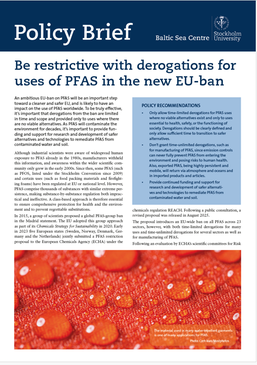
An EU-wide ban on PFAS (per- and polyfluoroalkyl substances) would be of great importance for both the environment and human health, the researchers argue. However, the revised proposal presented by the European Chemicals Agency, ECHA, in August 2025 includes both time-limited exemptions and exemptions without time limits for certain uses, which has raised concerns among the authors of the new policy brief.
“Derogations should be clearly defined, and only allow sufficient time to transition to safer alternatives,” they emphasise.
The researchers behind the policy brief, Ian Cousins, Amanda Rensmo and Romain Figuiere at Stockholm University, together with Lutz Ahrens at the Swedish University of Agricultural Sciences, all work on different aspects of PFAS-related issues. They welcome the prospect of these chemicals being regulated as a group at EU level, as regulating such a large group of substances individually would be both impractical and ineffective. One concern with the current proposal, however, is that it allows continued production of PFAS, both for uses granted derogations under the regulation and for export from the EU. This runs counter to the purpose of the regulation, the researchers argue.
“Emissions control will never fully succeed in preventing PFAS from entering the environment and eventually the human body. In addition, PFAS produced within the EU may return via the atmosphere, oceans or imported product,” they write.
TFA may become the next major environmental problem
PFAS is a collective term for more than 10,000 synthetic chemicals characterised by extreme persistence, meaning that they degrade very slowly or not at all. Many of these substances are also associated with serious health effects, such as liver damage, impaired immune function and an increased risk of cancer.
Where PFAS do degrade, they often form smaller PFAS, such as trifluoroacetic acid (TFA). Concentrations of TFA are increasing rapidly, in plants, groundwater, food and even in human blood. Partly because the molecule is so small, it is difficult and extremely costly to remove TFA from wastewater and from the environment. Previously, TFA was not considered particularly hazardous, but new studies suggest it may have harmful effects on reproduction.
”Without an ambitious PFAS-ban, TFA risks becoming the next long-term contaminant under our watch,” the researchers warn.
Remediation – a parallel necessity
Even if a ban comes into force, PFAS contamination will remain a problem for many years to come, the researchers point out.
Current remediation techniques are expensive, energy-intensive and do not actually break down PFAS, but merely transfer the substances to another medium, such as activated carbon.
“Hence, in addition to banning the use of PFAS, it’s important that research and development of new remediation technologies continues,” the researchers conclude.
Read the full policy brief here:
Be restrictive with derogations for uses of PFAS in the new EU-ban(layouted pdf)
Be restrictive with derogations for uses of PFAS in the new EU-ban (webb text)
Be restrictive with derogations for uses of PFAS in the new EU-ban (text version with references)
Var restriktiv med undantag i det nya EU-förbudet mot PFAS pdf, 3 MB. (in Swedish)
Last updated: 2026-03-19
Source: Stockholm University Baltic Sea Centre