


VIDEO: Tallberg and Dellmuth's joint interview on SCGG
Jonas Tallberg and Lisa Dellmuth, co-directors of the Stockholm Center on Global Governance, SCGG, gave an interview earlier this year with the Swedish Research Council.
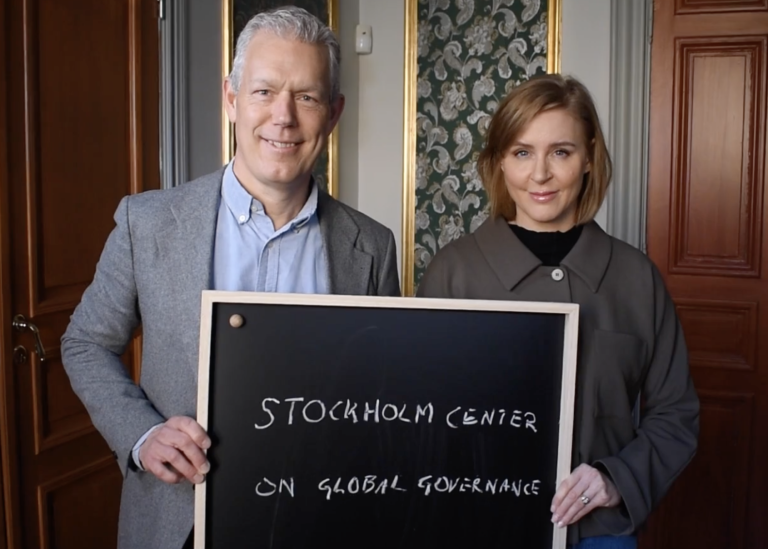
Jonas Tallberg and Lisa Dellmuth, Stockholm Center on Global Governance, SCGG. SCGG is one of 15 centers of excellence funded by the Swedish Research Council as from 2024. Photo: Swedish Research Council © 2024
Watch the full video here
Read the full transcript of the video below
TALLBERG: Well, the central theme of our research center is the contestation of global governance. And the starting point for our research is the observation that global governance is in demand like never before. We need international cooperation among states and non-state actors to combat problems like climate change, health pandemics, military conflicts, refugee flows, financial crises, and so on.
At the same time, global governance is more contested than ever before, and we see rising powers like Russia and China who are contesting the legitimacy of the existing international order. We have anti-globalist populists like Donald Trump and Marine Le Pen, who are challenging multilateral cooperation in a variety of ways.
And then we have a very different type of contestation coming from civil society groups that are demanding more ambitious, more effective, more democratic and more fair global governance.
So our interest in this research center is to explore these issues with a focus on four different themes: the sources of contestation, the processes of contestation, the consequences of contestation, and also how global governance in a more future oriented perspective can become more democratic, fair and effective.
DELLMUTH: Innovation in Swedish research today really requires three key ingredients originality, a robust method, and interdisciplinarity.
In terms of originality, be theoretical, empirical or mythological it really requires that you place your research at the international forefront. To facilitate this, our center pulls research at various institutes and departments at Stockholm University, and we seek to inspire and enable synergies.
And in terms of the method, past research tells us that, inspiring innovation in global governance research really requires a comparative approach. If you compare across time, for example, international events over time, across geographical space or across social groups, you arrive at a more robust evidence than if you were to look at one single instance, such as one country, say, Sweden.
TALLBERG: How do we know if we've succeeded in creating a successful research environment? That's a really good question. I think we would say that the answer would come in two different parts, that the first part would be focused on collaboration.
I mean, considering where we've come from, you know, we're a center that tries to bring together people from different disciplines of Stockholm University to pool their expertise, to work together. So, you know, getting people to actually talk to each other and to work together to a greater extent than ever before, I think would be the first sign of success.
The second indicator of success would be, impact and impact on the one hand, involves scientific impact in the sense of publications in excellent publication outlets, leading journals and leading academic publishers. But it also comes in the shape of societal impact, us actually contributing knowledge to the public debate and to the to informed public decision making. And I think those would be the parts that we would emphasize.
DELLMUTH: Right. I think a key benefit for society is clearly that this is the first center on global governance research in Northern Europe, and this is so important in today's ever more global world, where transboundary challenges are becoming more present. Think of climate change, forest displacement, health pandemics, military conflicts and more.
And I think our center will provide the robust knowledge that is needed in order to foster international cooperation and the international solutions that are required to address these challenges. And I might add that for Sweden, this is particularly important because we are a relatively small and open internationalized country.
Last updated: 2026-04-16
Source: SCGG