


Susan Hyde: Trends in Elections and (Eroding) Global Support for Democracy
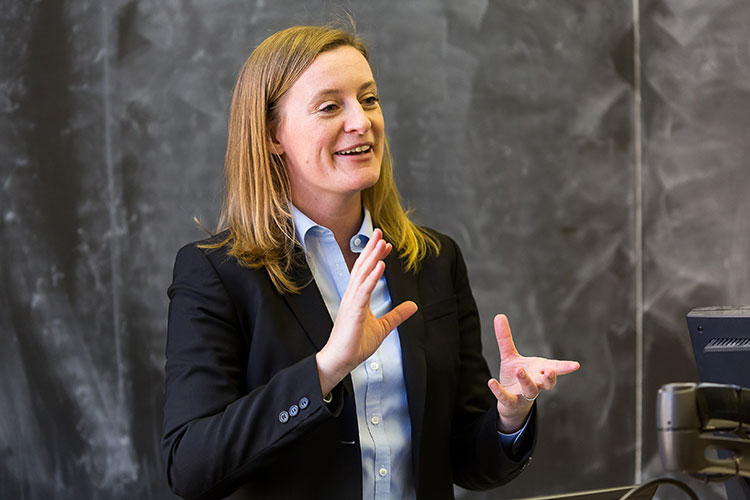
UC Berkeley Political Science Professor Susan D. Hyde. Photo: Tony Fiorini
How should scholars assess the trajectory of democracy globally? We propose a new approach to considering this question, rooted in the assessment of trends in elections over time, and explore recent trends relative to periods in which democracy promotion was less contested and a higher priority for Western democracies in their foreign relations. Join us for an SCGG Talk featuring Susan Hyde, a Kernan Robson Professor in Political Science at the University of California, Berkeley.
Elections are moments when country-level changes in democratic quality are observable, but they are also inconsistent spatially and temporally, potentially contributing imprecise measures of aggregate global changes in given years. To account for this imbalance, we assess electoral quality within five-year moving windows and divide our assessment into three levels of incumbent control: systemic, covering the existence of nominal competition; structural, reflecting the degree to which power can actually change hands; and agentic, relating to the electoral environment over which incumbents have more direct control. We reveal that, while the post-Cold War era featured large democratic gains across all three levels, recent concerns about democratic backsliding are rooted more narrowly in the agentic level. We also show that much of the recent reversion is limited to regimes that advanced toward democracy after 1991.
Bio
Susan D. Hyde is the Kernan Robson Professor of Political Science at the University of California, Berkeley, where she is also Director of the Institute of International Studies. She works on the role of regime type in international politics, international efforts to promote democracy, elections, and field experiments, and is the author of The Pseudo-Democrat's Dilemma: Why Election Observation Became an International Norm (Cornell, 2011). She is a co-creator with Nikolay Marinov of the NELDA dataset on national elections.
Last updated: 2026-10-15
Source: Department of Political Science