


Seminar: Fade to Blue? What the Revamped Senate Reveals about Thailand’s Politics
Join us for a seminar featuring Duncan McCargo, Nanyang Technological University, Singapore. McCargo will talk about "Fade to Blue? What the Revamped Senate Reveals about Thailand’s Politics".
Seminar
Date:
Wednesday 17 December 2025Time:
14.00 – 15.30Location:
C312, Stockholm Center for Global Asia, Stockholm University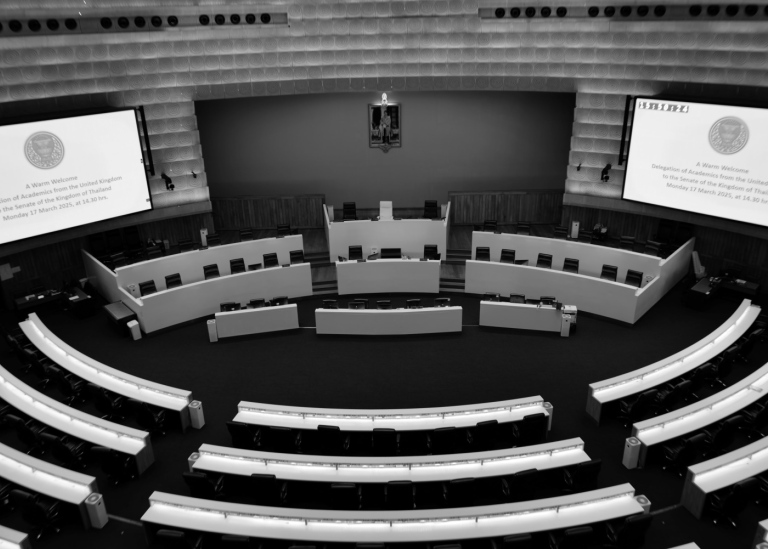
The Senate. Photo: Unknown
Please register at latest by 16 December 2025
Thailand’s Upper House became the focus of intense controversy in mid-2023, when unelected senators, many of them retired military officers appointed by the post-2014 junta, played a central role in blocking Move Forward Party leader Pita Limcharoenrat from being prime minister. A new Senate was selected in June 2024, through a somewhat arcane process, based on a combination of provincial representation and the representation of professional groups. Those nominated for the Senate effectively became voters, who were eligible to choose future senators from among themselves. Whilst in theory this was a non-political process designed to select the best-qualified candidates, in practice it was overshadowed by actors that included the Progressive Movement (linked to the Move Forward Party), the Pheu Thai Party, and especially the Bhumjai Thai Party.
The resulting Senate comprises 200 members, around three-quarters of whom are now closely linked to the influential Bhumjai Thai Party – the so-called blue faction, who were initially known for wearing blue clothing during parliamentary sessions to signal their loyalties and solidarity. Around 10-15 senators make up the independent or progressive group, who have been pressing for greater democracy and transparency. But given the blue faction’s powers to appoint key officials such as Constitutional Court judges, coupled with the group’s de facto veto power over constitutional reform, the new Senate may once again prove the graveyard of progressive politics in Thailand.
Drawing primarily on elite interviews, this paper analyses the selection, performance and dynamics of the post-2024 Senate, and asks what lasting significance the new chamber may have for the future of Thai politics
Duncan McCargo works primarily on the comparative politics of Southeast Asia, especially Thailand. His Tearing Apart the Land: Islam and Legitimacy in Southern Thailand (Cornell 2008) won the inaugural 2009 Bernard Schwartz Book Prize from the Asia Society; he most recently co-authored Future Forward: The Rise and Fall of a Thai Political Party (NIAS 2020). After a lengthy career at the University of Leeds and shorter stints at Columbia and Copenhagen (where he served as director of NIAS) in mid-2023 Duncan was appointed professor of global affairs at Nanyang Technological University in Singapore. At NTU, he is working on a new book about the politics of generational contestation in Thailand.
TIME: Wednesday 17 December 2025, 14.00-15.30
VENUE: C312, Stockholm Center for Global Asia, Stockholm University
Last updated: 2025-12-02
Source: SCGA