


New website offers insights into the population’s living conditions
How have people’s living conditions in Sweden changed over time? What differences exist between various groups in society – and how have these developed up to today? A new website is now being launched that makes unique data from the Swedish Level of Living Survey easily accessible through an interactive visualisation tool.
The Level of Living Survey (LNU) is one of Sweden’s most important social science studies. Since the first data collection was conducted in 1968, LNU has followed people’s living conditions and how they change over time. The survey covers key areas such as work, education, economy, health, family life, and housing.
Data covering nearly half a century
On the new website, visitors can now explore aggregated LNU data from the period 1981–2022, presented through user friendly charts and tables. The visualisations cover most areas of the survey and make it possible to follow developments over time in a clear and accessible way.
Using the visualisation tool, it is possible to view averages for the entire adult population or to break down results by different groups and see how differences have changed over four decades. For example, users can compare living conditions between women and men, across educational levels, or between people born in Sweden and abroad.
During the spring, data from earlier surveys will be added, with the aim of making all LNU waves available in the tool.
 Zoom image
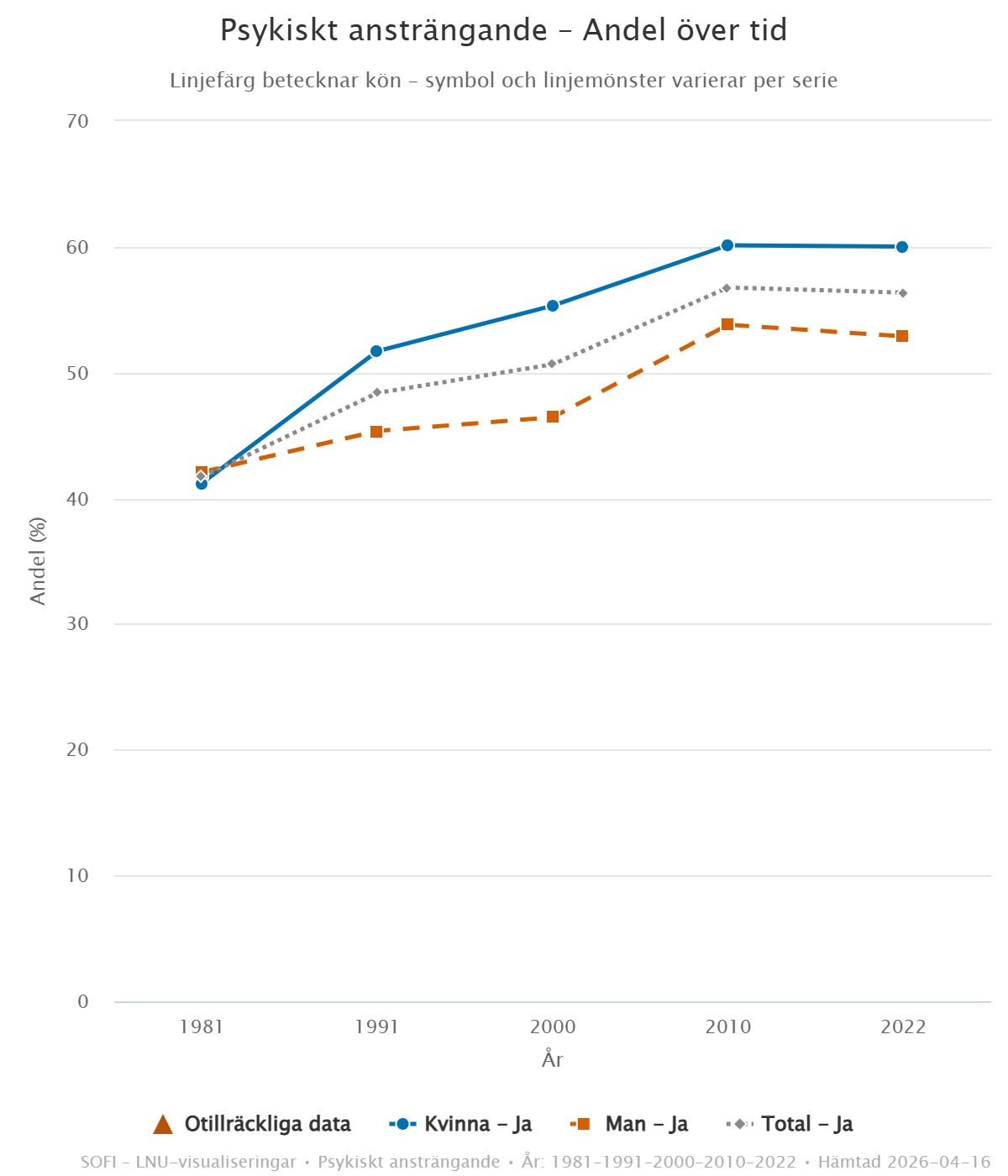
Share of respondents who answered “yes” to the question “Is your work mentally demanding?”.
Free access to aggregated data
The visualised results are based on aggregated data and are freely available online. The aim is to make knowledge about living conditions accessible to a wider audience, both within and beyond academia.
— We want as many people as possible to be able to use LNU, while at the same time we apply strict criteria for disclosure of microdata. With the visualisation tool, anyone can produce statistics at an aggregated level, that is, data that are not linked to individuals, says Katarina Boye, associate professor and and director for the Swedish Level of Living Survey.
The website is intended for use by people working in public authorities, students, and others interested in how societal development affects people’s lives.
— As we have data covering a long period of time, they can be used to produce statistics on changes in living conditions that are relevant to various public agencies. They can also be used to gain a general overview of developments within specific welfare areas. For example, we have extensive information on working conditions and the work environment, adds Katarina Boye.
Researchers can also use the visualisation tool to get an initial overview of the data before proceeding to apply for access to LNU microdata.
About LNU
The Swedish Level of Living Survey is conducted at Stockholm University and is a recurring national survey study. It is one of the world’s oldest ongoing panel studies and has been carried out in repeated data collection waves at intervals of approximately five to ten years.
The longitudinal design, in which many participants are followed over long periods of time, makes it possible to analyse how people’s living conditions are connected and how they change in the long term. With the launch of the new website, another step is taken toward making this unique data resource visible and useful to a wider audience.
Explore LNU data in the visualisation tool (in Swedish)
Apply for access to LNU microdata (in Swedish)
The Swedish Level of Living survey (LNU)
LNU is a recurring survey in which a sample of Sweden's adult population is interviewed or fills out questionnaires about their living conditions.
The purpose of LNU is to study people's living conditions and how these change over time. The survey has been carried out seven times since 1968. The eighth round of LNU data collection is being carried out during 2026.
LNU is part of the REWHARD research infrastructure and is located at the Swedish Institute for Social Research (SOFI), Stockholm University. Project leaders for LNU are Carina Mood, professor of sociology and Martin Hällsten, professor of sociology.
Last updated: 2026-04-17
Source: Swedish Institute for Social Research,Department of Psychology