


The Mecca Alliance for Defence and the Emergence of a Tripolar Middle East?
SUITS Policy Brief 2026:3. This policy brief aims contribute to a broad and well-researched understanding of Turkey and Turkish affairs through presenting a variety of voices on current issues and the foundational moments that impact today. The aim is to provide policy makers and others the tools to make informed decisions.
Paul T Levin a docent at Stockholm University and the director of SUITS
Summary
On 7 August 2026, Saudi Arabia, Turkey, and Pakistan signed the Mecca Joint Defence Agreement, creating the Mecca Alliance for Defence, whose mutual-defence clause resembles NATO’s Article 5. This brief argues that the alliance reflects a move toward multi-alignment in response to an unreliable United States and regional instability, and signals an emerging tripolar system of regional blocs (a “Sunni bloc, an “hexagon alliance,” and Iran’s Axis of Resistance). The Mecca Alliance could stabilize the region through deterrence, but it can also fuel an arms race. If deterrence fails, the complex system of regional blocs could widen local wars. For Europe, the downside risks include disrupted energy and trade, refugee flows, linked conflicts across theatres, and strain on NATO cohesion given Turkey’s dual commitments and the Greece–Turkey divide. Europe should maintain relations with both blocs, work to de-escalate, and support redundant infrastructure and connectivity.
The Issue
On August 7, Saudi Arabia, Turkey, and Pakistan announced the signing of the Makkah (Mecca) Joint Defence Agreement. The agreement establishes the Mecca Alliance for Defence, which is “intended to strengthen collective deterrence against any act of aggression, and stipulates that any armed attack against any one of the three States shall be regarded as an attack against them all.”
The alliance bears the name of the city in which it was inked—the holiest city in Islam—and some observers have dubbed it a “Sunni NATO.” The members form the core of a Sunni regional bloc, and Article 2 of the Mecca Agreement is similar to NATO’s Article 5. Still, much work remains before the alliance is fully operational. Pakistan and Saudi Arabia have reportedly ratified the agreement, while the Turkish parliament is doing so at the time of writing. A Secretariat is to be established in Riyadh. Foreign and defense ministers, along with military chiefs of the three states, held their first meeting in Istanbul on August 31, 2026. The post of Secretary-General (SG) will rotate every three years, and the first SG is retired Lt. Gen. Nauman Mahmood of Pakistan.
The three countries bring complementary strengths and interests to the alliance. Pakistan is nuclear-armed and has a large standing army. Turkey brings battle-proven forces that operate to NATO standards, along with a prominent, dynamic arms industry. Saudi Arabia contributes energy and financial muscle. Together, they can muster over a million active troops.
This brief argues that the creation of the Mecca Alliance represents a move toward multi-alignment in response to an unreliable America and regional instability. The Mecca Alliance signals the emergence of a tripolar system of regional blocs and is ultimately an attempt to balance, deter, or defend against threats from the other two blocs.
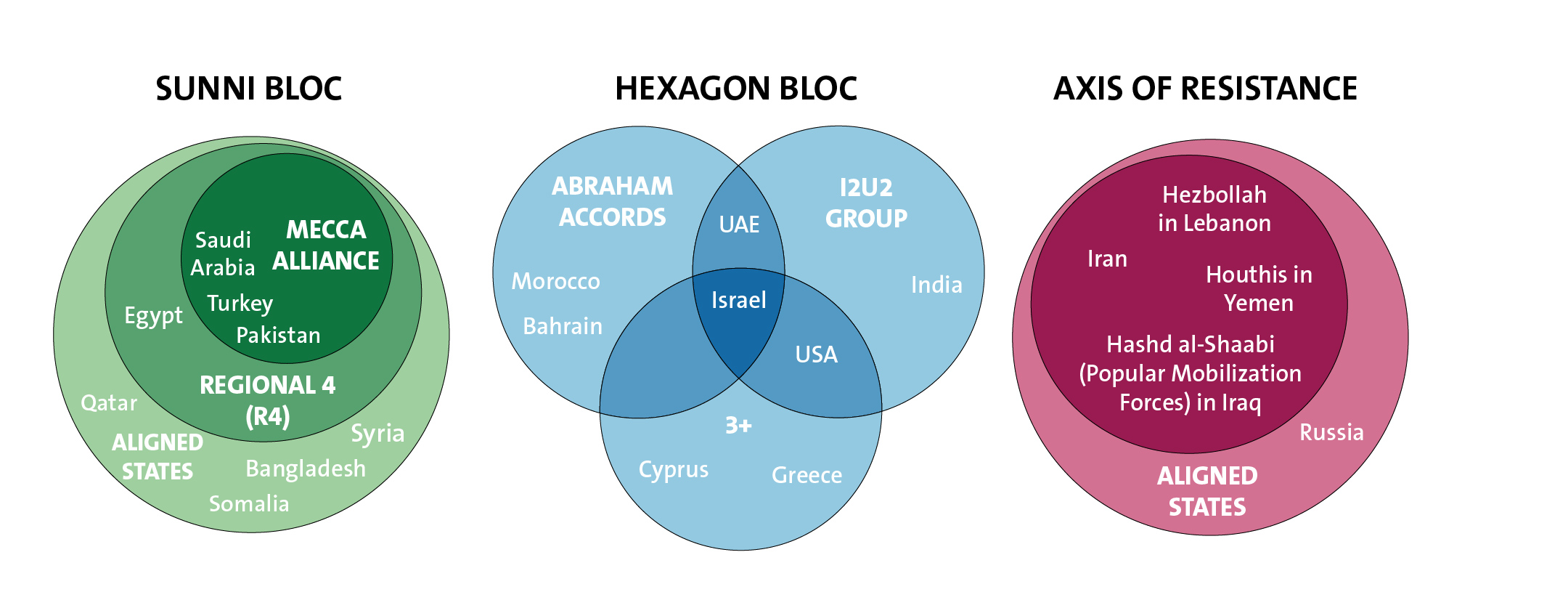
The implications for European security could be significant even if the dual alliance commitments of NATO member Turkey could be managed. In the best-case scenario, this could create a more stable balance among regional powers. In the worst-case scenario where deterrence fails, it could help spread local wars beyond the region.
Analysis
Multi-alignment in a tripolar region
The emerging tripolar system is mapped in the diagram above. While neither the cohesion nor the stability of the blocs should be exaggerated—the Mecca Alliance is the only formal collective defense treaty of the three—they are a useful representation of shifting political alignments in the broader region. From the point of view of the members of the Mecca Alliance, multi-alignment and diversification away from an over-reliance on the USA is a logical response to the close US partnership with their rivals in what Israeli Prime Minister Benjamin Netanyahu has called Israel’s Hexagon of Alliances.
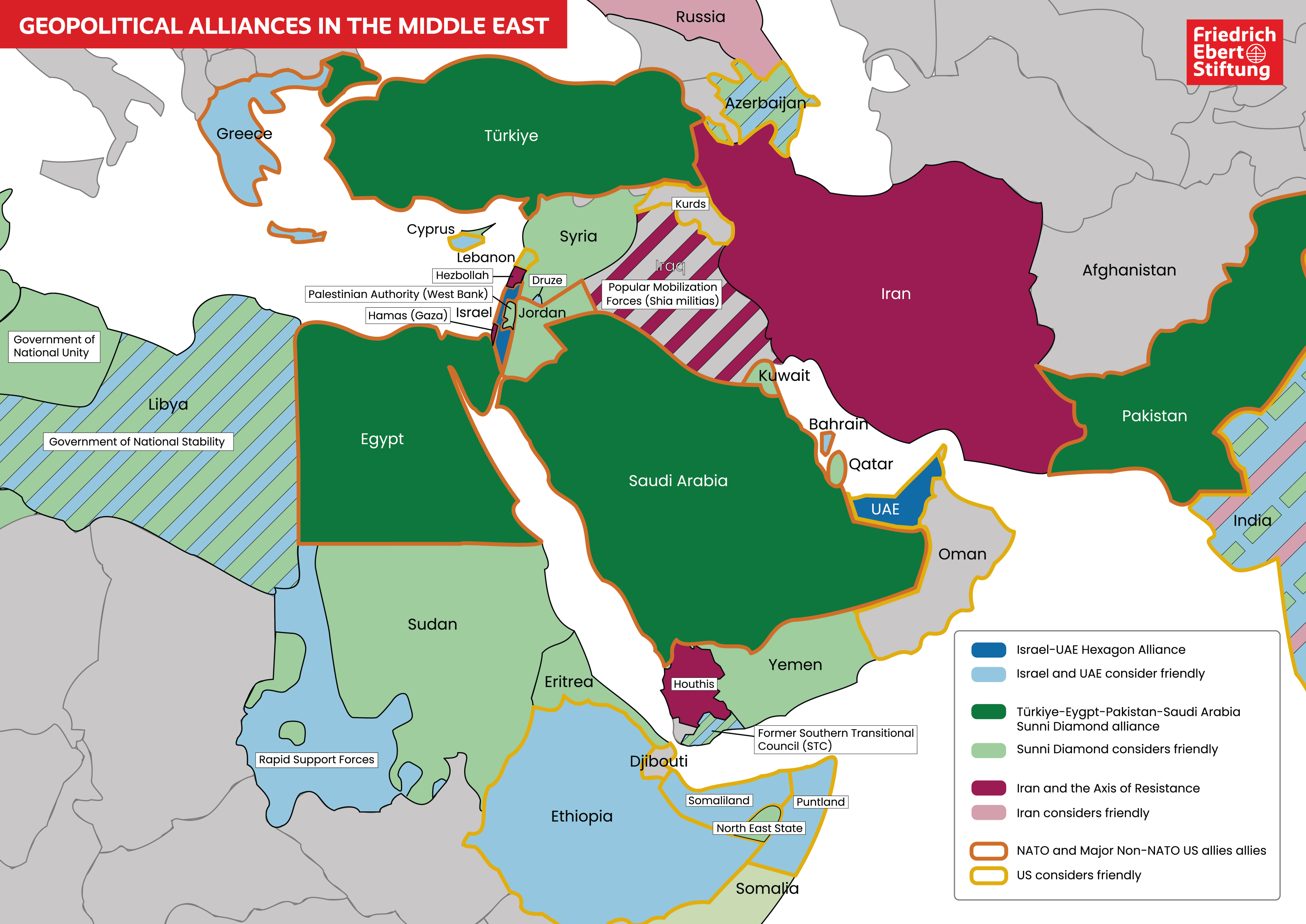
Courtesy of Marc Saxer and Marcus Schneider, Friedrich-Ebert-Stiftung
Deterring/defending against the Axis of Resistance
The small number of Iranian strikes against Turkey during the 2026 Iran War were successfully intercepted by NATO air defenses, but Saudi Arabia suffered multiple attacks despite the presence of American forces in the country. This contributed to the Kingdom’s desire to broaden its security partnerships.
The alliance’s ability to deter and/or respond to aggression has been tested almost from day one, with strikes against targets in Saudi Arabia by Iranian ally, the Houthis. Since these attacks are launched by a non-state actor, they do not technically trigger the collective defence clause (Article 2) of the Mecca Agreement, which concerns attacks “by another country or a group of countries.” However, they may still chip away at the credibility of the alliance if they go unanswered. The three declared on October 5 that Turkey and Pakistan would “move immediately to the practical implementation of the collective defense commitments” of the pact and the rapid deployment of the agreed-upon forces and capabilities to Saudi Arabia.
Balancing against the hexagon alliances and its partners
The members of the alliance also view Israeli belligerence and regional ambition as a major challenge. Following Hamas’ terror attack against Israel on October 7, 2023, Israel adopted a forward defense posture and conducted military strikes not just in Gaza, but in Iran, Lebanon, Yemen, Iraq, Syria, and Qatar. The latter strike in particular shocked many governments in the region, as Qatar hosts the largest US base in the Middle East.
Officials emphasize that the Mecca Alliance is not aimed at any particular country, but the timing of its creation is revealing. According to Turkish Foreign Minister Hakan Fidan, work on the Mecca Alliance began two months into Israel’s Gaza war, and it was signed six months into the 2026 Iran war that, according to reports, Israel had lobbied for. What might be described as a precursor to the alliance, the Strategic Mutual Defense Agreement between Saudi Arabia and Pakistan, had been inked in September 2025, only a week after Israel’s Doha strike.
All members of the alliance have adversaries in the hexagon alliance that they wish to balance against. Ankara is concerned that its growing rivalry with Israel could turn into a military conflict, and long-standing territorial disputes with Greece in the Aegean and Eastern Mediterranean remain. A growing rivalry between Saudi Arabia and the UAE shapes Saudi calculations, and the four-day war between Pakistan and India in 2025 heightened a desire in Islamabad to secure formal defense pledges from capable regional partners.
Implications
For regional stability
The Mecca Alliance could be a stabilizing force in the region. The clearly stated intent behind its creation is collective defense. If that ambition is backed up by credible commitments and capabilities, the alliance could act as a deterrent to Iranian aggression and a counterbalance to an otherwise unchallenged and unrestrained Israel.
However, the opposite is perhaps more likely. If the alliance proves a force to be reckoned with, it may prompt regional adversaries to balance against it and trigger a regional arms race. If it instead appears weak, it may encourage adversaries to test it, and an alliance where deterrence fails can end up turning bilateral conflicts into broader wars.
The rivalry between Mecca Alliance/R4 members and UAE/Israel is already playing out in proxy wars in the Horn of Africa that run the risk of both vertical escalation (in intensity) and horizontal escalation (geographic spread). The rivalry between the Axis of Resistance and the other two blocs is playing out in the Gulf, with serious risks of escalation in both Yemen and Iran at the moment of writing. If these wars were to “link up,” the result could be a major regional war.
For Europe
Europe would not be able to shield itself from instability created by such developments, which could further disrupt energy and trade flows and trigger refugee crises. Given that these bloc formations bind together geographies as remote as the Aegean Sea and South Asia, the horizontal escalation of local wars could also become a matter of direct concern for Europe.
There are already worrying signs of linkages between ongoing conflicts on different continents. Russo-Iranian collaboration is well established, and Ukraine has struck ships linked to Iran in the Caspian Sea. Ukrainian specialists and Russian mercenaries are operating against each other in several African conflict zones, including Sudan, where members of both the Sunni Bloc and Hexagon Alliance are are also active, supporting opposing sides. In the worst-case scenario, multiple distinct theatres could merge, potentially involving states in Europe, the United States, Africa, the Middle East, and South Asia.
For NATO
Turkey is now a member of two formal military alliances. This need not be a problem. Article 12 of the Mecca Agreement states that it “does not prejudice the rights and obligations of the Parties arising from the international agreements they have already concluded.” Nevertheless, this multi-alignment does raise political and operational/institutional questions for both Turkey and NATO that will have to be ironed out as the new alliance develops. Any war involving members of both the Mecca and “Hexagon” alliances could certainly pose serious challenges to NATO cohesion, given that Greece and Turkey are both NATO members but linked to opposite blocs.
European states should take a keen interest in the developments described in this brief. Unfortunately, it is hard today to point to a clear, unified European policy towards the Middle East. Regional actors therefore do not consider Europe a key player whose interests must be considered.
Without a more forward-leaning European agenda, the EU should at least avoid being dragged into Middle Eastern conflicts by external actors like the United States or by EU members pursuing their own interests. The Mecca Alliance is not a coalition of democracies, so there is limited value alignment with Europe, but they share an interest in promoting stability. Europe should support that objective.
Takeaways
- Europe should maintain good relations with members in both the Mecca Alliance and the “hexagon alliance” and work to contain and de-escalate regional wars.
- The EU should promote development by supporting redundancy in infrastructure and connectivity projects as opposed to picking winners.
- Europe, in cooperation with other democratic middle powers, should position itself as a democratic, reliable, and non-corrupt alternative to the global powers active in the region.
Further reading
Ziya Öniş. Regional Powers and the “Post-American” Middle East: Perspectives on the Mecca Defense Alliance Global Panorama. 8 September 2026
Azeema Cheema and Mohanad Hage Ali, The Mecca Agreement Unpacked Diwan (Carnegie Endowment). 13 August 2026
About the author
Paul T Levin is Director of the Stockholm University Institute for Turkish Studies and Managing Director of the Consortium for European Symposia on Turkey. He is a Docent in International Relations and is frequently consulted by media and authorities on Turkish and international affairs. A Research Fellow at the Swedish Research Institute in Istanbul and an Associate Researcher at the Swedish Institute for International Affairs, Paul received his Ph.D. in International Relations from the University of Southern California.
Last updated: 2026-11-02
Source: Communications Office