


Insecure jobs linked to higher fertility intentions among some migrant groups
Short-term contracts and insecurity in the job market drive many to postpone having children. But for non-Western migrants, the opposite is the case, according to a new study in Demography by Mimmi Lounela, PhD at Stockholm University. The correlation is especially strong among men.
In recent years, the Western countries have experienced higher levels of migration, while fertility rates have decreased. At the same time, labour market insecurity has become more prevalent, especially among non-Western migrants.
To find out how labour conditions affect fertility intentions, Mimmi Lounela has analysed the Swedish and Norwegian part of the Generation and Gender Survey. She has found that non-Western migrants in insecure jobs express a wish to become parents in the near future, to a greater extent than their Swedish-born counterparts.
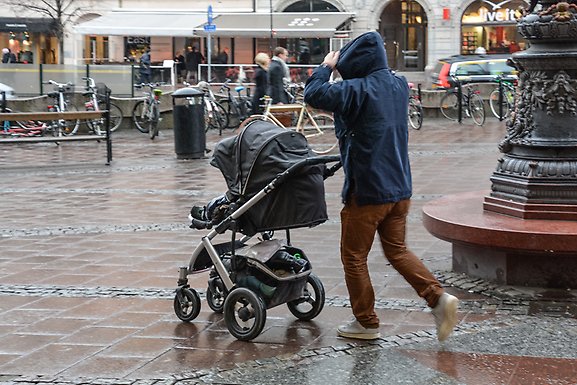
Photo: Mickes fotosida/Mostphotos
The results are surprising, according to Mimmi Lounela, because the usual expectation in social theory is that disadvantages among marginalised groups tend to accumulate and lead to more negative outcomes. Since non-Western migrants experience many different dimensions of insecurity, one could have expected that an insecure job situation would have a more negative impact on their intentions to have children.
A possible explanation for differing effects of insecurity on different groups could be related to different expectations about the future. Because the study focuses on fertility intentions instead of actual outcomes, it gives an indication of how the subjects see their future.
”The insecurity on the labour market has become normalised among these groups. If everyone around you is also in a precarious situation, then it may not have a significant impact on your plans, because you don’t have the same expectations regarding the need to have a stable job before you become a parent”, says Mimmi Lounela.
The study also shows that this positive effect of job insecurity on fertility intentions is strongest among men. According to Mimmi Lounela, this indicates that the intention to build a family cannot be explained only by cultural or normative differences. For instance, one could have thought that men from more patriarchal societies than that of Sweden would feel stronger pressure to be able to support their family before they have children. However, this does not seem to be the case. Instead, they are more likely to expand their families when they experience some form of employment insecurity.
”I think that there are many mechanisms at play here. This is very much part of the public discourse at the moment, and it is important to provide more nuanced information and design policies that take the increasing heterogeneity of our society into account”, says Mimmi Lounela.
More about the study
This study is part of Mimmi Lounela’s coming PhD thesis. There, she also plans to study fertility outcomes among these groups, to form a broader picture of the interplay between labour market conditions and family building.
Read the study in Genus: Employment uncertainty and fertility decision-making: migrant-native disparities in Sweden and Norway
Contact
E-mail: mimmi.lounela@sociology.su.se
Telephone: +46 (0)8-16 25 26
Last updated: 2026-05-19
Source: Department of Sociology