


Structures rather than individual ambitions influence women’s leadership motivation
Clara Plückelmann’s research shifts the focus from individual shortcomings to the structural and cultural factors that influence who is seen – and sees themselves – as having leadership potential.
In February 2026, Clara Plückelmann defended her doctoral thesis entitled Understanding Women’s Leadership Motivation: The role of participative decision making and leader role framing.

The thesis cover.
In her dissertation, researcher Clara Plückelmann looks at women’s underrepresentation in leadership positions. She has specifically studied how organizational expectations often favor stereotypically masculine traits in leaders, and how these expectations shape both women’s and men’s opportunities within organizations and their career choices.
– My work and findings challenge common beliefs about gender inequality and women's underrepresentation in leadership. Primarily, the widespread idea that women only apply for leadership roles if they meet 100% of the requirements, while men apply at 60%, is oversimplified. Our results show that women are less likely to apply only when job requirements reflect stereotypically masculine leadership norms.
Instead, the studies demonstrate that gender inequality in leadership is not primarily about individual ambition or overt discrimination, but about structures and expectations that shape opportunities over time.
– Even in Sweden, often described as a frontrunner in gender equality, subtle, covert inequalities persist. We found that women frequently feel less included in decision-making, specifically decisions regarding the organizational level.
THE STUDIES IN SHORT
Method: Based on large-scale survey data from Sweden and the United States, as well as an experimental study to test how job descriptions and organizational messages influence leadership application intentions, the dissertation explores how stereotypes, participation in decision-making, and leadership motivation are interconnected.
Results: The outcomes highlight mechanisms that operate through everyday practices and interactions: The findings show that who is included in decision-making and who is signaled as having leadership potential matter for long-term career development. This moves the discussion beyond individual-based explanations – such as women lacking confidence – and instead points to structural and cultural factors.
Consequences of a ‘gendered’ workplace
Gender characteristics in the workplace can be understood as the expectations and stereotypes about how women and men ‘are’ and ‘should’ behave. Women are generally expected to be communal, supportive, and nurturing, while men are expected to be assertive, confident, and decisive. Leadership is traditionally more closely aligned with traits ascribed to men, making it harder for women to be seen as potential leaders.
A workplace is considered ‘gendered’ when these expectations are reflected in everyday practices, interactions, and communication. Clara Plückelmann explains:
– For example, men are more often invited to high-level meetings or challenging projects, women’s ideas may be interrupted or overlooked in discussions, and informal networks that support promotions can be male-dominated. Gendered expectations can also be reflected in material objects, such as job ads or company brochures, which often highlight traits and skills traditionally associated with men, subtly signaling who is seen as a typical leader.
Stereotypes shape opportunities and experiences, which then influence career aspirations and advancement, creating a cycle that can perpetuate inequality.
What are the consequences of gender inequality on the organizational level, as well as for the individual?
– On the organizational level, it can limit the talent pool in leadership, reduce diversity of perspectives in governance, and affect overall performance and innovation. For individuals, subtle biases and exclusion can reduce motivation, self-efficacy, and the likelihood of aspiring to leadership roles.
From stereotypes to career outcomes
As reflected in the findings of her studies, Clara Plückelmann suggests that there is a connected pathway: gender stereotypes and norms shape who is included in decision-making, who is recognized as having leadership potential, and who is signaled to belong in leadership roles. These experiences influence individuals’ perceptions of their own fit and readiness for leadership, which in turn affect their willingness to apply for leadership positions and their likelihood of being selected for them.
– Stereotypes shape opportunities and experiences, which then influence career aspirations and advancement, creating a cycle that can perpetuate inequality.
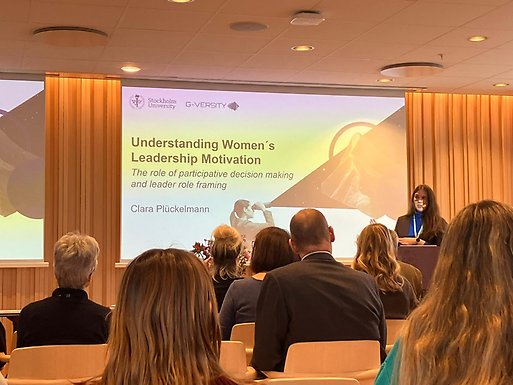
Clara Plückelmann during the doctoral defence. Photo: Private
Strategies to reduce the influence of norms and stereotypes
What could be done from the employer perspective to come to terms with these inequalities?
– From an organizational perspective, reducing inequality means examining structures rather than focusing only on individuals. Employers need to ensure that access to high-visibility tasks, strategic projects, and decision-making opportunities is distributed more equally. This could, for example, be done by making task allocation more transparent, rotating responsibility for high-profile assignments, and regularly reviewing who is included in key meetings and projects. Organizations should also review recruitment materials, promotion processes, and evaluation practices to identify where gendered assumptions may subtly influence decisions. Encouraging female leadership is therefore less about changing women and more about creating fair and transparent systems in which leadership potential is identified and supported based on competence rather than gendered expectations.
What could be done as an employee?
– At the individual level, women can engage in strategies such as developing relevant skills, seeking mentorship, and participating in professional networks to build competence and ensure support. However, it is important to recognize that individual effort alone cannot fully overcome structural and cultural barriers, and that organizations should be the primary focus of interventions.
Finally, what will be the next step for you and your research?
– I hope to continue research on this topic in some capacity and share the findings with organizations to help create more inclusive workplaces. I’m also interested in seeing how these insights can be applied in practice to support women in pursuing leadership roles.
The G-VERSITY project
Clara Plückelmann’s thesis project is part of the European Training Network (ETN) G-VERSITY, which aims at fostering new kinds of expertise and jobs needed in Europe to help employers overcome the underrepresentation of women, men, and sexual and gender minority groups. More info can be found here: gversity-2020.eu/g-versity-project.html
Last updated: 2026-03-06
Source: Department of Psychology