


The strong force may have flipped a switch — and the universe still hums
In a new study, researchers at Stockholm University and the Oskar Klein Centre have found that a theoretically well-motivated extension of the standard description of the strong nuclear interactions could have made the early moments of Big Bang cosmology more tumultuous, leading to a prediction of gravitational waves remarkably consistent with emerging observational hints.
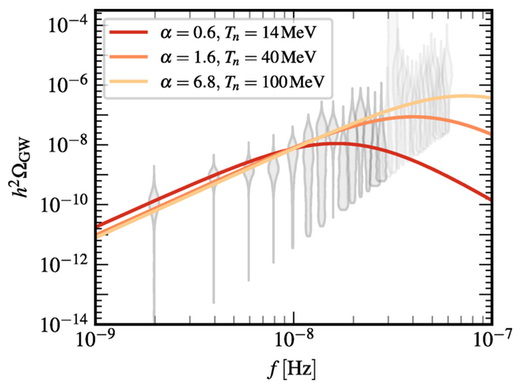
Gravitational wave spectra from a dilaton-induced QCD PT overlaid with NANOGrav 15-yr free-spectrum constraints (two shades of gray violins). The red curve corresponds to the best-fit spectrum to the 14 lowest-frequency bins (darker gray). For more information, see the main text.
During the first microsecond after the Big Bang, the universe was a hot plasma of elementary particles. The building blocks of ordinary matter, quarks and gluons, were moving freely in this hot and dense soup of particles. However, as the universe expanded and cooled, quarks and gluons became confined inside protons and neutrons, forming the matter that we and everything around us is made of. In today’s best theory of the strong nuclear force, Quantum Chromodynamics, that change happened smoothly, without producing dramatic signals observable today.
The starting idea of the new work is that the strength of the strong force might have been controlled by an additional scalar field that, like a switch, weakened the force in the early universe.
“Early in cosmic history, strong thermal effects that lock the switch in a temporary state in which the strong force is weaker than it is today”, says Charalampos Nikolis, a PhD student at Stockholm University and one of the authors of the study. “That delays the moment when quarks are forced to bind together into protons and neutrons ”
When the switch finally flipped, the transition may have happened abruptly, similar to how water boils. Bubbles of a new phase, where quarks and gluons were locked inside protons and neutrons, would have formed and rapidly expanded. These bubbles raced through the surrounding quark-gluon plasma at relativistic speeds, eventually colliding with one another. Physicists refer to this kind of event as a first-order phase transition. While such transitions are common in everyday life, this one would have unfolded on cosmic scales.
“Those impacts would have sent ripples through spacetime in the form of gravitational waves that still wash over Earth today as a cosmic background, a faint, steady cosmic hum”, says Aleksandr Chatrchyan, a postdoc at Stockholm University and Nordita.
“Remarkably, the predicted signal naturally falls in the nano-Hertz range — the ultra-low frequencies probed by networks of precisely timed pulsars — and can match the size and shape of the excess signal reported by pulsar-timing experiments. If confirmed, it would open a new window on the early Universe,” said David Marsh, an Associate Professor at Stockholm University. “The theory can be further tested using both cosmological observations and particle experiments, e.g., by searching for new scalar particles or deviations in the strong interactions at particle colliders, like the LHC, potentially revealing new physics beyond the Standard Model.”
The work, co-authored by Aleksandr Chatrchyan, David Marsh and Charalampos Nikolis, is now published in Physical Review Letters.
More information
Alexandr Chatchryan, Postdoc, Department of Physics, Stockholm University
David Marsh, Associate Professor, Department of Physics, Stockholm University
Charalampos Nikolis, PhD, Department of Physics, Stockholm University
Gravitational Waves from a Dilaton-Induced, First-Order QCD Phase Transition - APS Physical Review Letters
Last updated: 2026-03-27
Source: Communications Office