


New physics course in Quantum Metrology
Mário Bettencourt Amaro is a PhD student who is 24 years old and comes from Alenquer outside Lisbon in Portugal. “I work in unconventional superconductivity, exploring whether electrons can form exotic four-particle condensates beyond the usual pairing, with a focus on BKFA, a family of iron-based superconductors. I’m planning and building the laboratories, and in 2026 I’ll be a Teaching Assistant for the new course in Quantum Metrology.”
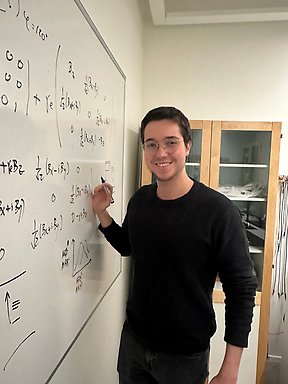
Mário Bettencourt Amaro, PhD Student at Fysikum
He has an engineering background and wanted to understand physics on a fundamental level.
“I needed a deeper understanding and I have a true passion and profound curiosity for the small things that become abstract. Their quantum nature dominates and the world behaves differently”.
Mário finished a bachelor’s degree at the University of Lisbon in 2022. After that he came to Sweden where he studied at KTH and did his master thesis at Mohamed Bourenanne’s research group.
“I’m really enjoying being in Sweden and I like the weather and culture. Sweden is well known for research, engineering and physics. There is a lot of funding and companies. I do love Sweden and I want to stay here.”
Nitrogen–vacancy (NV) centers (which we use in the laboratory) are one of many types of quantum sensors. NV centers are atomic-scale defects in diamond that can be used as sensitive quantum sensors at room temperature. By illuminating them with green light and applying microwaves, we can read out their electron spin through changes in fluorescence, a technique called optically detected magnetic resonance (ODMR). Magnetic fields shift the spin resonances via the Zeeman effect, while temperature changes affect the zero-field splitting. Since NV centers are oriented along four crystallographic directions, measurements from all orientations allow reconstruction of the full three-dimensional magnetic field.
“The course itself (funded by EDU-WACQT) is much broader than only NV centers and covers many other types of quantum sensors, techniques, and the theory behind all of it as well. The NV center laboratory is where we will do two of the three labs of the course, but it is just a selected example of quantum sensing techniques in an ocean of them. With NV centers, one can measure magnetic fields and temperature with very small sensors in very different contexts, from circuits to biological systems and medical applications. The course will be on a master level and we plan for it to be scheduled for the next autumn semester.”
WACQT stands for Wallenberg Centre for Quantum Technology.
Professor Mohamed Bourenanne will be the teacher and Mário Bettencourt Amaro will be the teaching assistant in the laboratory.
“There’s a myriad of techniques to use quantum systems as probes to measure temperature, magnetic fields and many other quantities. We look forward to a great development and welcome students to apply for the course in the spring application period.”
In 2014, Professor Mohamed Bourennane at the Department of physics, Stockholm University, was elected Swedish member of the Academy’s Class for physics in the Royal Swedish Academy of Sciences. Mohamed Bourennane is professor at the Division of Condensed Matter and Quantum Optics, Department of physics, Stockholm University.
Last updated: 2026-03-27
Source: Communications Office