


Proteins in a crowd: European XFEL looks inside cells
Inside our cells, millions of proteins push past each other in a constant crowd, yet they must react quickly when needed. Until now, their movements have been hard to observe. Using the European XFEL X-ray laser near Hamburg, a team led by Anita Girelli and Fivos Perakis at Fysikum, Stockholm University has now captured these motions—and found a surprising pattern.
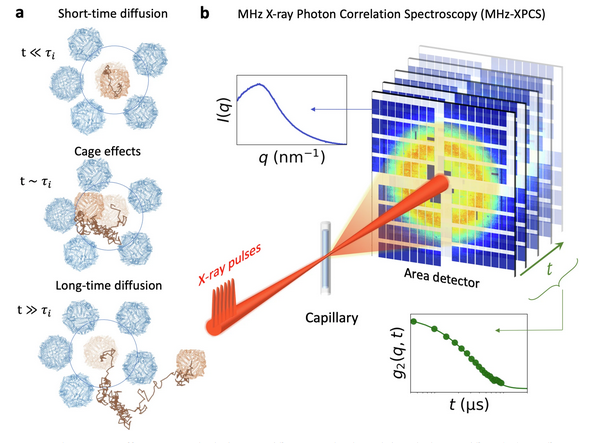
Ferritin protein molecular dynamics at different time scales. Schematic of the Megahertz X-ray Photon Correlation Spectroscopy (MHz-XPCS) experiment.
To understand how cells work, scientists need to know how proteins move in the crowded interior of the cell. When many proteins are packed together, their movements can change—but exactly how has been hard to measure.
Using an ultrafast X-ray technique at the European XFEL, researchers studied how the protein ferritin moves on microsecond time scales. They found that at high concentrations, ferritin doesn’t diffuse smoothly. Instead, it shows anomalous motion, as if the proteins become briefly trapped in cages formed by their neighbors before breaking free again.
Computer modeling confirmed that these unusual movements come from a mix of hydrodynamic effects and direct interactions between the proteins.
These insights help scientists better understand how proteins navigate crowded environments—knowledge that could improve ferritin-based drug delivery, where protein motion limits how fast medicines can be released.

Comic strip about proteins
More information
Coherent X-rays reveal anomalous molecular diffusion and cage effects in crowded protein solutions - Nature Communications
Proteins in a crowd: European XFEL looks inside cells - European XFEL
Last updated: 2026-03-27
Source: Communications Office