


Foundation Year Day - science in a different way
Foundation year students from SU and students from Skarpnäcks adult education center participated in the Foundation Year Day 2025. Study coordinators and study counselors from the various departments also answered questions. Researchers in natural science subjects are the teachers on the education and teaching is given remotely. Some laboratory work and exams are conducted on the Stockholm University campus.
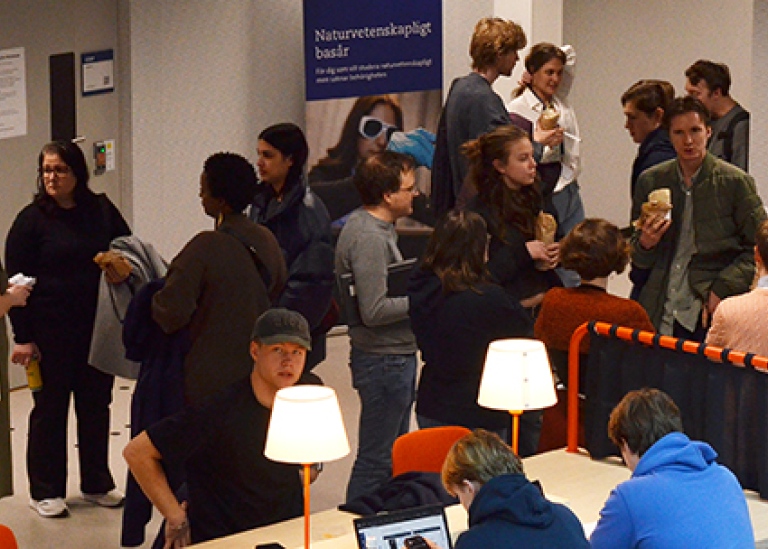
Lunch mingle during the Foundation Year Day 2025. Photo: Gunilla Häggström
"During this morning, you will meet passionate scientists who will be your teachers and see the Physics Show perform experiments. You will be doing laboratory work yourself during the course," said Alexandra Lundholm, the Base Year study administrator. She organized the day as a way to showcase the Base Year subjects in a fun and interesting way, to show a different side of what the university's science education can contribute with exciting knowledge.
Biology lectures
"How do fish choose their spawning partners? What do they look for and how do they do it?" said John Fitzpatrick, Professor at the Department of Zoology. He has been studying what attributes Hemiramphidae, a type of beaked pike, find particularly attractive in a potential spawning partner. They are using AI to study reproductive behavior in a laboratory.
"Why do two different populations in Africa react differently to malaria? We have collected antibodies from the Fulani and the Mossi because the latter have a stronger immune system,” said Anki Östlund Farrants, Professor at the Department of Molecular Biosciences Wenner-Gren Institute. They have made comparisons and the packing of chromosomes differs. She also talked about molecular mechanisms in immunology and metabolism.
Popular Science Lecture in Mathematics
"How many times do you need to shuffle a deck of cards to make it sufficiently mixed?" said Daniel Ahlberg, Senior Lecturer at the Division of Mathematical Statistics.
He is a researcher in probability theory and gave a popular science lecture that links, among other things, to knowledge of gene mixing.
Research in chemistry on botox as a drug
- Botulinum toxin, also known as botox, is the world's most toxic substance. Very small amounts are used in medicine and also for cosmetic procedures, said Pål Stenmark, professor of biochemistry. He said that one tube of 5 ml concentrated is enough to perform cosmetic procedures on 500 million people, or help hundreds of millions of people with medical problems. But it can also kill 2 million people.
PhysicsShow PhD students demonstrate liquid nitrogen and visible sound waves
"How is an apple affected by liquid nitrogen? How can you see sound waves?" Ludwig Neste and Arun Subramani are PhD students at Fysikum. Arun is doing research in molecular physics and spectroscopy at the Division of Atomic Physics. Ludwig is doing research in particle astrophysics, more specifically neutrino astronomy with the IceCube detector located inside the glacier ice at the South Pole. The Physics Show visits many schools, and in doing so, they meet many pupils who will go on to become students. They demonstrated what liquid nitrogen can do, such as making an apple so hard that it can be used to hammer a nail into a board. The audience also got to see how sound waves are affected by loudness using a metal pipe, fire and gas.
More information
Last updated: 2025-03-27
Source: Gunilla Häggström, Kommunikatör, Fysikum