


She wants to change the stereotypes around maths
Eleonora Svanberg wants to change the perception of maths and inspire more young girls to take up the subject. She is currently pursuing a PhD in Mathematical Physics at the University of Oxford and is a passionate advocate for gender equality in STEM (science, technology, engineering and maths).
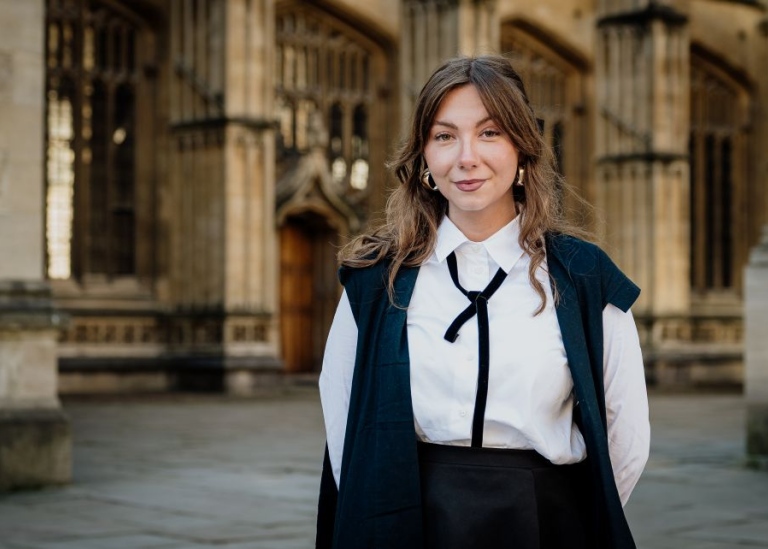
Eleonora Svanberg is doing her PhD in mathematical physics at the University of Oxford. Photo: Laura Smith
She founded the non-profit organisation Girls in STEM to promote gender equality in science, technology, engineering and mathematics. She reaches thousands of followers as a maths and physics influencer on social media and has studied at Stockholm University, the University of Cambridge and the University of Oxford. Eleonora Svanberg has achieved a lot but is far from finished.
"My dream is to do research and at the same time work with gender equality issues in STEM. Getting more young girls to find the love for maths is a big passion for me," says Eleonora.
Early interest in space and maths
"I suddenly remembered how cool space is! That's when I realised that maths and physics are key subjects for understanding the universe."
"Eleonora's fascination with space began as a child, when she combined music with solving maths problems after school. Her interest waned during her teenage years but was rekindled during high school after watching a documentary on the Higgs particle.
After high school, Eleonora chose physics
After completing upper secondary school and taking a gap year, which included working as an hourly teacher, Eleonora began studying on the Bachelor's programme in physics at Stockholm University. She chose the research branch, a variant of the programme that gives students an early connection to research and training in problem solving.
"The opportunity to start researching early was crucial for me to choose this particular programme," says Eleonora."
A time to remember
Her time at Stockholm University was one of the best periods of her life. Small teaching groups and close contact with the teachers made the programme both personal and engaging.
"The Bachelor's programme gave me a very strong foundation that I have benefited greatly from in my further studies. I look back on that time as one of the best in my life."
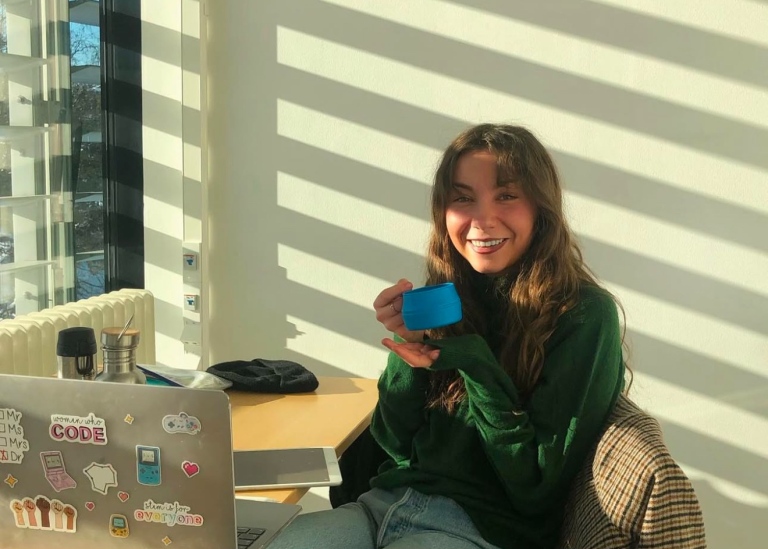
Eleonora studied the Master's programme in physics at Stockholm University. Photo: private
Practised independent learning
One of the most important insights Eleonora gained from her studies at Stockholm University is how to learn to learn. With relatively few hours of lessons, students learnt early on how to independently seek knowledge and solve problems.
"You don't remember all the details from the exams, what you really learn is study skills and problem solving. You become disciplined and develop the ability to be an "independent learner," says Eleonora. That's the most important thing I've learnt from my education and something I can use in all aspects of my life, whether it's assembling an IKEA shelf or learning a new language.
Challenging studies at Cambridge
After a research internship at the University of Cambridge, Eleonora was encouraged to apply for a Master's programme there.
"Studying at Cambridge was intense. Lots of lectures, large classes and all the exams at the end of the year. It was a challenging but educational time."
During her master's she found her research field and today she is doing her PhD in the field of mathematical physics where she uses maths to explain and gain more knowledge about black holes.
"Being able to use maths to understand the universe is like realising my childhood dream."
My sabbaticals have given me valuable experience that has also helped me in academia
Driven by curiosity and the desire to learn
Eleonora is driven by an ever-growing curiosity and desire to understand. But has she always wanted to be a scientist?
"I am driven by the desire to learn more. After each course, I've always felt that there are more questions I want answers to, so I keep going. I also enjoy the research process itself - being confused and not understanding at first, but then, the more you read and think, you start to find answers," Eleonora says.
During her master's programme, she applied for a PhD position at Oxford University - and got it. The first thing she did, however, was to ask for a sabbatical.
"I am not a stressed person. I know I want to do research, but I don't feel pressurised to do everything in a certain timeframe. My sabbaticals have given me valuable experience that has also helped me in academia."
A book on maths confidence
During her sabbatical, Eleonora worked as a consultant for a MedTech company while writing her book, Study with me - how to build maths confidence.
"The book contains all the things I wish I had been told when I first became interested in maths. I want to show that everyone who wants to has a place in the world of maths," she says.
As a young girl in a male-dominated environment, Eleonora knows how it can feel to have to prove yourself.
"In high school, when I became more interested in maths and physics, I often ended up in rooms where I was the only girl. I was questioned and often had to struggle to prove myself. I was lucky to have my mum, who is an engineer. She was an important role model for me."
Alla matematiker behöver inte vara som Einstein
Relatable role models make a difference
Gender equality in STEM has long been close to Eleonora's heart. Today, she is an active maths influencer on Instagram and TikTok. She believes that role models play a crucial role in inspiring the next generation.
"My role models have been other women in my field, especially my supervisors. They have gone through doubts and challenges themselves, and that has inspired me," she says.
Eleonora emphasises the importance of breaking stereotypes in mathematics.
"Not all mathematicians have to be like Einstein. Maths can be used for everything from climate modelling to crochet. We need to talk to children early on about what maths actually is and what it can be used for."
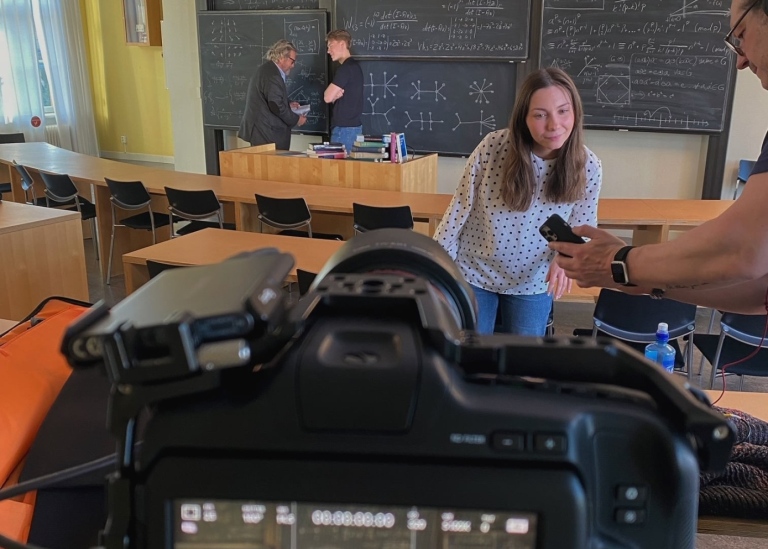
Eleonora reaches thousands of followers as a maths influencer on social media. Photo: private
You don't have to be a genius
You don't have to be a genius to be good at maths either. This is one of Eleonora's most important messages to today's students.
"Don't think you're not smart enough to study physics or maths. Don't let that insecurity stop you. I feel, and will probably always feel, unsmart sometimes - but that's because I'm learning something new. Always dare to try!"
Written by Student Division, Stockholm University
Curious about ...
Stuudy physics - you can find more information here
Study maths - you can find more information here
Follow Eleonora Svanberg ...
Last updated: 2025-01-23
Source: Gunilla Häggström, Communications Officer, Fysikum