


Unlocking Cryoprotection: The Role of Glycerol in Supercooled Water
Researchers uncover how glycerol, a common cryoprotectant, manipulates water's behavior at extremely low temperatures to prevent ice formation. The study, published in Nature Communications, provides a deeper understanding of the complex interplay between glycerol and water, with profound implications for cryopreservation – the science of preserving biological materials at ultra-low temperatures. This is an international research effort, led by Stockholm University (SU), in collaboration with Pohang University of Science and Technology (Republic of Korea), RIKEN SPring-8 Center (Japan) and Brooklyn College of the City University of New York (USA).
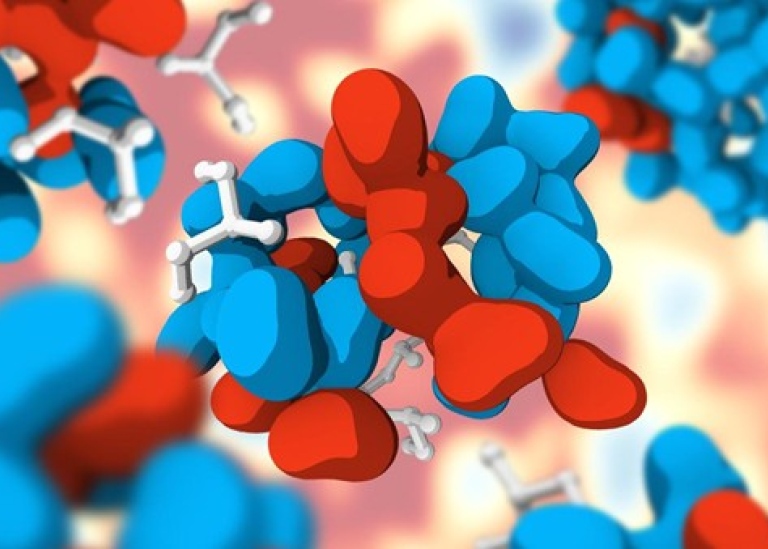
Molecular dynamics simulation snapshot showing the interplay of glycerol (white molecules) with water density fluctuations (red/blue correspond to high/low density regions). Image made by Iason Andronis.
Conducted at the SPring-8 Angstrom Compact free electron LAser (SACLA) facility in Japan, the study utilized advanced experimental techniques and molecular dynamics simulations to investigate the structure and dynamics of supercooled glycerol-water solutions.
New Research uncovers How Glycerol Protects Cells in Extreme Cold
“A key finding of the study is that glycerol, even at dilute concentrations, significantly alters water's behavior at the molecular level” explains Sharon Berkowicz, PhD student at the Physics department at SU. While pure water is known for its dramatic density fluctuations as it cools, the presence of glycerol acts as a stabilizing force, smoothing out these fluctuations and hindering the formation of ice crystals. “This is thought to occur because glycerol molecules, with their unique ability to form multiple hydrogen bonds, disrupt the intricate hydrogen bond network that governs water's properties” Berkowicz adds.
The research also suggests that glycerol shifts the 'Widom line' of water to lower temperatures. “This theoretical boundary is thought to separate the two regions, where water resembles locally a high-density liquid (HDL) and a low-density liquid (LDL)” says Iason Andronis PhD student at the Physics department at SU. He further explains that “By pushing the Widom line to colder temperatures, glycerol makes it more difficult for water to transition between these two forms, further contributing to the suppression of density fluctuations and ice formation”.
To probe these intricate interactions, the research team utilized an experimental setup involving the rapid evaporation of microscopic glycerol-water droplets in a vacuum chamber. This technique, combined with ultrafast X-ray pulses from SACLA, allowed the researchers to capture snapshots of the water molecules' arrangement within the supercooled droplets, revealing the subtle but significant influence of glycerol on water's structure.
Implications for Cryopreservation
“The implications for cryopreservation are significant.” explains Prof. Fivos Perakis. Glycerol is already a widely used cryoprotectant, added to solutions to protect cells and tissues from damage during freezing. The study's findings provide the first direct experimental evidence to explain how glycerol performs its protective role at the molecular level. “By disrupting water's hydrogen bond network and suppressing density fluctuations, glycerol effectively prevents the formation of ice crystals – those microscopic 'daggers' that can pierce and destroy delicate biological structures.” explains Perakis.
The study's findings underscore the importance of basic research in driving innovation and solving real-world challenges. By delving into the fundamental interactions between water and other molecules, the researchers are not only gaining insights into the nature of water itself but also paving the way for breakthroughs in fields as diverse as medicine, materials science, and food preservation.
Reference
Supercritical density fluctuations and structural heterogeneity in supercooled water-glycerol microdroplets
S. Berkowicz*, I. Andronis*, A. Girelli, M. Filianina, M. Bin, K. Nam, M. Shin, M. Kowalewski, T. Katayama, N. Giovambattista, K. H. Kim, and F. Perakis, [*equal contribution]
Nature Comm. (2024)
Last updated: 2024-12-05
Source: Gunilla Häggström, Communications Officer, Fysikum