


Spruce volume increases across Sweden – despite shrinking areas suited under future climate
Norway spruce is of major economic importance in Swedish forestry, but climate projections indicate that large parts of southern Sweden may become unsuitable for spruce by the end of this century. A new study from Stockholm University and the Swedish University of Agricultural Sciences (SLU) shows that current management trends are moving in the opposite direction: spruce volume is increasing, including among young trees, across all regions.
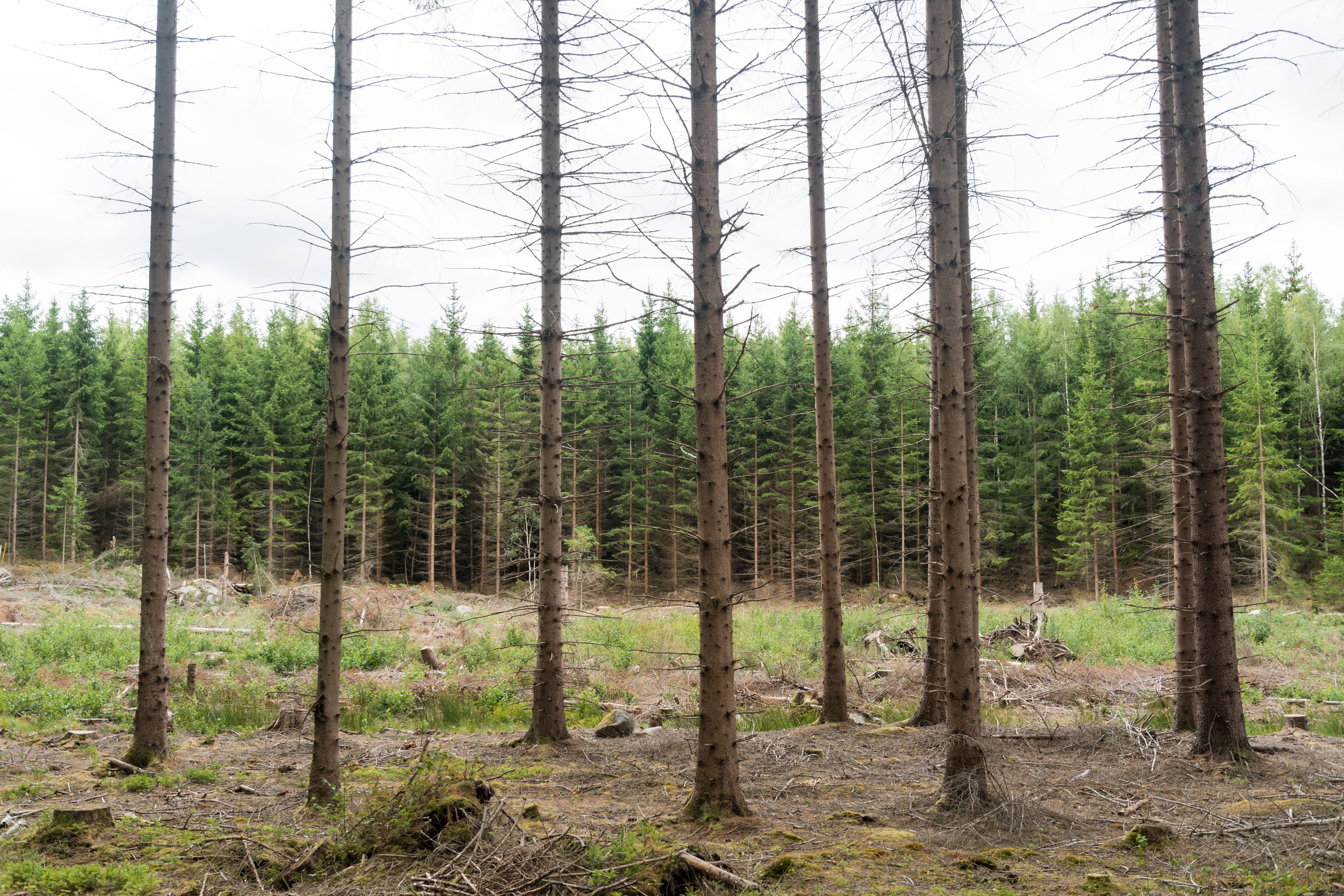
Spruce tree forest in different ages. Photo: Kennerth Kullman/Mostphotos
Caroline Greiser. Photo: Frank Pätz
Using projected habitat suitability for Norway spruce from 2005 to 2095 under two climate scenarios, researchers from Stockholm University and the Swedish University of Agricultural Sciences (SLU) have compared expected range shifts with long-term forest inventory data on spruce growing stock. The results show that in Southern Sweden (Götaland), a large share of spruce stands that existed in 2005 are projected to end up in areas that are no longer suitable for spruce by 2095.
“Under a moderate emissions scenario, by the turn of the next century 55 per cent of Sweden’s spruce forest will be located in areas not suitable for spruce in terms of climate. In a scenario with high emissions, this figure rises to 84 per cent,” says Caroline Greiser from Stockholm University, one of the authors of the study.
At the same time, observed trends in spruce growing stock between 2005 and 2020 often run counter to the projected changes in suitability, although patterns vary between counties. In addition, the growing stock of young trees is rising across all regions of Sweden, indicating that management practices are maladapted to climate change.

Jeannette Eggers. Photo: Mona Bergman/SLU
“Norway spruce is the backbone of Swedish forestry, but our analysis shows a growing gap between where spruce is being planted and where climate conditions are projected to support spruce growth in the long term,” says Caroline Greiser.
The study highlights a risk that forest landscapes may become more vulnerable to climate-related stress where spruce is expanded or maintained in areas projected to become less suitable. The authors argue that climate-adaptive forest planning needs to be more directly integrated into operational decisions – such as tree species choice, regeneration strategies, and long-term risk management – if Swedish forests are to remain resilient as the climate changes.
“Our findings show that planting new spruce trees in Southern Sweden comes with high ecological and economic risks as trees may face a higher pre-harvest mortality due to climate-driven stressors such as drought, windthrow or attacks from the bark beetle,” says Jeannette Eggers, co-author of the study and program director for Forest Sustainability Analysis at the Swedish University of Agricultural Sciences, SLU.
How the study was conducted
The researchers calculated where spruce trees could grow between 2005 and 2095, under two different climate scenarios: a moderate emissions scenario (RCP4.5) where greenhouse gas emissions stabilise leading to an estimated temperature increase in Sweden of 3.0–4.5°C (compared to the period 1971–2000) and a high emissions scenario (RCP8.5) with continued high greenhouse gas emissions leading to an estimated temperature increase in Sweden of 4.5–6.5°C (compared to the same period). The calculations were combined with long-term data from the Swedish National Forest Inventory on how spruce volume has developed.
Publication
Title: Spruce volume increases across Sweden – despite decreasing future climate suitable areas
Journal: Scandinavian Journal of Forest Research
Authors: Schulte, L. A., Greiser, C., Eggers, J., Wallin Viman, M., Jarsjö, J., Schwarz, E. DOI: 10.1080/02827581.2026.2628636
Key findings
- Large projected loss of suitability in southern Sweden: By 2095, much of today’s spruce area in Southern Sweden is projected to fall outside the suitable climate envelope.
- Observed spruce volume trends often move the other way: From 2005–2020, spruce growing stock frequently increased where future suitability is projected to decline, with variation among counties.
- Young spruce is increasing everywhere: The growing stock of young trees is rising across all regions of Sweden, indicating management practices are maladapted to climate change
Last updated: 2026-03-05
Source: Department of Geological Sciences