


Beyond sequences: Reconstructing the Tree of Life Using 3D Protein Structures
We are pleased to announce that Group Bryant's latest paper, "Structural History of Eukarya", has been published in Science Advances.
How did organisms evolve across billions of years? Phylogenetic trees are built to describe evolutionary relationships among organisms. In a new study published in Science Advances, Daumiller et al. analyse the evolution of Eukarya through AI-predicted protein structures. The resulting evolutionary tree, SHE (Structural History of Eukarya), sheds new light on the tree of life and showcases the potentially impactful applications of AI in molecular biology. SHE is freely available as an interactive portal.
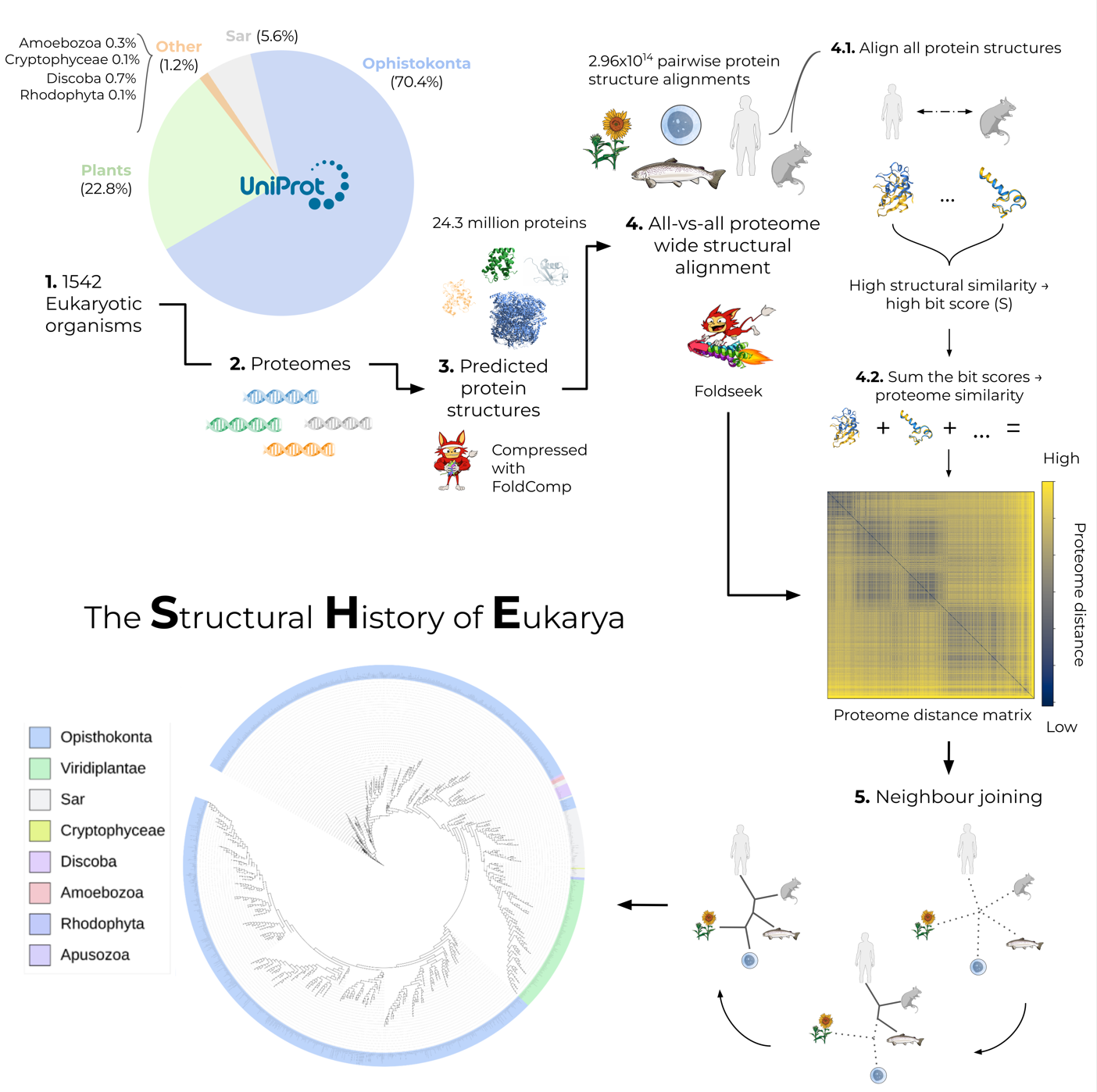
Workflow to build SHE: from proteome retrieval, to protein structure prediction and alignment (from Figure 1, Daumiller et al.).
New Insights from Structural History of Eukarya
Traditional evolutionary trees rely on comparing shared genetic sequences across organisms. However, over long evolutionary timescales, these sequences accumulate mutations that leave unclear ancestral relationships. Because 3D protein structures are more conserved than the sequences encoding them, structural phylogenetics can offer a clearer view into distant evolutionary history. SHE scales this approach through proteome-wide structural comparisons across 1,542 eukaryotic organisms (including animals, plants, fungi, and protists). This mapping required the generation of about 24 million AI-predicted protein structures to run 300 trillion pairwise structural alignments. Key findings include:
- A conserved cytoskeletal core.
- Varying evolutionary rates, with acceleration in birds and ants.
- Potential support for structure-driven annotation of functionally uncharacterized proteins.
- Strong backbone agreement with traditional sequence-based trees.
Applying SHE: Data-Driven Model Organism Selection
On the SHE webpage, all the pairwise 3D protein structure comparisons are available as a tool to help in the evaluation of the most suitable model organisms to study specific biochemical pathways. Users can query the database to locate organisms of interest, whose relevant proteins share the highest 3D structural (and consequently functional) similarity to the target species (i.e. humans).
For example, circadian rhythm is traditionally studied in fruit flies. However, by querying four key human circadian rhythm proteins simultaneously, SHE identifies the western clawed frog and the house mouse as better structural matches. While the final model organism choice depends on multiple practical lab considerations, SHE fills a crucial missing gap: supporting researchers in the selection of model organisms sharing maximum structural alignment with the target species’ proteins, for any custom pathway.
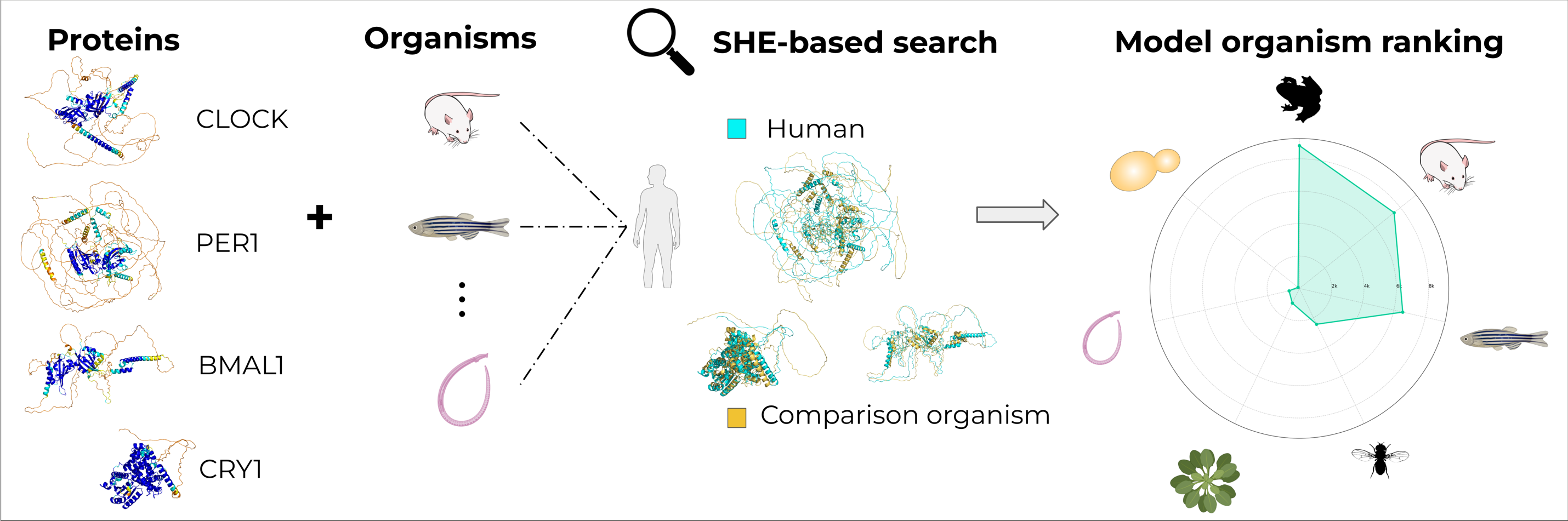
SHE can rank candidate model organisms (mouse, frog, fly, etc.) based on maximum 3D protein alignment to the target species (human) across entire custom protein set (CLOCK, PER1, BMAL1, CRY1). (from Supplementary Figure 1, Daumiller et al.).
Last updated: 2026-11-03
Source: Department of Molecular Biosciences, The Wenner-Gren Institute