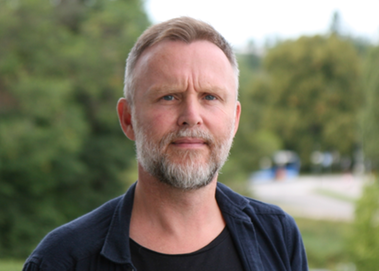
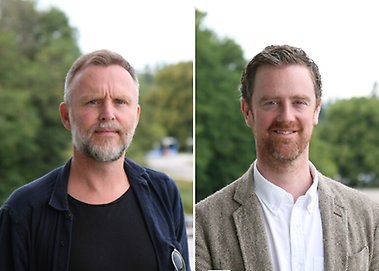
Lena Fält and Lukas Smas have written an article which is now published in the journal Geografiska Annaler: Series B, Human Geography. "Legitimizing a world-class hospital: policy mobility and narratives in megaproject planning" is written by Lena Fält and Lukas Smas, Department of Human Geography, Stockholm University. The article is published in Geografiska Annaler: Series B, Human Geography. Geografiska Annaler: Series B, Human Geography Lena Fält Lukas Smas
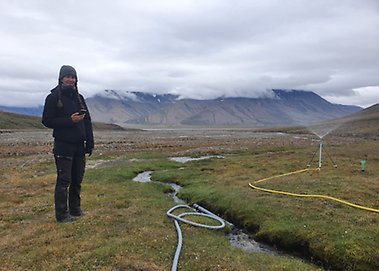
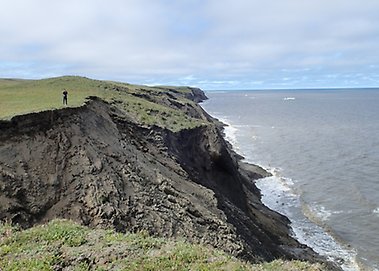
How can we understand the link between precipitation and permafrost carbon feedback? Learn more in a summary of three scientific articles. Recent research led by Rúna Magnússon from Wageningen University and Research (WUR) and Alexandra Hamm from the Department of Physical Geography, Stockholm University, has explored how increasing summer rainfall due to climate change will impact permafrost thaw in the Arctic.
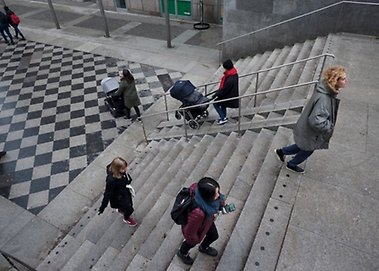
Researchers in human geography Annika Strandin Pers, Maja Lagerqvist and Annika Björklund write about children's school routes between 1840 and 1930 in a new article published in Forskning & Framsteg. Like today's debate, the discussion was also characterised by adults' concerns and socio-economic conditions.
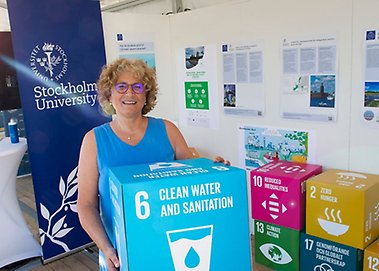
Gia Destouni, Professor of Hydrology and Water Resources at Stockholm University, has been elected as a corresponding member of the Academy of Athens. My research interests include hydroclimate, water resource availability and security, diffuse pollution of water in the environment, and the interactions and shifts of water resources with climate change and various human activity developments, says Gia Destouni.
On February 6, Gia Destouni was elected as an international member of The National Academy of Engineering (NAE), one of the highest honours in engineering.
Two research projects at the Department of Human Geography have been granted research funding totaling nearly SEK 6 million, from Formas, research council for sustainable development.
The Swedish Research Council has awarded a Research Environment Grant in Segregation to Karen Haandrikman for the project “Disentangling segregation at different scales: The role of intergenerational transmission, household mobility and housing development” (17.4 million SEK) for the period 2024-2029.
Two researchers from Stockholm University will work within the new project on the vulnerability of soil carbon, focusing on mapping carbon storage in permafrost and on modelling microbial responses to changes in environmental conditions. The project will develop a new generation of models to predict the fate of carbon in ecosystems under increasing stress due to climate change. An international research project on the global carbon cycle The project called CALIPSO is an international research project funded through a gift from the Virtual Earth System Research Institute (VESRI) , an initiative of Schmidt Futures, and is co-led by the Laboratoire des Sciences du Climat et de l'Environnement , the University of Exeter and the University of East Anglia, with Stockholm University as a collaborating institution. Stefano Manzoni and Gustaf Hugelius at the Department of Physical Geography, Stockholm University will work on the vulnerability of soil carbon, focusing on mapping carbon storage in permafrost and on modelling microbial responses to changes in environmental conditions. This opportunity to work in a large and truly international consortium with leading global experts gives us a unique chance to use new methods to tackle some of the largest remaining challenges in our understanding of the Earth’s carbon cycle, and to better understand how we humans are changing that carbon cycle. I am really looking forward to working with this group and to see what new knowledge we can achieve together, says Gustaf Hugelius. Focus on new representation of carbon loss pathways from plants, soils and ocean This ambitious multi-year project aims to understand the fate of future CO2 and climate change through a new representation of carbon loss pathways from plants, soils and ocean, by leveraging novel observations, theoretical understanding, machine learning tools and integration of processes with Earth system models.
The article by Dominic Power and Patrick Collins is presented in the video. "Peripheral visions: the film and television industry in Galway, Ireland" is written by Dominic Power, Department of Human Geography, Stockholm University, and Patrick Collins, School of Geography, Archaeology and Irish Studies, National University of Ireland Galway. The article is published in Industry and Innovation. Industry and Innovation Dominic Power
Estelle Evrard and Peter Schmitt have written an article which is now published in the journal European Planning Studies. "Do new brooms sweep clean? Striving for ‘A Just Europe’ in the Territorial Agenda 2030" is written by Estelle Evrard, Department of Geography and Spatial Planning, University of Luxembourg, and Peter Schmitt, Department of Human Geography, Stockholm University. The article is published in European Planning Studies. European Planning Studies Peter Schmitt
Eva Andersson and Ida Borg have written an article which is now published in the journal Social Indicators Research. "Trajectories of Latent Vulnerability and Distress: Identifying Social and Spatial Fringes of the Swedish Population" is written by Eva Andersson and Ida Borg, Department of Human Geography, Stockholm University. The article is published in Social Indicators Research. Eva Andersson Ida Borg Social Indicators Research