


IGV seminar series
The Department of Geological Sciences at Stockholm University holds seminars on interesting and current topics in earth sciences. These seminars are given by the Department’s own staff as well as invited guests and are open to the public.
2026
Exploring the Holocene deglaciation of North Greenland with a 3D ice-sheet model
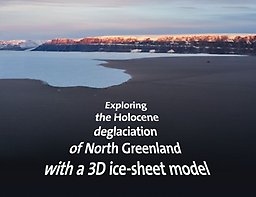
November 2026
Speaker: James Barnett, PhD student at the Department of Geological Sciences, Stockholm University
Abstract
The Greenland Ice Sheet is out of equilibrium with modern climate and is likely committed to losing mass over the coming centuries. North Greenland is of particular importance as the region houses some of the ice sheet’s last remaining floating ice shelves, which suppress ice discharge into the ocean. Their collapse could accelerate ice loss and sea-level rise. Yet future mass-loss projections remain highly uncertain, as ice-sheet models are often benchmarked only against recent decades of ob-servations. Fortunately, the paleo-record can extend these observations and offer a precedent for how Greenland responds to pronounced climate shifts, such as the transition from the Last Glacial Maximum (LGM) into the Holocene interglacial. The three Oden expeditions to the region’s major fjords, culminating in the GEOEO expedition to Victoria Fjord and C.H. Ostenfeld Glacier in 2024, have produced a wealth of marine geophysical data that constrain the Holocene history of the major outlet glaciers across the region. We combine this unique dataset with a high-resolution 3D thermomechanical ice-sheet model to determine what drove ice loss in North Greenland over millennial timescales and to contextualise the modern response of the ice sheet to anthropogenic climate change.
The Seismic History of the North Anatolian Fault deduced from Archeoseismicity, lacustrine and terrestrial Paleoseismology, and Geochronology of fault
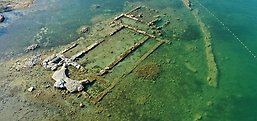
October 2026
Speaker: Julia de Sigoyer, Université Grenoble Alpes, ISTerre, UFR Phitem
Abstract
Almost the entire 1,500 km length of the North Anatolian Fault (NAF), an intracontinental fault in Turkey, has experienced devas-tating earthquakes over the last century. However, some segments in the Marmara area have remained quiet, representing gaps in seismic activity. The stress in these gaps has accumulated over a longer period than in other segments; these gaps could be the location of future earthquakes. Therefore, it is necessary to investigate the timing of the last earthquake, the recurrence of past earthquakes and the long-term slipping rate of each segment. Our study focused on the Middle Strand of the North Anatolian Fault (MNAF), the segment with the longest seismic gap in the NAF system. In collaboration with 15 international researchers, we adopted a multidisciplinary approach in this area thanks to the presence of Lake Iznik and major archaeological sites. This ap-proach involved integrating archeoseismicity, lacustrine and terrestrial paleoseismology, and U/Th dating of fault mirrors, as well as assessing the region’s seismic hazard.
SGU’s recent report on current developments in carbon capture and storage (CCS)
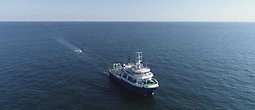
May 2026
Speaker: Sofie Lindström, Geological Survey of Sweden
Abstract
Carbon capture and storage (CCS) is considered an important tool for reducing atmospheric green-house gas concentrations during the transition to greener energy systems. In a recent government commission, the Geological Survey of Sweden (SGU) identified two potential offshore sites for geolog-ical carbon storage: south of Skåne and southeast of Gotland. The study combined new drilling cam-paigns, borehole analyses, and seismic data to evaluate the potential for safe and long-term storage of captured carbon dioxide beneath the Baltic Sea seafloor. In this seminar, Sofie Lindström will present the main findings of the report, discuss the geological requirements for carbon storage, and outline the challenges and next steps toward developing CCS capacity in Sweden.
Microbial Degradation of 35S-labeled Dimethylsulfoniopropionate (DMSP)
Photo: private
February 2026
Speaker: Dr. Allie Smith
Allie completed her PhD Marine Sciences in December 2025 at the University of South Alabama and has served as the NOAA Sea Grant John A. Knauss Marine Policy Fellow for the past year at the Ocean, Great Lakes, and Coastal Program within the Department of the Interior (DOI).
Abstract
Dimethylsulfoniopropionate (DMSP) is an important component of the marine carbon and sulfur cycles, and its degradation products, especially the gas dimethylsulfide (DMS), have important implications for the global climate.There is a lack of understanding of what conditions drive marine bacteria to process sulfur from DMSP through the different degradation pathways. This work shows how changes in bacterial sulfur demand influence the processing of DMSP in two marine bacteria from the Roseobacter clade.
2025 Seminars
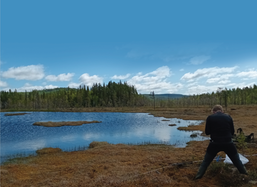
Tracing the Pioneers of Scandinavia: drawing inferences from ancient environmental genomics
December 2025
Speaker: Ernst Johnson, PhD student at Centre for Palaeogenetics and the Department of Geological Sciences, Stockholm University
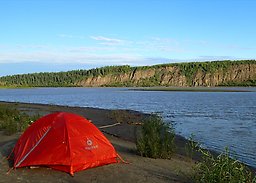
Provenance analyses: a tool to constrain tectonic changes. Parallelism between the ancient Yukon-Koyukuk Basin (Alaska) and modern Southeast Asia
May 2025
Speaker: Simone Seminara, PhD student at the Department of Geological Sciences, Stockholm University
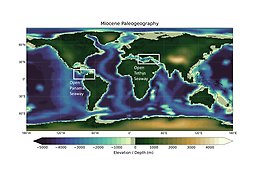
Ocean gyre circulation and gateway transports during early and middle Miocen
April 2025
Speaker: Trusha Naik, PhD student at the Department of Geological Sciences, Stockholm University
Download abstract pdf, 255.5 kB. (255 Kb)
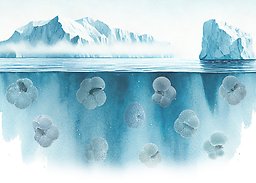
Foram-idable adaptations: 10 million years of Neogloboquadrina evolution in the high latitude North Atlantic and Arcti
April 2025
Speaker: Tirza Weitkamp, PhD student at the Department of Geological Sciences, Stockholm University
Download abstract pdf, 1.3 MB. (1295 Kb)
FORALIEN project: Developing novel methods to identify alien species of benthic foraminifera to assess their impact on native biodiversity of the Swedish west coast
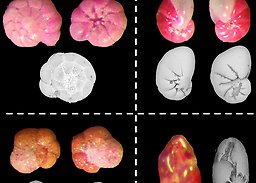
March 2025
Speaker: Jean-Charles Pavard, Marie-Curie postdoctoral fellow from University of Gothenburg, Sweden
Download abstract pdf, 404.1 kB. (404 Kb)
The mineralization potential and ore-forming processes in magma chambers in Greenland
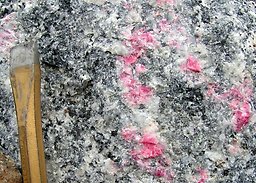
February 2025
Speaker: Thomas Ulrich, Institute of Geotechnology and Mineral Resources, Clausthal University of Technology, Germany
Download abstract pdf, 275.7 kB. (275 Kb)
Temperature and fluid composition during the aqueous alteration of CM carbonaceous chondrite
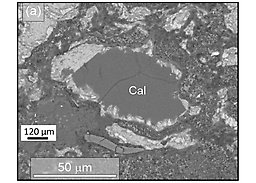
February 2025
Speaker: Matthieu Clog, Lecturer in Earth Sciences, SUERC East Kilbride, United Kingdom
Download abstract pdf, 1.9 MB. (1974 Kb)
Constraining marine silicate alteration in the Ulleung Basin (East/Japan Sea) using stable Si isotope and reaction transport modellin
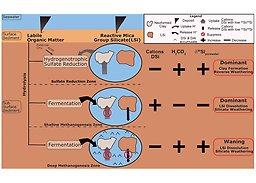
January 2025
Speaker: Tzu-Hao, PhD student at the Department of Geological Sciences, Stockholm University
Download abstract pdf, 210.8 kB. (210 Kb)
2024 Seminars
Stochasticity, Stability, and Hysteresis in Biogeochemical Cycling of Carbon and Silicon
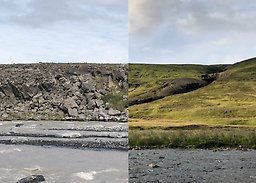
November 2024
Speaker: Yi Hou, Postdoctoral Researcher at Geological Institute, Department of Earth Sciences, ETH Zürich
Download abstract pdf, 781.2 kB. (781 Kb)
Cryospheric Cap Degradation as a Driver of Antarctic Seep Emergence
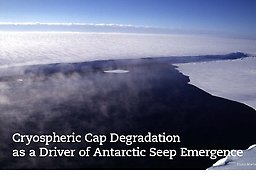
April 2024
Speaker: Dr Sarah Seabrook, Marine Biogeochemist at National Institute of Water and Atmospheric Research (NIWA), New Zealand
Download abstract pdf, 159.9 kB. (159 Kb)
No laughing matter: nitrous oxide cycling in oxygen depleted waters
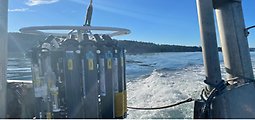
March 2024
Speaker: Laura Bristow, Associate Professor of marine Chemistry at Göteborg University
Download abstract pdf, 284.8 kB. (284 Kb)
Tectonic transitions through Earth history: a current synthesis and future directions
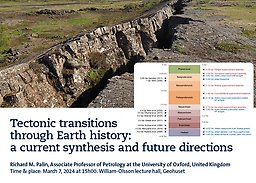
March 2024
Speaker: Richard M. Palin, Associate Professor of Petrology at the University of Oxford, United Kingdom
Download abstract pdf, 560.3 kB. (560 Kb)
Temporal scale changes in species distributions in Store Mosse bog, south-central Sweden
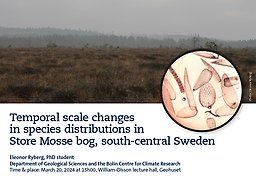
March 2024
Speaker: PhD student Eleonor Ryberg, Department of Geological Sciences, Stockholm University.
Download abstract pdf, 595.6 kB. (595 Kb)
Paleoenvironmental reconstructions in the Canadian Arctic using biomarkers
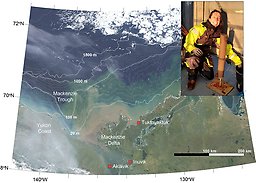
February 2024
Speaker: Julie Lattaud, Department of Environmental Sciences, University of Basel, Switzerland.
Download abstract pdf, 373.1 kB. (373 Kb)
Simulating the mid-Miocene, from single cell to global paleoclimate modelling
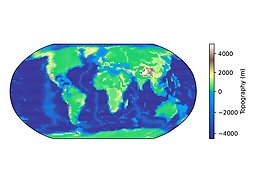
January 2024
Speaker: Martin Renoult, postdoctoral researcher at the Department of Geological Sciences.
Download abstract pdf, 349.8 kB. (349 Kb)
2023 seminars
Estuaries as biogeochemical reactors; implications for Si and Ca transport across tropical monsoonal estuary
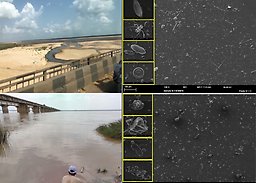
September 2023
Speaker: Sarath Pullyottum Kavil, Post-doctoral researcher at IGV, Department of Geological Sciences, Stockholm University.
Download abstract pdf, 843.1 kB. (843 Kb)
Diverse lava flow morphologies in the stratigraphy of the floor of Jezero crater, Mars
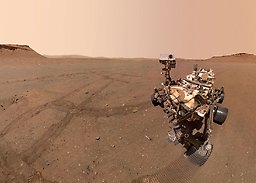
May 2023
Speaker: Sanna Alwmark, Associate Senior Lecturer at the Department of Geology, Lund University.
Melt Inclusions in Migmatites and Granulites
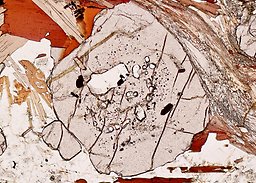
April 2023
Speaker: Bernardo Cesare, Professor of Petrography and Petrology at the Geosciences Department of the University of Padua, Italy.
Methane seepage in the sedimentary record: application of geochemical proxies to modern and fossil systems
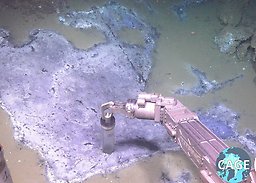
February 2023
Speaker: Claudio Argentino, Centre for Arctic Gas Hydrate, Environment and Climate, UiT-The Arctic University of Norway, Tromsø, Norway.
Download abstract pdf, 1.2 MB. (1203 Kb)
Zircon complex history during high-grade metamorphism: insights from multimethod petrochronology
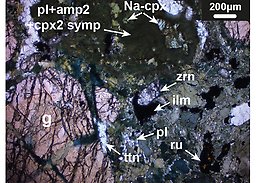
January 2023
Speaker: Dr. Caroline Lotout, Centre de Recherches Pétrographiques et Géochimiques, France and the Memorial University of Newfoundland, Canada.
2022 seminars
Using trace metal isotopes to study marine biogeochemistry: studies on marine Fe and Zn cycles
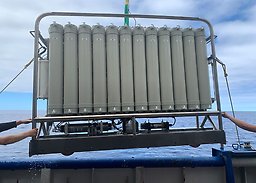
November 2022
Speaker: Wen-Hsuan LIAO, Postdoctoral Research Fellow from the Department of Ocean Systems (OCS), Royal Netherlands Institute for Sea Research (NIOZ), Texel, The Netherlands.
Download abstract pdf, 151.2 kB. (151 Kb)
Depositional environment and provenance switch at the edge of Baltica during the late Neoproterozoic and Cambrian
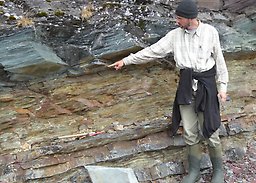
November 2022
Speaker: Professor Guido Meinhold, Technische Universität, Bergakademie Freiberg, Germany
Time Machine Biology: Paleobiology provides glimpses of future ocean
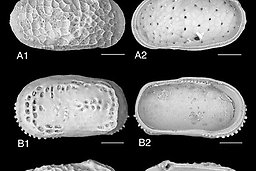
October 2022
Speaker: Dr. Moriaki Yasuhara, University of Hong Kong.
Lithium isotopes in Himalayan rivers: adding constraints to silicate weathering dynamics
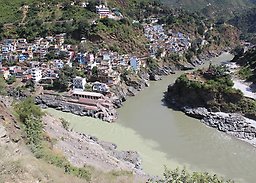
October 2022
Speaker: Madeleine S. Bohlin, Researcher at the Department of Earth Sciences, Uppsala University
Bizarre carbonates and palaeoclimate: glendonite and its parent mineral ikaite
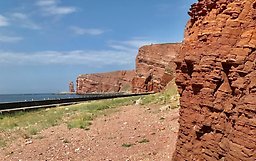
September 2022
Speaker: Postdoctoral Fellow Madeleine Larissa Vickers, bild Foram-idable adaptationsUniversity of Oslo, Norway
Magmatic evolution during the 2021 Cumbre Vieja eruption on La Palma, Canary Islands, Spain
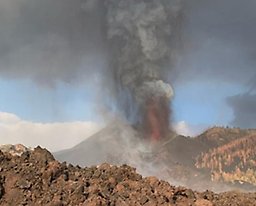
May 2022
Speaker: Dr. Jane Scarrow, University of Granada, Spain
Critical Raw Materials for the Energy Transition
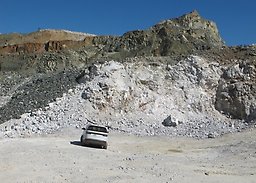
March 2022
Speaker: Kathryn Goodenough, British Geological Survey
How can we use acoustics to visualize, map and quantify turbulent mixing and vertical transport rates?
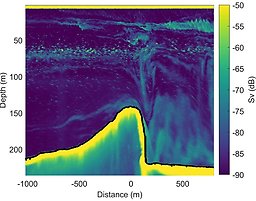
March 2022
Speaker: Julia Muchwski, PhD student at the Department of geological sciences
Experimenting with melts and sediments from large igneous provinces
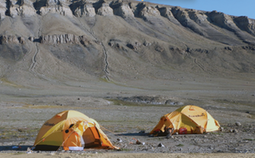
February 2022
Speaker: Frances Deegan, Department of Earth Sciences, Uppsala University, Sweden
A case study from Thailand
– Paleoenvironmental and paleoclimatological research using molecular fossils and compound-specific isotope analysis from lake sediments
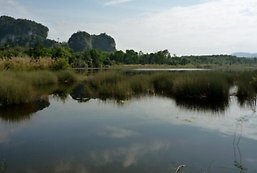
January 2022
Speaker: Dr. Rienk Smittenberg, Univ. Docent at the Department of Geological Sciences
2021 seminars
Endless Forams: Automating large-scale geobiological studies using deep learning
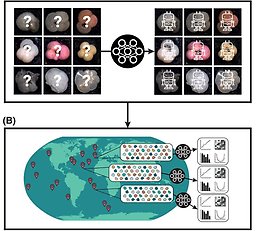
October 2021
Speaker: Allison Hsiang, Researcher at the Department of Geological Sciences
Download abstract pdf, 314.6 kB.
Tracing climate shifts using Sediment DNA from Hall’s Cave, Texas
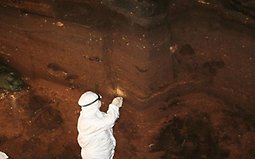
September 30 2021
Speaker: Anna Linderholm, researcher at the Department of Geological Sciences
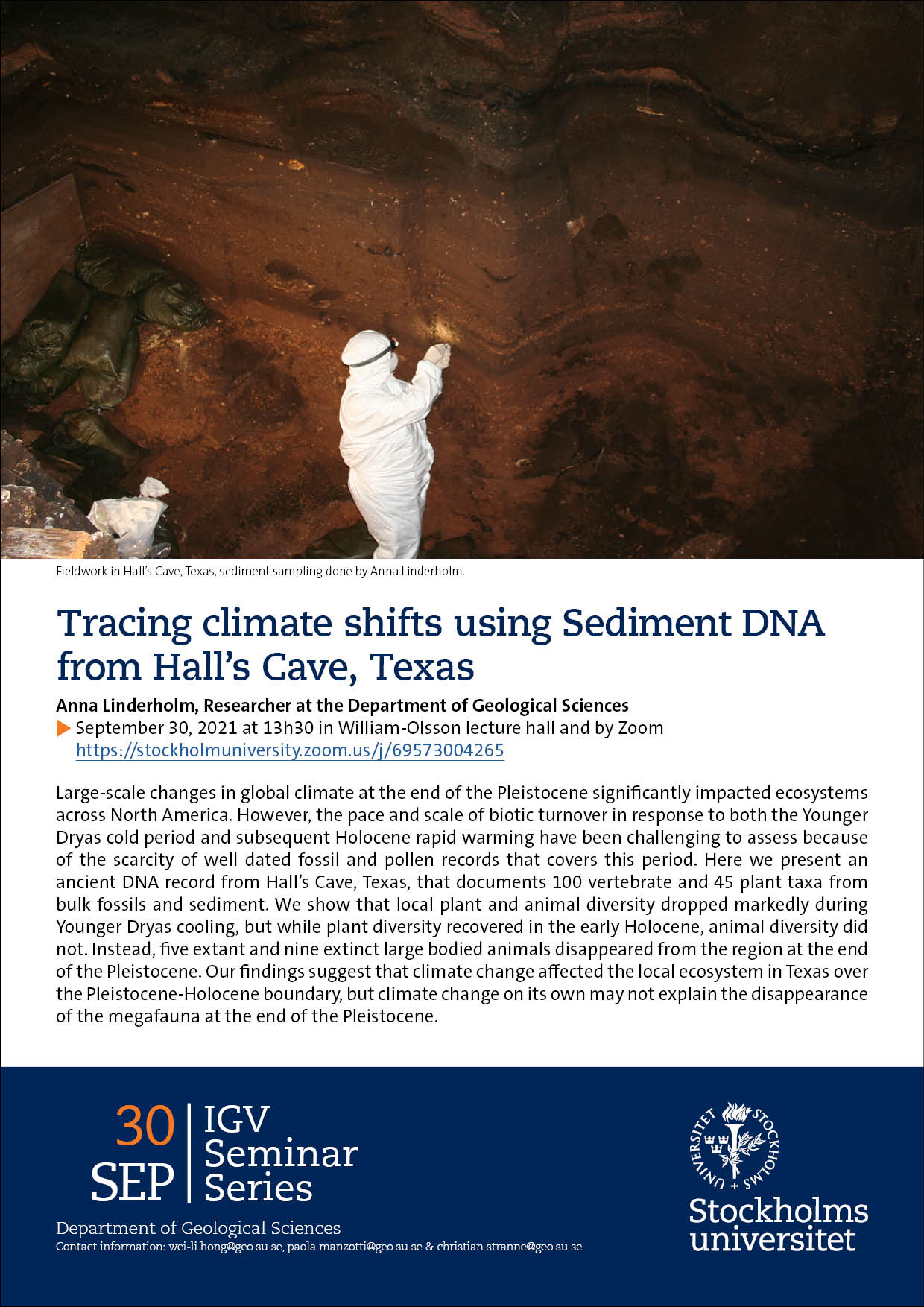
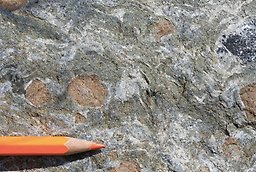
Survival of an old basement in the Alpine belt
March 2021
Speaker: Francesco Nosenzo (PhD student) Stockholm University
Download abstract pdf, 277.3 kB. (277 Kb)
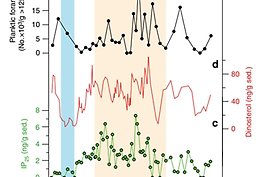
Sea ice marginal conditions in the Eurasian sector of the Arctic over the last ~800 000 years
March 2021
Speaker: Dr. Jochen Knies, Geological Survey of Norway & CAGE, Tromsø, Norway.
Download abstract pdf, 259.9 kB. (259 Kb)
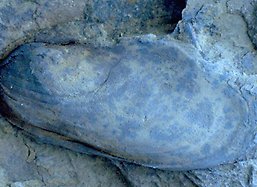
Freshwater bivalves as a record of the topographic evolution of the Variscan belt
January 2021
Speaker: Michel Ballèvre | University of Rennes, France.
Download abstract pdf, 549.3 kB. (549 Kb)
2020 seminars
Cryosphere-regulated groundwater discharge in submarine environments
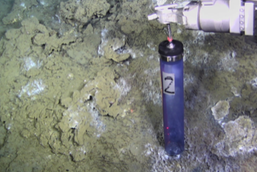
November 2020
Speaker: Wei-Li Hong | Assistant professor Department of geological sciences, Stockholm University.
Download abstract pdf, 164.1 kB. (164 Kb)
Blue minerals and blue rocks: From minerals to models
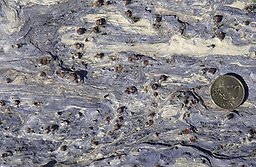
November 2020
Speaker: Paola Manzotti | Assistant professor, Tectonics, metamorphic petrology and geochronology" Department of geological sciences, Stockholm University.
Download abstract pdf, 659.3 kB. (659 Kb)
Last updated: 2026-11-04
Source: Department of Geological Sciences